
8.4 TIME-DIVISION MULTIPLE ACCESS (TDMA)
Time-division multiple access achieves deterministic separation by partitioning the channel in the time domain rather than in frequency. All users share the same frequency band, but each transmits only during assigned time intervals. Provided that these intervals do not overlap, mutual interference is avoided.
Unlike FDMA, which requires frequency coordination and filtering, TDMA requires precise timing coordination. Users must align their transmissions to a common frame structure so that bursts arrive within their allocated slots.
TDMA is inherently suited to digital transmission because separation is defined in terms of symbol intervals and discrete time slots. It is widely used in cellular systems, satellite links, wireless networks, and many packet-based systems.
The fundamental idea of TDMA is separation in time. The available channel bandwidth is shared among users, but transmission is organized into repeating frames. Each frame is divided into a set of non-overlapping time slots, and each user is assigned one or more slots within the frame.
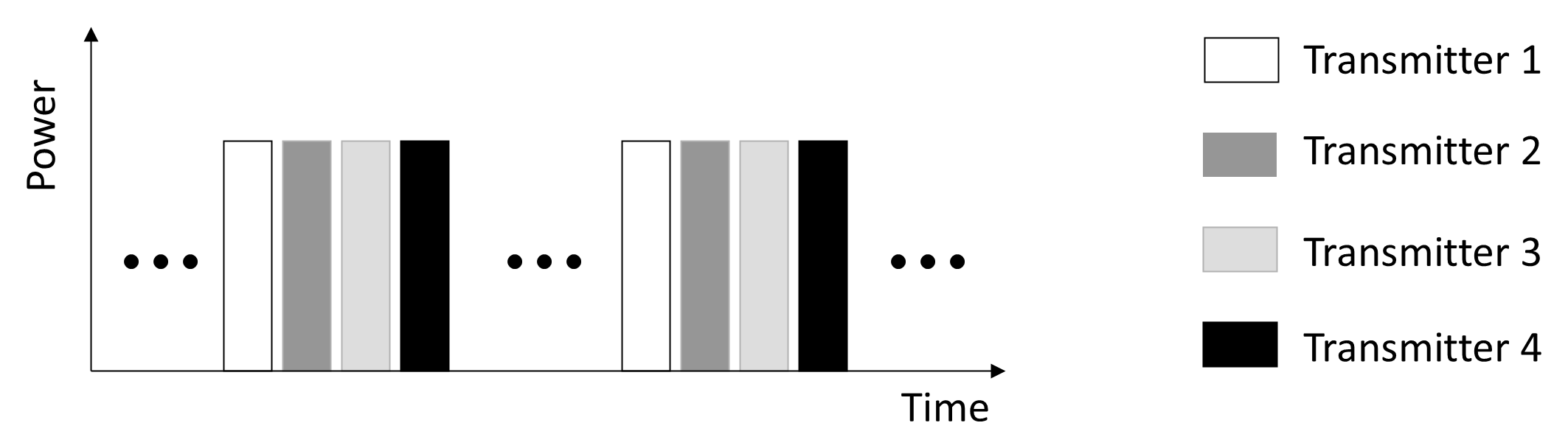
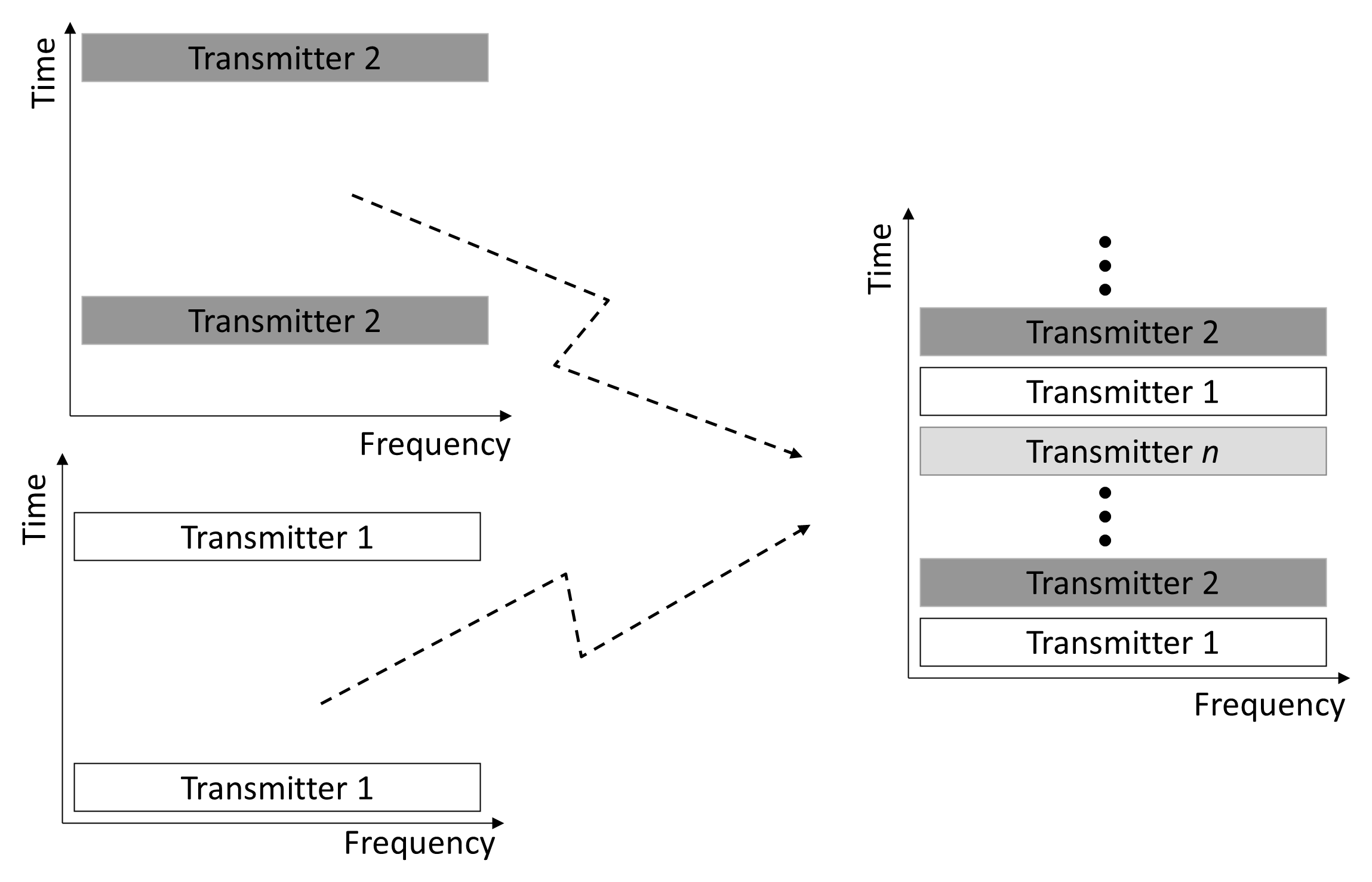
In the time–frequency plane, TDMA may be visualized as vertical segmentation: all users occupy the same frequency band, but each transmits during a distinct time interval. Because no two users transmit simultaneously within the same slot, orthogonality is achieved through temporal separation.
In the time–frequency representation depicted in Figure 8.9, all users occupy the same frequency band and bursts appear as sequential blocks in time. Guard intervals appear as small gaps between bursts. Transmitters share the same spectrum (Figure 8.8(a) and (b)), but each emits its signal only during its allocated slot. The composite signal received at a central receiver (Figure 8.9 (c)), therefore consists of successive bursts within one frequency band, each separated in time.
Let the frame period be TF, and the burst duration allocated to a particular user be TB. The ratio TB/TF defines the user’s duty cycle. If all users are assigned equal slot durations, the number of users that can be supported is approximately TF/TB neglecting guard intervals and control overhead.
Perfect time separation requires that bursts do not overlap at the receiver. In practice, uncertainties in propagation delay, oscillator drift, and scheduling tolerances require the insertion of guard intervals between adjacent bursts. These guard intervals consume a portion of the frame and reduce net throughput, but they ensure that small timing errors do not result in collisions.
Unlike FDMA, where all users transmit continuously, TDMA users transmit in short bursts at a higher instantaneous data rate than their average traffic rate. This burst-mode operation has important implications for buffering, synchronization, and power requirements, which are examined in the following sections.
Back to reading