8.10.1 TDMA/FDMA Combinations
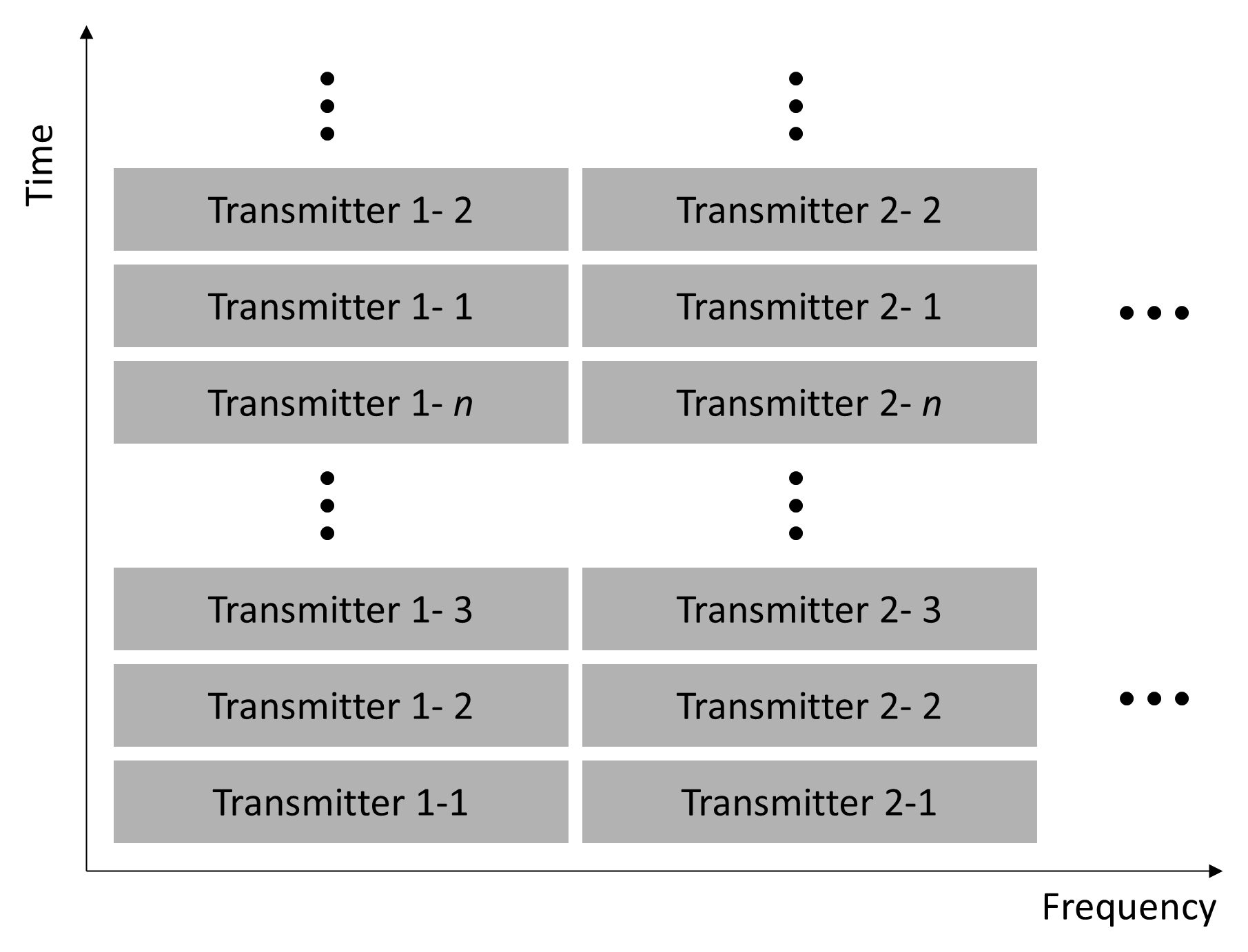
Time-division and frequency-division techniques are frequently deployed together. In such systems, the total available spectrum is first partitioned into multiple frequency channels using FDMA. Within each frequency channel, users share access through TDMA, as illustrated in Figure 8.24.
This architecture often arises from hardware and linearity constraints. In high-power amplifiers or satellite transponders, simultaneous transmission of multiple carriers can introduce intermodulation distortion. By allocating separate frequency sub-bands and restricting each sub-band to a single time-division frame structure, designers limit nonlinear interaction while preserving the scheduling advantages of TDMA.
Within each frequency sub-band, terminals access the channel in assigned time slots, providing predictable delay and controlled resource allocation. Across sub-bands, frequency separation limits mutual interference and simplifies spectrum management. This hierarchical partitioning enables scalable system growth: additional capacity can be introduced by allocating additional frequency channels, each supporting its own time-division structure.