
8.1 INTRODUCTION
In Chapter 7 we examined multiplexing—the combination of multiple information streams within a single transmitter to produce a composite signal. Multiplexing assumes that the signals to be combined are available at a common physical point before transmission. In many practical systems, however, transmitters are geographically separated and must share a common communication channel. In such cases, the problem is no longer multiplexing, but multiple access.
Multiple-access techniques address the problem of two or more independent transmitters sharing the same physical channel without causing unacceptable interference. The answer lies in the fundamental observation that two signals interfere only if they overlap in both time and frequency. As shown in Figure 8.1, separation in either domain is sufficient to avoid mutual interference. This principle extends naturally to additional signal dimensions such as spreading code and spatial diversity.
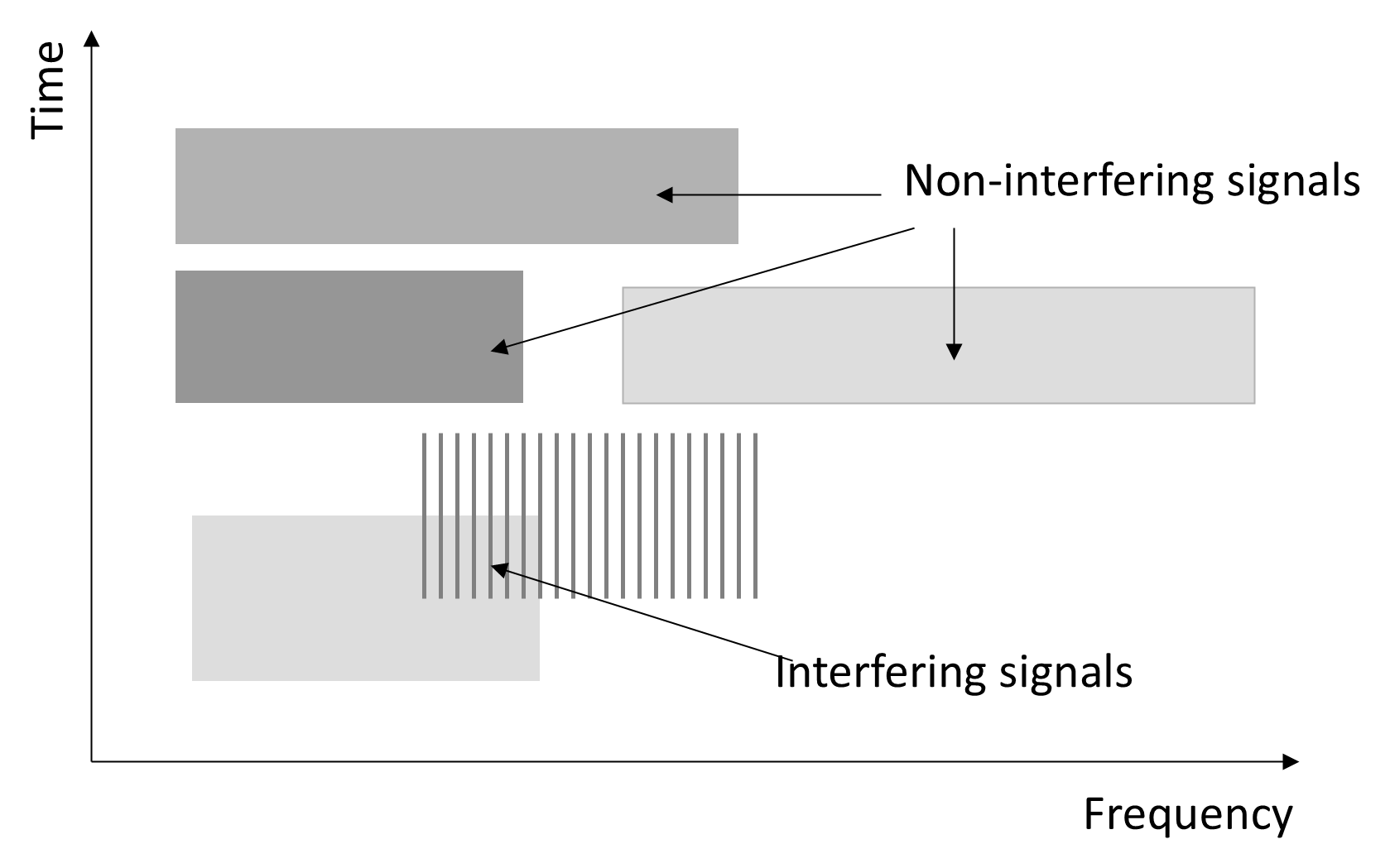
From this observation arise four deterministic techniques for resource partitioning:
- Frequency separation: users are assigned distinct frequency bands.
- Time separation: users transmit at different times.
- Code separation: users transmit simultaneously over the same time and frequency resources but are distinguished by orthogonal or pseudo-random spreading codes.
- Spatial separation: users transmit simultaneously over the same time and frequency resources but into different portions of the spatial domain, through antenna directivity, sectoring, beamforming, or MIMO processing.
In addition to resource partitioning, multiple-access systems require access control: a mechanism that determines which transmitter may use the channel at a given time. Access control may be centrally scheduled, dynamically assigned on-demand, or entirely contention-based.
This chapter examines multiple access from three complementary perspectives:
- Deterministic multiple access techniques: deterministic separation in frequency, time, code, or space.
- Random-access and contention-based access techniques: decentralized transmission schemes such as ALOHA and CSMA.
- Spread-spectrum and frequency-hopping techniques: bandwidth expansion methods that provide interference resilience and multiple-access capability.
Each of these techniques can be applied on their own or in combination in contemporary terrestrial, satellite, and wireless networks.
Throughout the chapter, emphasis is placed on the trade-offs among: spectral efficiency, power efficiency, synchronization complexity, interference tolerance, and implementation cost. Multiple-access design fundamentally involves balancing these competing objectives to suit the operational environment, whether it be a broadcast system, a cellular network, a satellite link, a local area network, or a tactical radio system.
We begin with deterministic resource partitioning.
Back to reading