
10.4 COMPARISON OF TRANSMISSION MEDIA
Transmission media vary widely in their electrical, mechanical, and operational characteristics. From low-frequency audio links to terabit optical systems, the choice of medium determines the performance and practicality of the communication link. Figure 10.23 and the discussion that follows summarize the essential features.
Figure 10.23 provides a comparison of the major properties of the transmission lines we have discussed in this chapter, along with a summary of typical applications.
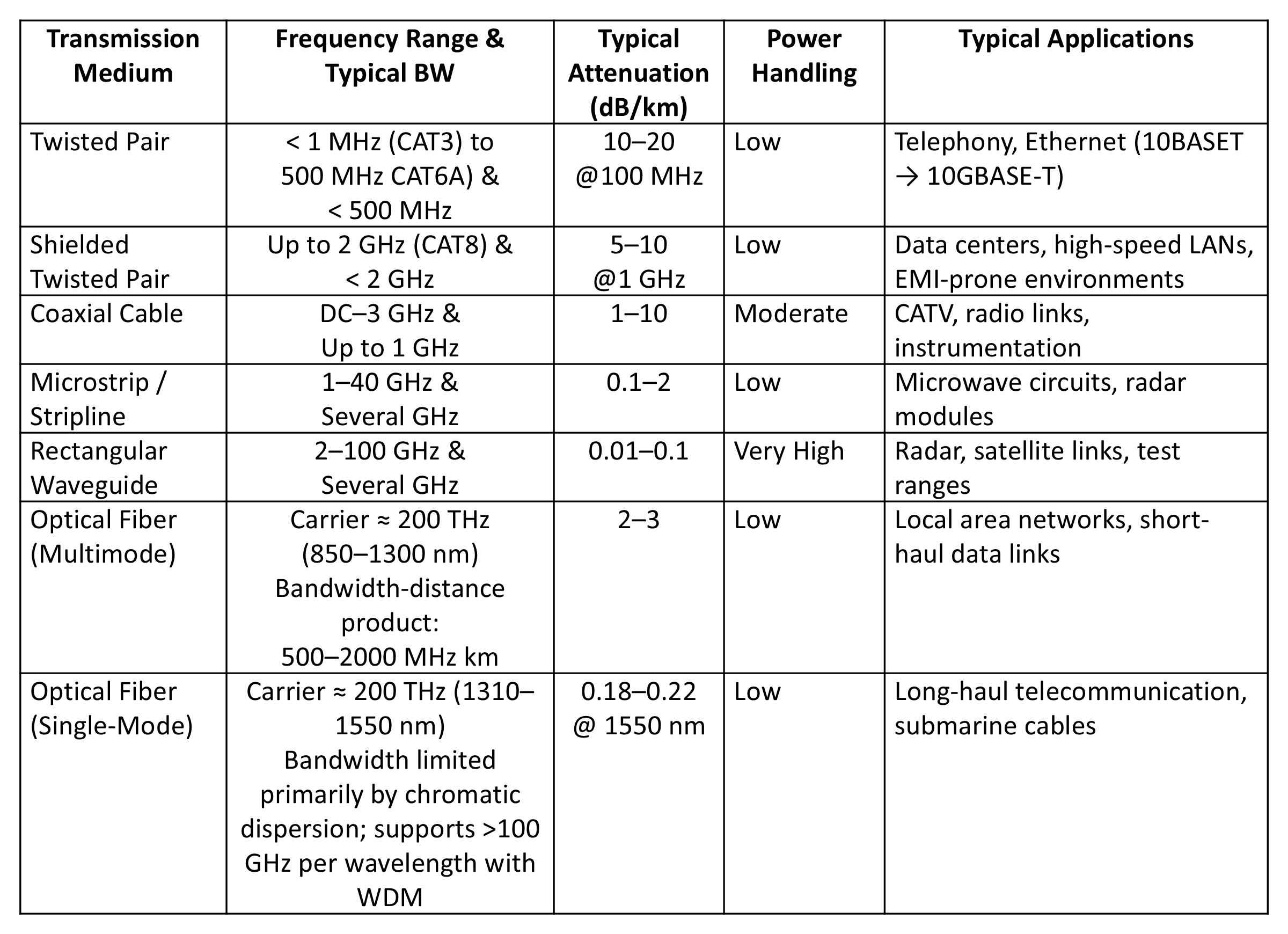
The tradeoffs among the properties of various types of transmission line need a little more consideration:
- Frequency range and bandwidth. The usable frequency range of a medium increases progressively from twisted pair through coaxial cable, planar lines, and waveguide to optical fiber. Bandwidth grows roughly exponentially with carrier frequency, making optical systems capable of terabit-per-second throughput.
- Attenuation. Resistive and dielectric losses dominate at low frequencies, while surface-resistance and radiation losses increase at microwave frequencies. Typical attenuation for shielded twisted pair at 1 GHz is roughly 6 dB/100 m (≈ 60 dB/km), much improved over older copper designs because of superior shielding and precision twisted-pair geometry. Note that copper attenuation increases approximately with the square root of frequency due to skin effect, whereas optical attenuation varies primarily with wavelength-dependent material properties. Optical fibers achieve the lowest attenuation of all, with modern single-mode fibers offering < 0.2 dB/km at 1,550 nm.
- Power handling. Metallic lines can handle moderate powers, but waveguides remain unmatched for very high microwave power levels (kilowatts or more). Optical fibers carry minimal power but convey information efficiently through modulation rather than amplitude.
- Electromagnetic compatibility. Twisted pair and coaxial lines are vulnerable to crosstalk and electromagnetic interference (EMI), whereas waveguides and optical fibers are effectively immune. This makes fiber-optic systems ideal for electrically noisy or high-voltage environments.
- Installation, cost, and mechanical considerations. Twisted pair remains the most economical for short runs. Coaxial and microstrip lines require greater precision but are flexible. Waveguides are bulky and expensive but essential where low loss and high power are paramount. Optical fibers offer outstanding performance but require specialized splicing and connector techniques.
10.4.0.1 Performance Trends And System Choice
The evolution of transmission media reflects a trade-off among operating frequency, attenuation, power handling, dispersion, mechanical constraints, and system cost:
- For short, low-frequency links, twisted pair or coaxial cable remains practical and economical.
- For microwave systems, waveguide and microstrip dominate due to their power capacity and low loss.
- For long-distance, high-data-rate systems, single-mode optical fiber provides unrivalled performance and scalability.
The underlying principle across all media is guided electromagnetic propagation—whether confined by metal walls or refractive boundaries. Continued material and fabrication advances are steadily blurring the traditional boundaries between electronic and photonic transmission, giving rise to hybrid RF-over-fiber and millimeter-wave photonic systems that combine the advantages of both domains.
Back to reading