10.2.1 Balanced Transmission Lines
In a balanced line, the voltages on the two conductors are equal in magnitude and opposite in polarity with respect to ground, so that the currents are equal and opposite.
10.2.1.1 Two-Wire Line
Two-wire lines consist of two parallel conductors maintained at a fixed spacing. There are two main forms: open two-wire line and insulated two-wire line.
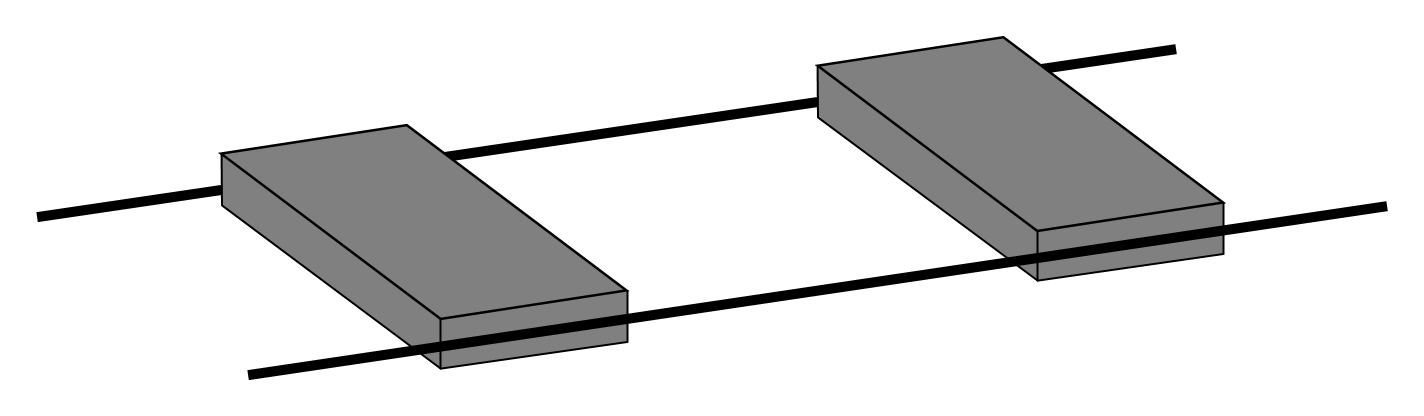
- Open two-wire line. Figure 10.14 shows an open two-wire line in which the two parallel conductors form a balanced transmission line. The wires are held apart by insulating spacers to maintain constant spacing and mechanical stability. The balance is easily disturbed, however, by nearby metallic structures or non-uniform installation. The required conductor spacing depends on the desired characteristic impedance, wire diameter, and operating frequency.
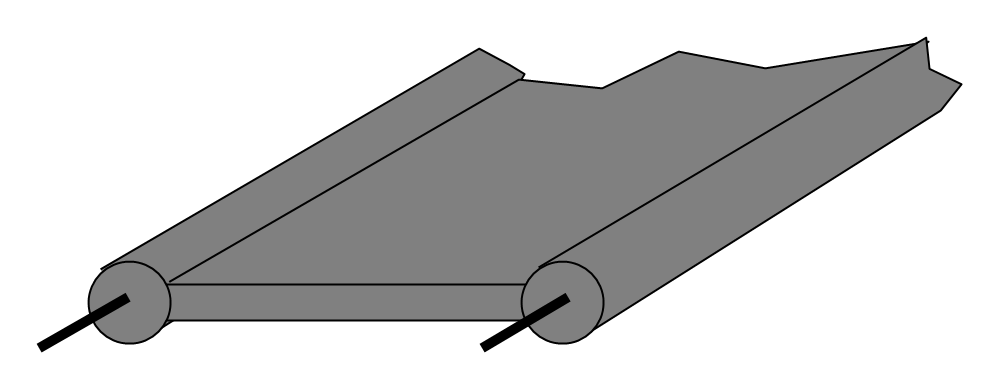
- Insulated two-wire line. Open two-wire line is difficult to install because the conductor spacing must be maintained precisely in air. As shown in Figure 10.15, insulated two-wire line employs a solid dielectric between the conductors, providing a more robust and flexible cable at the cost of higher dielectric loss and slightly lower impedance. A common example is the 300 Ω twin-lead used traditionally for connecting domestic television receivers to antennas (most such connections are now coaxial cable). The characteristic impedance is determined by the conductor diameter and separation.