
10.2.2 Twisted-Pair Cable
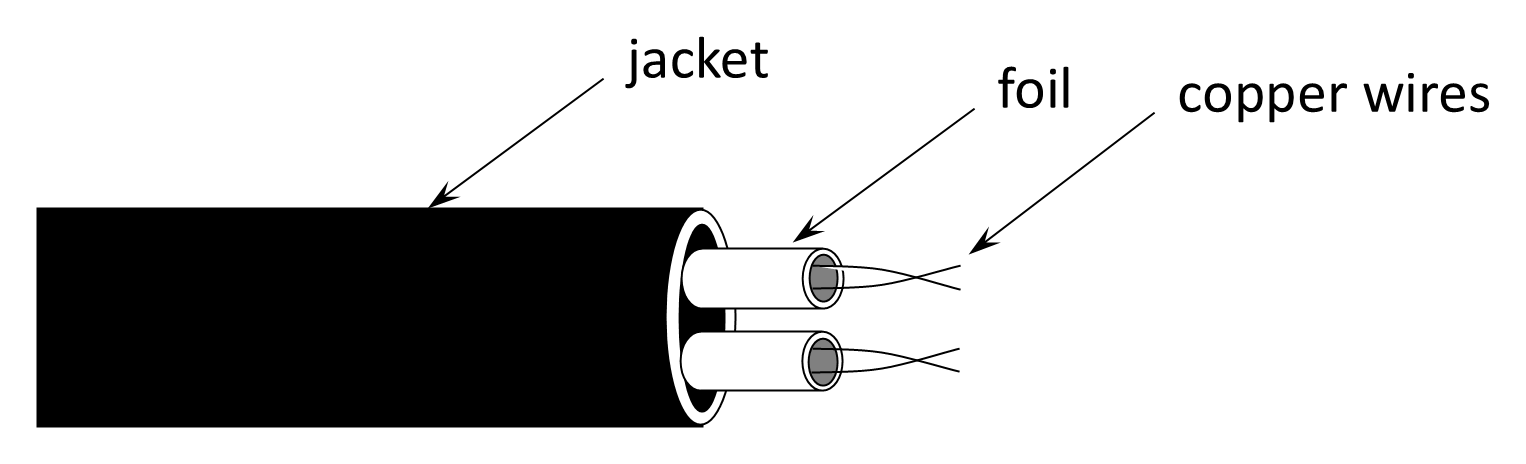
Twisted-pair cable is formed by twisting together two insulated copper conductors to maintain a fixed spacing and to improve magnetic-field cancellation. The twisting also reduces crosstalk and external interference. Further isolation is achieved by enclosing the pair in a metallic foil or braided shield, producing shielded twisted pair (STP), illustrated in Figure 10.16.
Twisted-pair cable exhibits relatively high loss and limited bandwidth compared with coaxial or waveguide systems but remains inexpensive, flexible, and easy to install. Modern unshielded twisted pair (UTP) and shielded twisted pair cables are widely used in local area networks and data links operating up to several hundred megahertz. Typical characteristic impedances are 75 Ω (video and instrumentation) and 100–120 Ω (data networks). Current Cat 8 cable is defined for high-performance twisted-pair copper Ethernet cabling, providing a maximum of 25–40 Gbps over ~30 m (lower data rates are supported over longer distances including the standard 10 Gbps over 100 m).
Multicore cable comprises multiple twisted pairs—typically up to 50—bundled within a common foil or braided shield. Each pair is color-coded for identification, and non-conducting strength members may be included for mechanical reinforcement. Multicore cables are generally used for low-frequency applications (below 1 MHz), for signal and control circuits up to about 300 V, and over short distances (less than 1 km). Because there is limited shielding between pairs, crosstalk increases with age as the insulation deteriorates, reducing isolation between channels.
Back to reading