
9.2.8 AF Stage
The AF stage amplifies the detected baseband signal to a suitable power level for headphones, loudspeakers, or digital interfaces. Post-detection signal levels are typically ≈ 100 µW; portable receivers delivering ≈ 100 mW output require about 30 dB gain, while console receivers may require greater than 60 dB.
Modern designs incorporate low-distortion Class AB or Class D amplifiers, as well as tone-control and equalization circuits. In communication receivers, the AF stage may also include digital audio processing, noise reduction, and speech-clarity enhancement filters.
In digital receivers, the AF stage may be replaced or supplemented by digital audio processing blocks that perform filtering, compression, and interface formatting before presentation to external systems.
9.2.8.1 Squelch
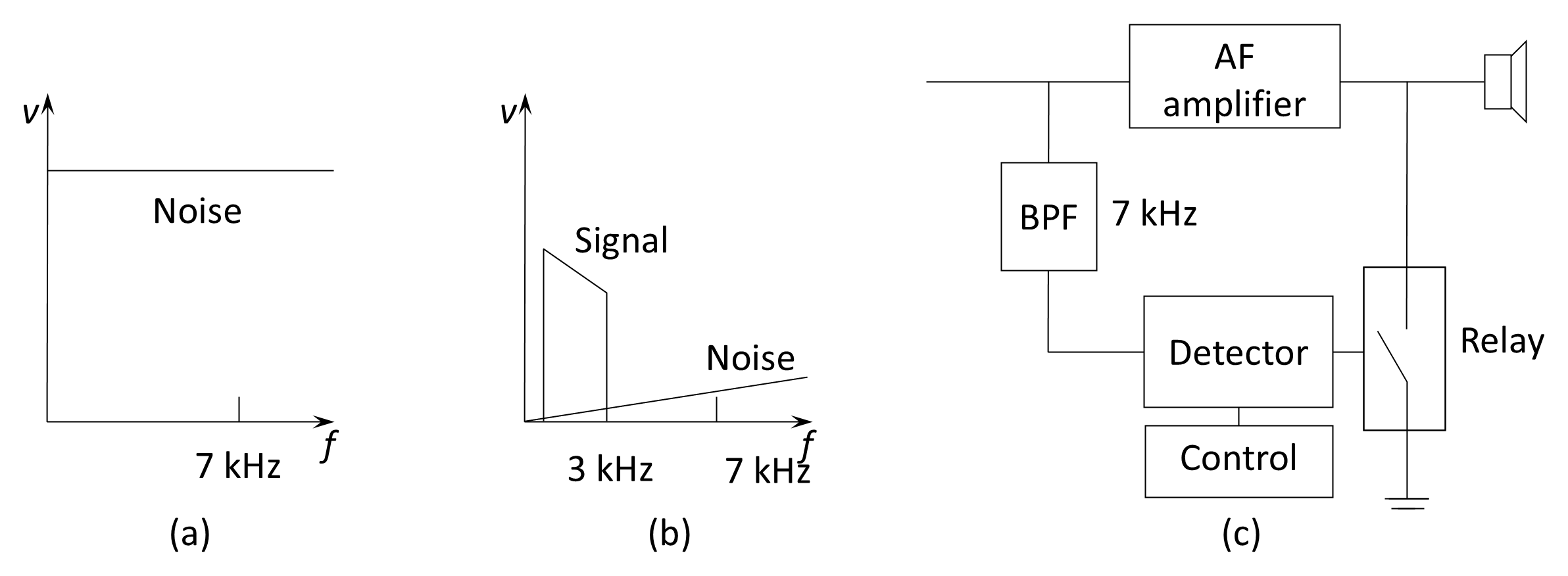
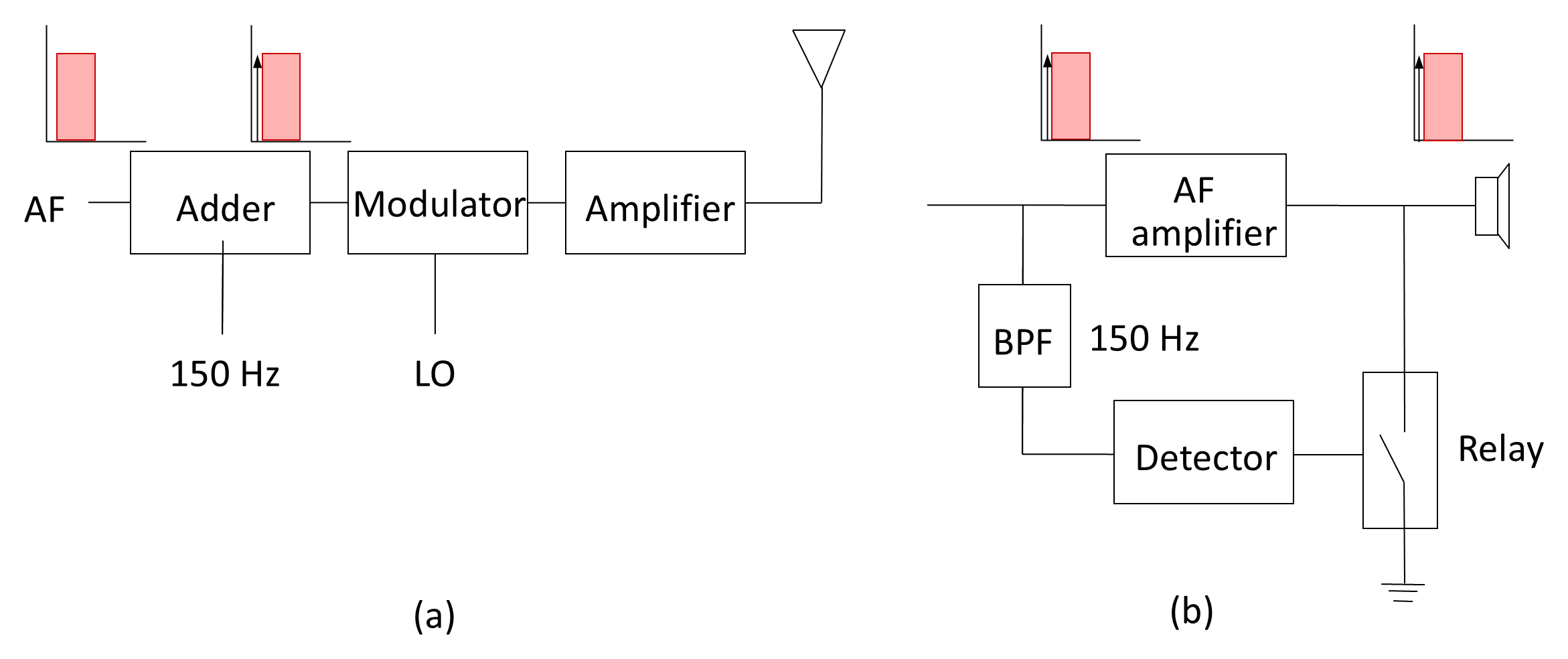
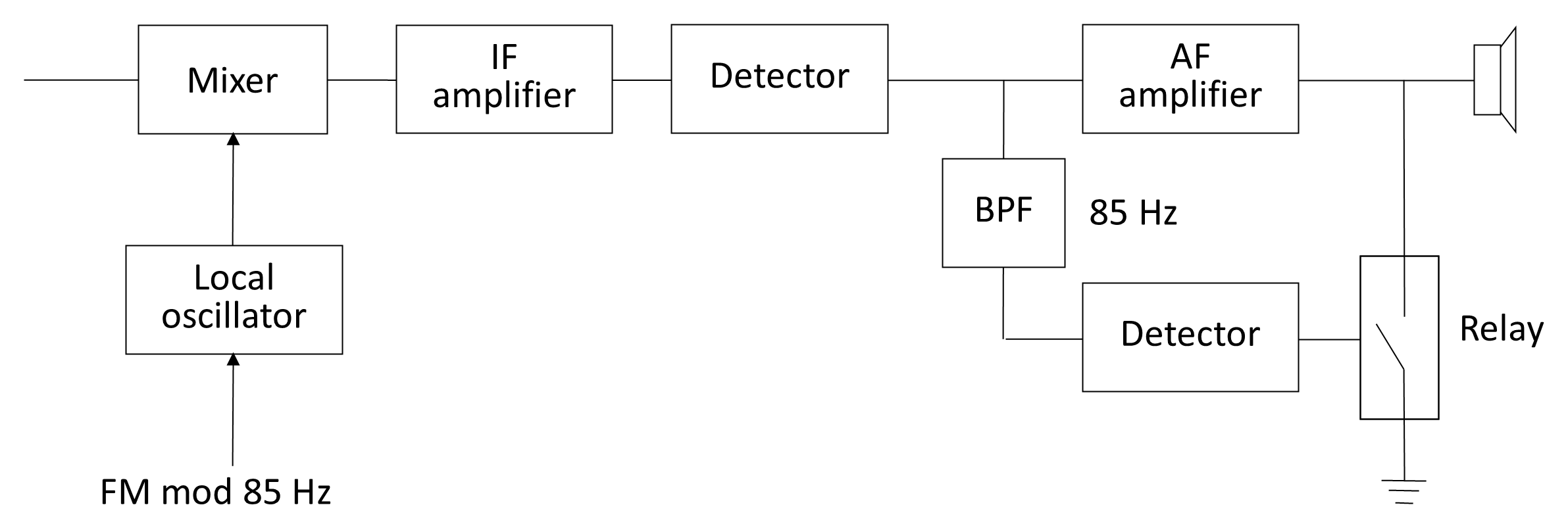
Because AGC increases gain during weak-signal conditions, it also amplifies background noise when no carrier is present. Squelch circuits mute the AF output unless a valid signal is detected. There are three broad options for squelch:
- Noise squelch. A noise squelch detects the high-frequency noise component (typically around 7 kHz) at the detector output. When noise exceeds a preset threshold, the AF amplifier is muted (Figure 9.16). This technique is simple but may suppress very weak signals if set incorrectly.
- External-tone squelch. In this system, an inaudible sub-audible tone (e.g., 150 Hz) is transmitted with the signal. The receiver detects this tone and enables audio output only when it is present (Figure 9.17). This ensures channel privacy and eliminates false openings. The method underlies commercial CTCSS (Continuous Tone-Coded Squelch System) and DCS (Digital-Coded Squelch) standards [5].
- Internal-tone squelch. An alternative design modulates the receiver’s own LO with a low-frequency tone (≈ 85 Hz). The tone appears in the demodulated output only when a valid RF signal is present (Figure 9.18). Absence of the tone indicates no carrier, keeping the speaker silent. Modern SDRs implement these squelch functions digitally using signal-quality metrics such as carrier-to-noise ratio (C/N) or bit-error rate (BER).
Endnotes
- [5] TIA-603-E, Land Mobile FM or PM Communications Equipment Measurement and Performance Standards, ANSI/TIA, 2020. back