
9.2.7 Automatic Gain Control (AGC)
The signal level presented to a receiver can vary over a very wide dynamic range due to changes in propagation conditions (fading, multipath, shadowing, rain attenuation), transmitter power differences, antenna misalignment, movement of the transmitter or receiver, and normal variations in path loss with distance. In addition, sudden changes in channel conditions or the appearance of nearby transmitters can cause the received signal strength to increase or decrease abruptly. Without compensation, these fluctuations may either reduce the signal to a level too small for reliable detection or drive the receiver into overload.
Automatic gain control (AGC) is employed to maintain a nearly constant output amplitude despite these input variations. By adjusting the gain of RF, IF, or AF stages inversely with signal strength, AGC keeps the signal within the optimal operating range of the detector and subsequent stages. Maintaining a constant level is important for several reasons: it prevents distortion due to amplifier saturation, preserves the linearity required for accurate demodulation (particularly in AM and digital systems), stabilizes the signal-to-noise ratio presented to later processing stages, and ensures consistent audio output volume or symbol amplitude. AGC therefore extends the usable dynamic range of the receiver by automatically adjusting gain to accommodate both very weak and very strong input signals without manual intervention.
In a conventional analogue implementation, a DC control voltage is derived from the detector output (see Figure 9.15) and fed back to control the gain of earlier amplifier stages. As the detected signal increases, the control voltage reduces amplifier gain; as it decreases, the gain is increased. Modern receivers typically employ digital AGC loops, implemented in baseband or intermediate-frequency processing, with microsecond response times and programmable attack and release time constants. The attack time determines how rapidly gain is reduced when a strong signal appears, while the release time governs how slowly gain is restored as the signal level falls, preventing excessive gain “pumping.”
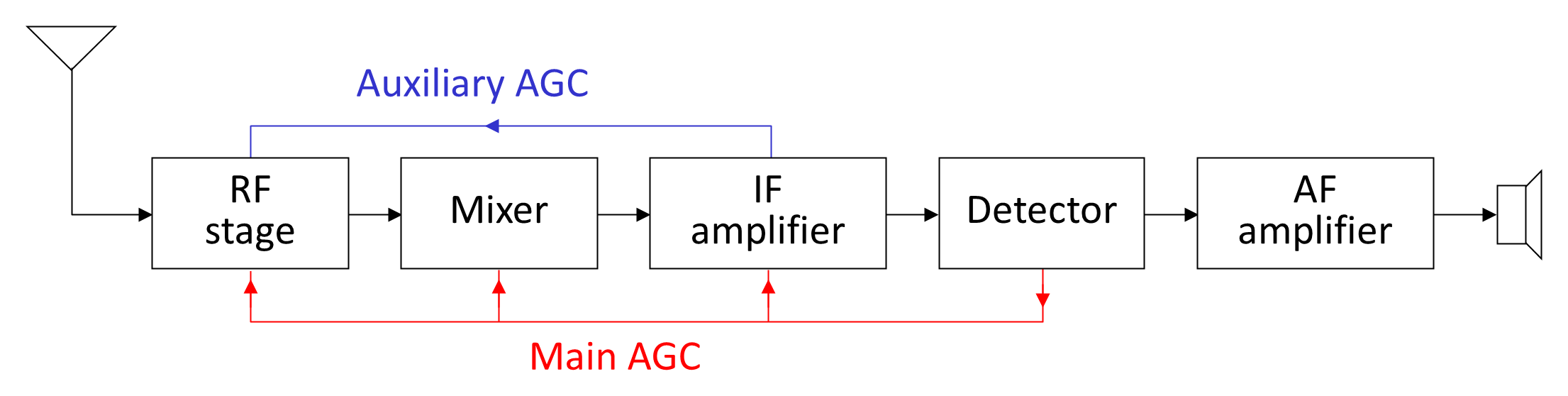
Auxiliary AGC (sometimes called fast AGC) is used to protect the receiver front end from overload by rapidly reducing gain when unusually strong signals are detected. This protection is important in environments where nearby transmitters may intermittently produce high input levels. However, auxiliary AGC circuits are designed to respond to conventional communication signal envelopes with finite rise times. They are effective against slow- or moderate-rise signals but cannot fully protect against extremely fast, high-energy transients such as electromagnetic pulses (EMP) or directed-energy weapon (DEW) events, whose rise times and field strengths may exceed the response capability and damage thresholds of the front-end components before the AGC loop can react. Consequently, protection against such threats requires additional hardening measures beyond AGC alone. It should therefore be understood that AGC is a signal-conditioning mechanism, not a surge-protection device; physical protection against extreme electromagnetic events requires dedicated front-end protection circuits, limiters, and hardening techniques.
Other AGC approaches. Other approaches to AGC include delayed AGC which delays gain reduction until a signal exceeds a threshold; and forward AGC which denotes a feed-forward control topology rather than a feedback-derived gain loop.
AGC in software defined radios. In modern software-defined receivers, automatic gain control is typically implemented in the digital domain after the analogue-to-digital conversion, rather than through purely analogue feedback loops. The RF front end commonly consists of a fixed-gain LNA and minimal analogue conditioning, with gain regulation performed digitally using programmable algorithms. As a result, traditional distinctions such as fast versus delayed AGC, or forward versus feedback control, become implementation details within digital signal processing rather than distinct hardware circuits. Contemporary receiver specifications therefore describe AGC behavior in terms of programmable parameters—such as attack time, release time, target RMS or peak level, and saturation or clipping thresholds—reflecting a shift from fixed analogue time constants to flexible, software-defined control strategies.
Back to reading