11.5.1 The Structure Of The Ionosphere
The Earth’s upper atmosphere consists principally of nitrogen, oxygen, and nitric oxide molecules. These molecules continually undergo a process of ionization by ultra-violet radiation from the sun. The free electrons respond primarily to the electric field of an incident radio wave, producing a frequency-dependent refractive index that causes refraction of HF signals. The reverse process to ionization is called recombination where free electrons are recombined with positive ions. During the day, ionization is the dominant process and a fairly steady level of ionization is produced. At night, in the absence of ultra-violet radiation, only recombination occurs so that the level of ionization is gradually reduced.
The strength of the solar radiation diminishes as it penetrates further into the atmosphere as well as the increasing density of the gas on which it is to work. Obviously, at some great height, there will be a lot of radiation but not a lot of gas to ionize. Conversely, at a much lower height, there is a lot of gas but the radiation will have been severely attenuated. At some intermediate height, both the radiation and the gas density are sufficient to produce large amount of ionization.
In fact, the ionization process forms not one but a number of layers. The gas in the upper atmosphere is a mixture of different gases that tend to lie in layers rather than be mixed together. Each different layer of gas is ionized by a different band of the ultra-violet radiation. The layers form the ionosphere, which is defined as that part of the atmosphere where ions and electrons are present in sufficient quantities to affect the propagation of radio waves.
11.5.1.1 D Layer
The D layer extends from approximately 50–60 km to about 90–100 km altitude. It is present primarily during daylight hours, reaching its maximum effect around local noon, with peak electron densities of the order of 10⁸–10⁹ m⁻³ occurring near 75–80 km. At night, electron densities decrease rapidly to very low values as ionization ceases.
Because it is the lowest ionospheric region, the D layer has the lowest ionization density, although this density increases rapidly with height. Some refraction occurs in the D layer at very low and low frequencies (VLF and LF), but it is insufficient to support sky-wave propagation at MF. Although the D layer is not used directly for communication, all sky-wave signals must pass through it and are therefore subject to attenuation. This attenuation is caused primarily by collisions between free electrons and neutral particles; since the D region is at low altitude, the density of neutral atoms and molecules is high and the collision frequency is correspondingly large.
As a result, D-layer absorption largely determines the lowest usable frequency (LUF) for ionospheric communication. Lower frequencies, particularly MF and the lower part of the HF band, are most affected, as absorption decreases with increasing frequency. At night, the disappearance of the D layer leads to markedly improved HF sky-wave propagation compared with daytime conditions.
11.5.1.2 E Layer
The E layer, sometimes referred to as the Kennelly–Heaviside layer, is named after Arthur Kennelly and Oliver Heaviside, who independently postulated its existence in 1902 to explain the success of Marconi’s trans-Atlantic radio communication in 1901. This layer exists primarily during daylight hours and is only weakly ionized at night. It has a higher ionization density than the D layer and typically extends from approximately 90 to 140 km above the Earth.
The E layer provides sufficient refraction to return lower-frequency HF waves to Earth via sky-wave propagation. It exhibits pronounced diurnal variations, with additional seasonal variation such that ionization densities are generally lower in winter than in summer. Electron densities in the E region also vary with the 11-year solar cycle, being of the order of 10¹¹ m⁻³ at solar minimum and typically around 50 % higher at solar maximum. At night, electron concentrations decrease by approximately two orders of magnitude.
Under certain conditions, the E layer may contain localized regions of intense ionization, known as sporadic E, which can significantly disrupt or enhance radio propagation. During daylight hours, the E layer supports much of the short- to medium-range HF communication.
11.5.1.3 F Layers
The F region contains the highest electron densities of the normal ionosphere and is therefore the most important region for long-distance HF propagation. During daylight hours it normally consists of two distinct layers, the F1 and F2 layers. The F1 layer is a daytime feature that largely disappears at night; at local noon its peak electron density is typically of the order of 1.5 × 10¹¹ m⁻³ at solar minimum and may increase to approximately 4 × 10¹¹ m⁻³ at solar maximum.
The F2 layer exhibits the highest electron densities of all ionospheric regions and remains strongly ionized both day and night, with densities at night remaining significantly higher than those in the D and E regions. The F2 peak occurs at altitudes between roughly 200 and 400 km, with night-time peak electron densities typically in the range of 4–5 × 10¹¹ m⁻³, falling to a pronounced diurnal minimum near local dawn. During the day, peak densities are generally higher and strongly influenced by solar activity.
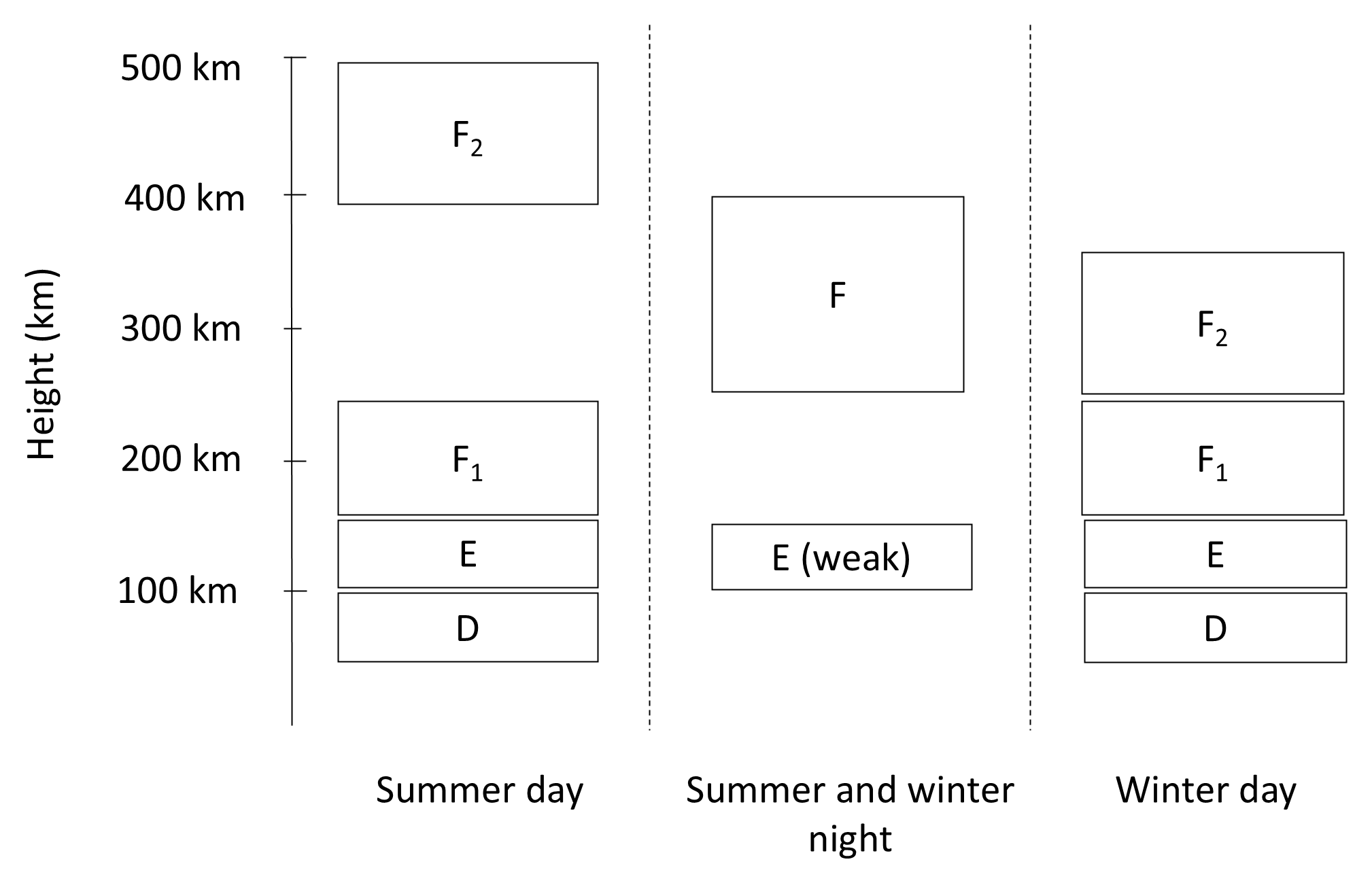
Two well-defined F layers are therefore present during daylight hours: the F1 layer, typically between 140 and 250 km altitude, and the F2 layer, between approximately 250 and 400 km. Both layers are more heavily ionized than the E layer and, under appropriate conditions, are capable of refracting frequencies throughout the HF sky-wave band. The F2 layer is the principal medium for long-range and night-time HF communication. The F region is sometimes referred to as the Appleton layer, after Sir Edward Appleton, who established its existence experimentally.
11.5.1.4 Variations In The Layers
Since the height of formation of the layers depends on the intensity of ultra-violet radiation the layers will vary in height from day to night and from summer to winter. Under normal solar radiation conditions the gases present in the atmosphere allow up to four layers of ionization to exist during the day (D, E, F1, and F2). At night, when the solar radiation is reducing, recombination of ions and free electrons predominates and when the solar radiation is at a minimum, the D and E layers effectively disappear and the two F layers combine to form one layer. These variations are summarized by Figure 11.17.