11.4.1 Conductivity
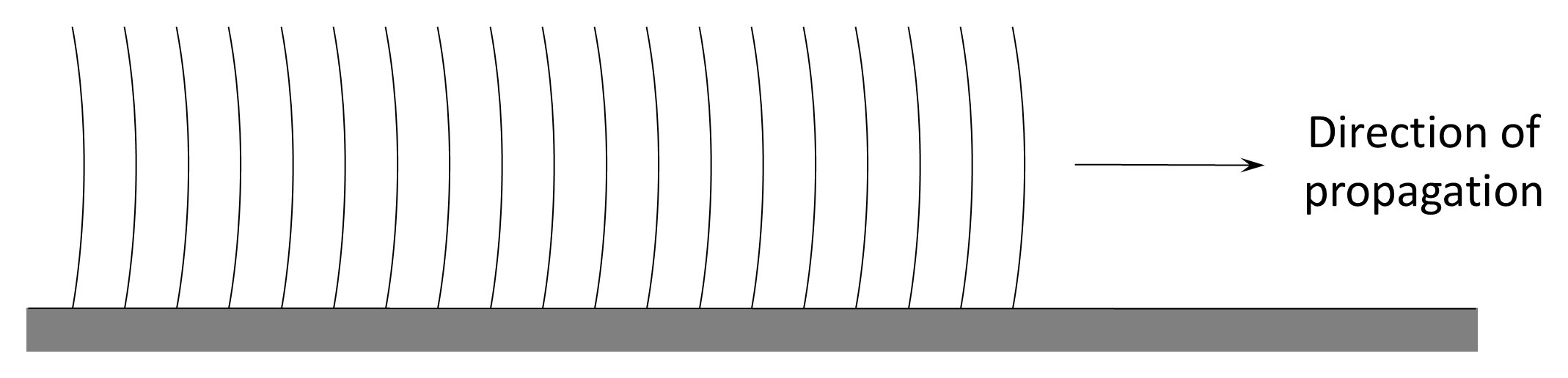
Figure 11.15 illustrates how a surface wave propagates along the ground. If the ground were perfectly conducting, no energy would be lost in supporting the induced currents. In practice, all natural surfaces have finite conductivity, and some of the wave energy is dissipated as heat in the ground.
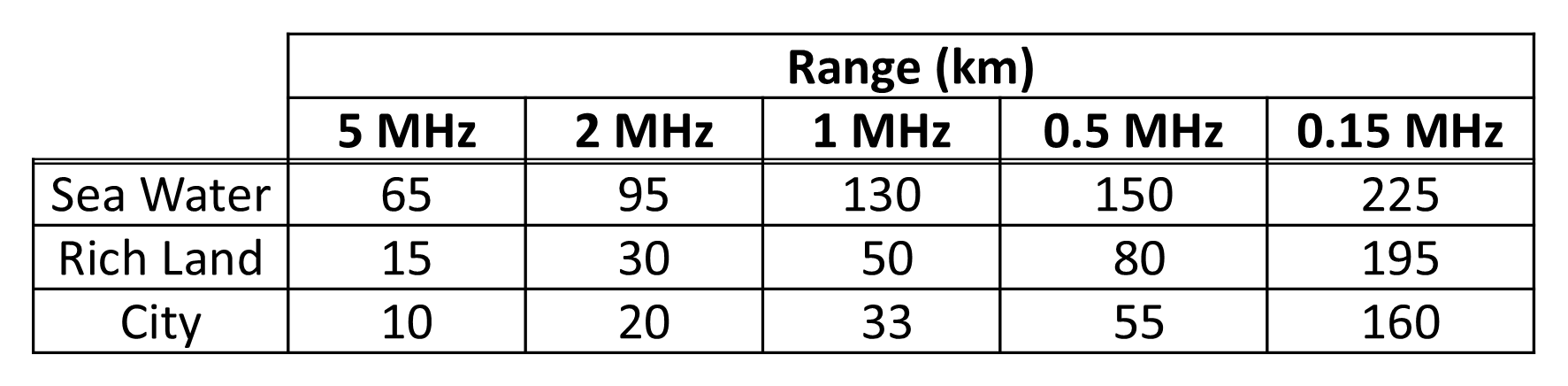
Seawater, having high conductivity, provides excellent surface-wave range. Fresh water and wet soil offer moderate conductivity and reasonable ranges. Dry, rocky terrain, urban environments, and jungle have poor conductivity and therefore yield significantly reduced ranges.
The absorption of energy in the ground produces a retarding effect on the portion of the wave in contact with the surface, causing the wavefront to tilt slightly forward in the direction of propagation. Poor conductivity increases attenuation and wavefront tilt and may eventually lead to effective absorption of the surface-wave component.
Although the intrinsic conductivity of the ground is a material property, the attenuation of surface waves increases with frequency. As frequency rises, the effective surface impedance of the ground increases, reducing the efficiency with which ground currents can be supported. Consequently, surface-wave propagation becomes progressively less effective at higher frequencies.
For an idealized surface wave over a homogeneous conducting Earth, the field strength decreases approximately as:
where α is an attenuation constant determined by ground conductivity, permittivity, and frequency. This behavior differs from free-space propagation, in which the field varies approximately as 1/d and power as 1/d², reflecting the additional dissipative loss associated with ground currents.
Figure 11.16 provides illustrative ranges for a constant transmitter output over several types of terrain at different frequencies. Although ground conductivity is a material property, the attenuation of surface waves increases with frequency because the effective surface impedance of the ground rises as frequency increases. As an example of the effect of frequency and ground conductivity on communication range These values assume vertical polarization and antennas close to the ground; actual ranges depend on antenna configuration, terrain irregularity, and atmospheric conditions.