11.2.2 Sky Waves And Scattered Waves
Communication using space waves is limited to line-of-sight distances, and surface-wave range is governed largely by the electrical properties of the ground. Under typical terrestrial conditions, practical surface-wave ranges are on the order of several tens of kilometers, depending strongly on frequency and ground conductivity. Long-distance communication is achieved through the influence of the atmosphere, which is divided into three main regions as shown in Figure 11.5.
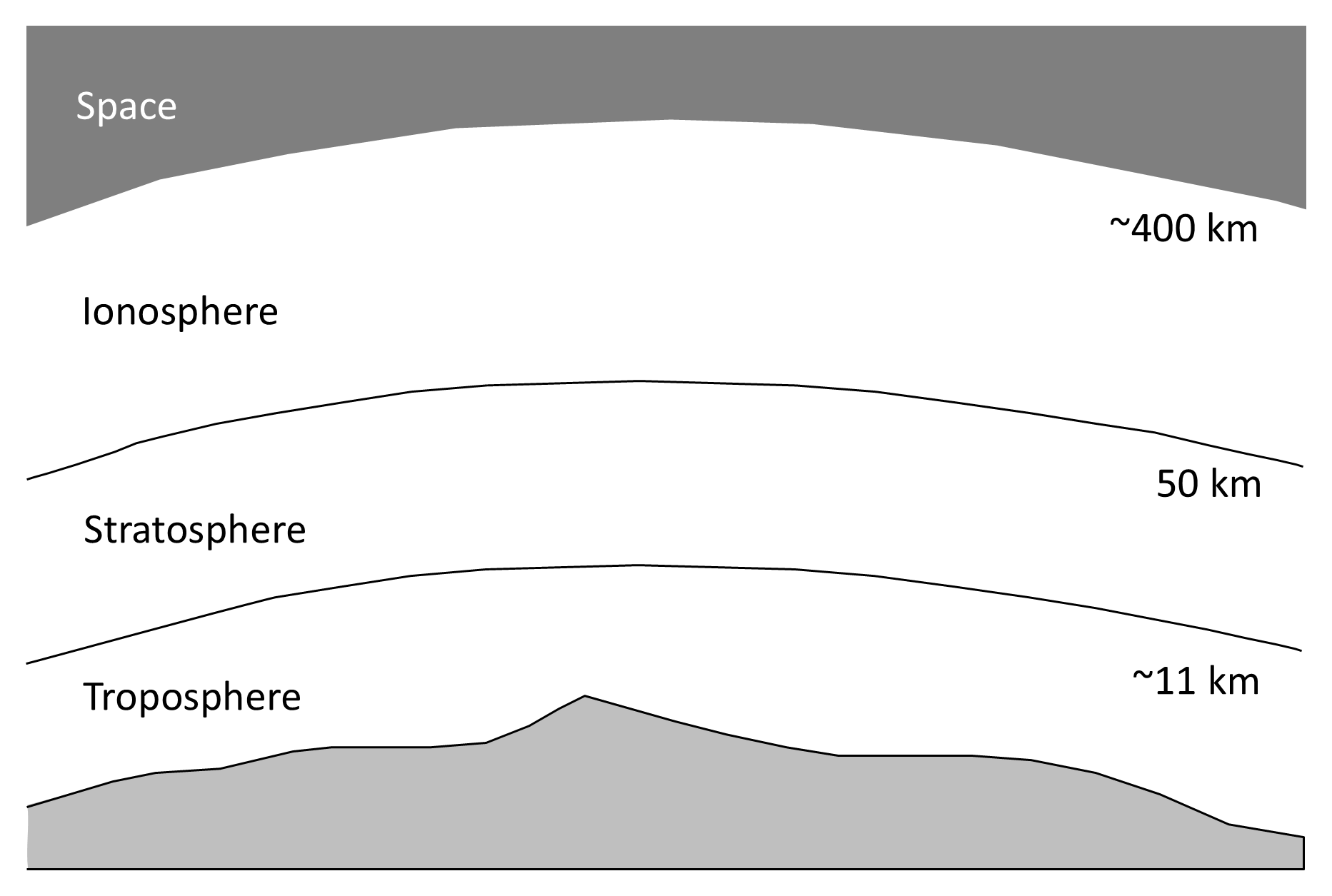
The troposphere extends from the Earth’s surface to a height of about 11–16 km. Within this region, the air is turbulent and not significantly ionized. The stratosphere extends upward to roughly 40–50 km, where the air is more stable, temperature nearly constant, and moisture content low. The stratosphere plays little role in radio communications.
Above the stratosphere lies the ionosphere, beginning at approximately 50–60 km and extending several hundred kilometers. In this region the air becomes sufficiently ionized to refract certain high-frequency radio waves, enabling propagation over great distances beyond the horizon.
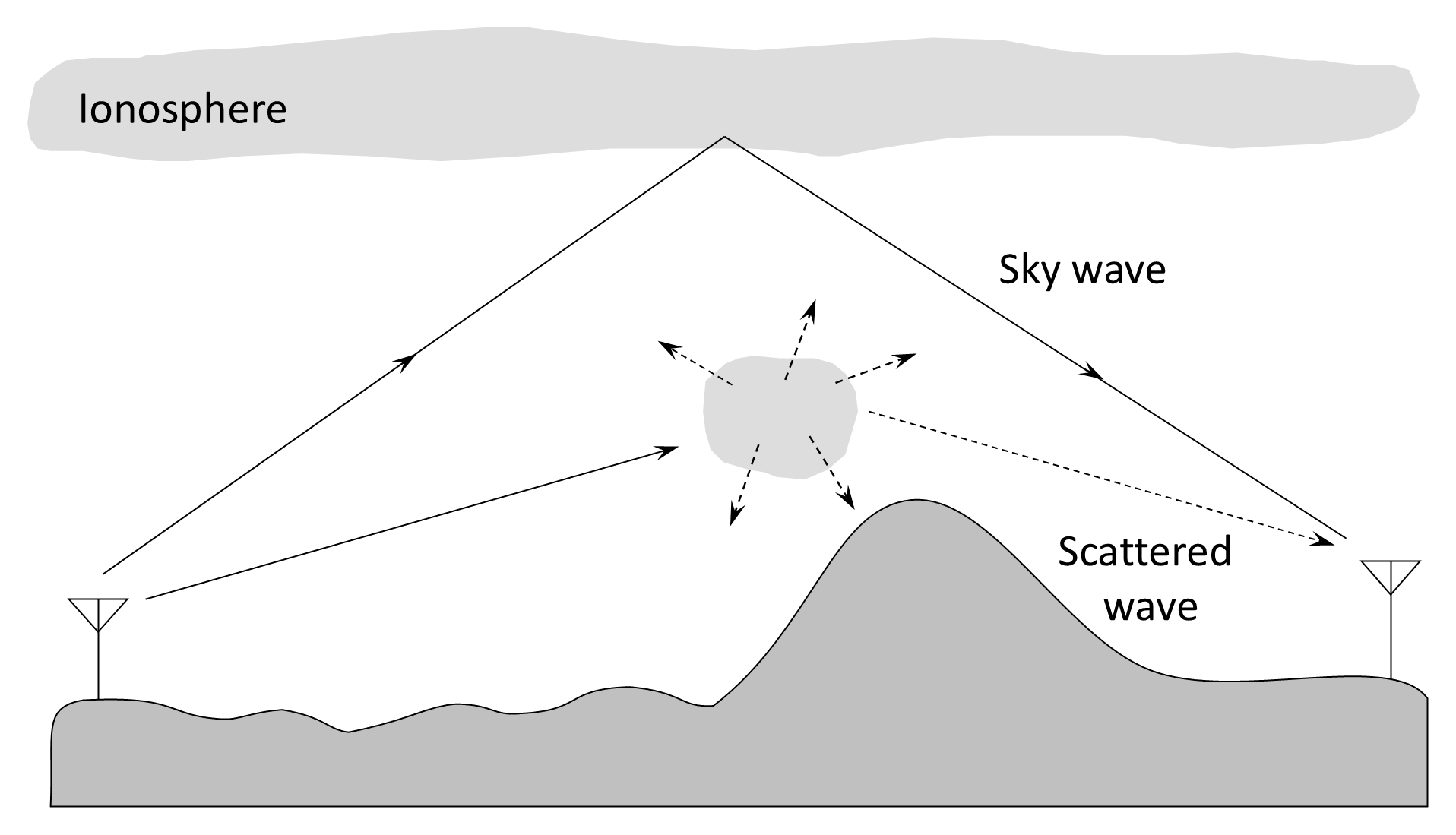
As shown in Figure 11.6, signals can also reach beyond line-of-sight by refraction of sky waves in the ionosphere, or by scattering caused by atmospheric irregularities. When the scattering occurs in the troposphere, the effect is called troposcatter; when in the ionosphere, it is called ionospheric scatter. Scattering may also occur from the ionized trails of meteors, a phenomenon exploited in meteor-burst communication.