
11.3 SPACE-WAVE COMMUNICATIONS
We now turn to space-wave communications between two antennas. To build understanding, let us begin with an idealized case. Suppose that our transmitting antenna is a perfect isotropic radiator—that is, an antenna that radiates power equally in all directions. The radiated energy then spreads spherically outward from the antenna, as illustrated conceptually in Figure 11.8. A helpful two-dimensional analogy is the circular ripple pattern formed when a stone is dropped into a still pond.
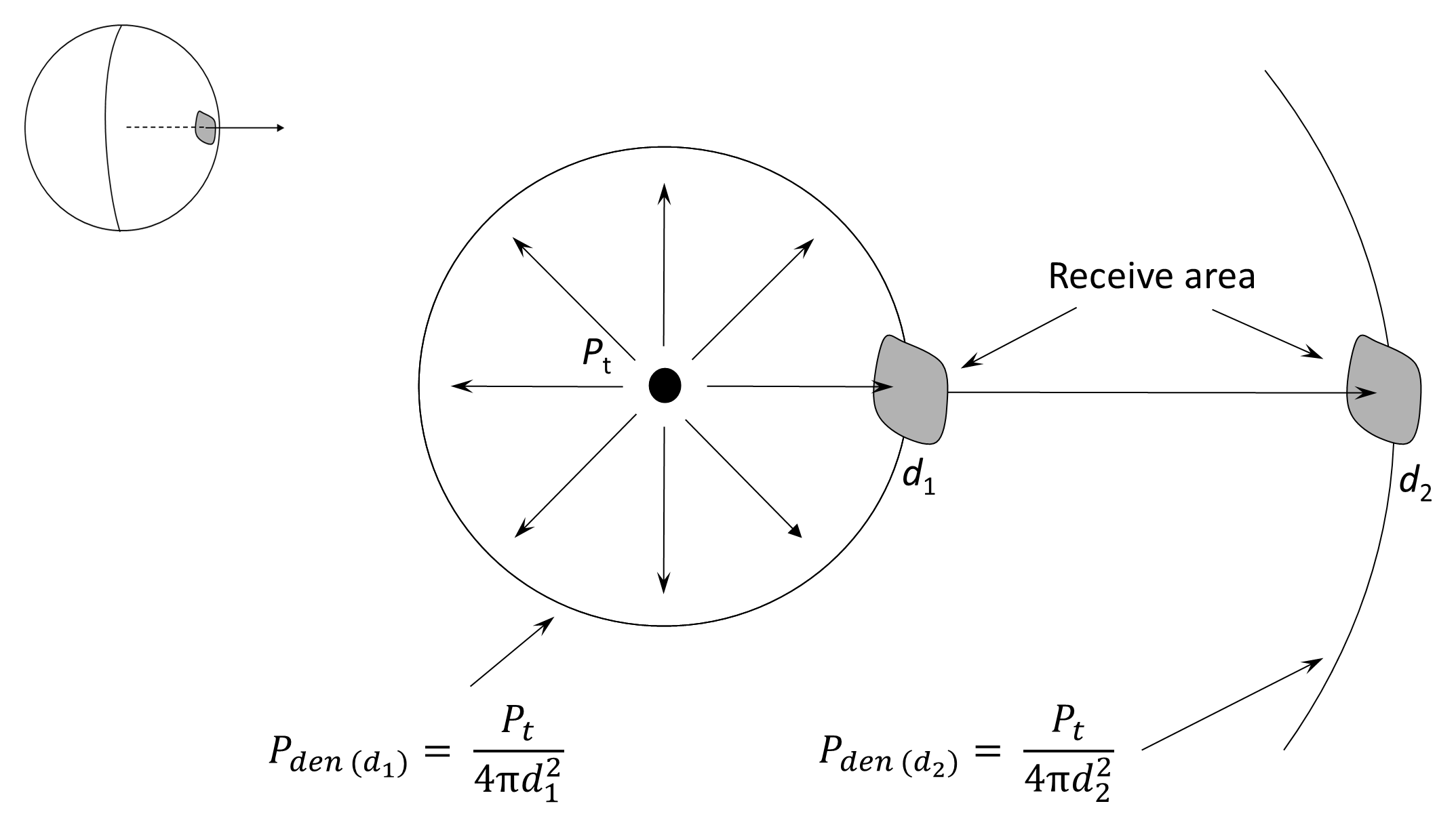
In this ideal situation, all the power delivered to the antenna is radiated into free space, and the propagation medium itself is perfect—meaning that the electromagnetic wave suffers no attenuation as it travels. Although these assumptions are not physically realistic, they provide a convenient starting point for understanding how radiated power diminishes with distance.
A perfect isotropic radiator produces a spherical wavefront that propagates through the medium. What we wish to determine is the amount of power incident on a receiving antenna located a distance d away. The key quantity is the power density—that is, the power per unit area (W m⁻²)—of the expanding spherical wavefront, as shown in Figure 11.8.
At a distance d₁ from the transmitting antenna, the total power Pₜ is spread uniformly over the surface area of a sphere of radius d₁ (4πd₁²). Thus, the power density is:
At a greater distance d2, the power density is:
As the radius of the spherical wavefront increases, the same transmitted power is distributed over a larger area. Because the receiving antenna has a fixed physical aperture, the incident power on that antenna decreases with distance. Even in this lossless case, received power density falls in proportion to the inverse square of the distance. Thus, if the distance is doubled, the received power density is reduced by a factor of four.
Back to reading