11.1 THE ELECTROMAGNETIC WAVE
Before examining the various modes of radio-wave propagation, it is useful to review briefly how a radio wave is created and how it propagates through space. The creation of the wave is discussed in more detail in Chapter 12, when we consider antennas.
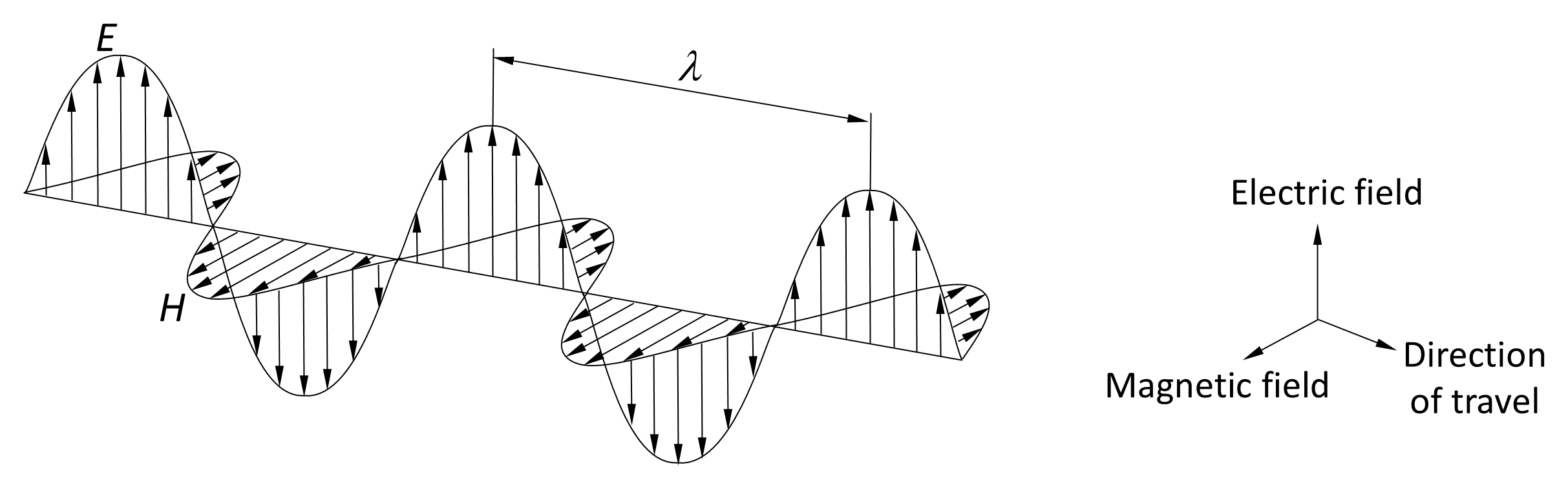
For the moment, consider that a radio wave is typically produced by driving an alternating electric current through an antenna, which is commonly a rod or wire. The alternating current generates time-varying electric (E) and magnetic (H) fields that radiate outward from the antenna. Figure 11.1 illustrates this process for a sinusoidally varying current.
In the far-field region, the resulting radiation is called a transverse electromagnetic (TEM) wave because its electric and magnetic fields are always at right angles to each other and to the direction of propagation. In free space, the magnitudes of the fields are related by the impedance of free space, which has the approximate value of 120 π Ω (≈ 377 Ω):
The wave propagates in free-space at the speed of light c ≈ 3 × 10⁸ m s–1.
Equation (11.1) applies to fields in free space. More generically, the constant of proportionality is the intrinsic impedance for the medium through which the fields are passing, which depends on the medium’s permittivity (ε), permeability (μ), conductivity (σ), and frequency (f). In a lossless medium , and in free space, . Transmission lines such as twisted pair cables or coaxial cables possess a characteristic impedance determined by their geometry and materials, which is distinct from the intrinsic impedance of a propagation medium.
One of the fundamental properties of a TEM wave is its polarization, which describes the orientation of the electric field as the wave travels through space. If the plane of the electric field is vertical, the wave is said to be vertically polarized; if it lies horizontally, the wave is horizontally polarized. The wave shown in Figure 11.1 is vertically polarized. Vertically polarized waves are radiated by vertical antennas, while horizontally polarized waves are radiated by horizontal antennas.
Vertical and horizontal polarization represent two orthogonal orientations of linear polarization. In circular polarization, the electric-field vector rotates at the same angular frequency as the wave, so that the polarization appears to rotate continuously as the wave propagates. The rotation may be right-handed (clockwise) or left-handed (counter-clockwise), as determined by an observer looking in the direction of propagation. In elliptical polarization, the electric-field vector traces an ellipse at a fixed point in space, representing the most general form of polarization; linear and circular polarization are particular cases of this more general condition.