
3.5 CHAPTER SUMMARY
Speech-coding techniques may be broadly classified into waveform coders, model-based coders, and hybrid waveform/model-based coders, each offering different trade-offs between bit rate, intelligibility, and subjective quality—Figure 3.22 provides a summary. Waveform coders such as PCM, ADPCM, and DM aim to reproduce the speech waveform directly and can achieve high fidelity, but generally require higher bit rates or accept increased distortion. In contrast, model-based coders—including early vocoders and predictive schemes such as LPC—achieve much higher compression by transmitting only a compact set of speech parameters, at the cost of reduced naturalness and speaker fidelity.
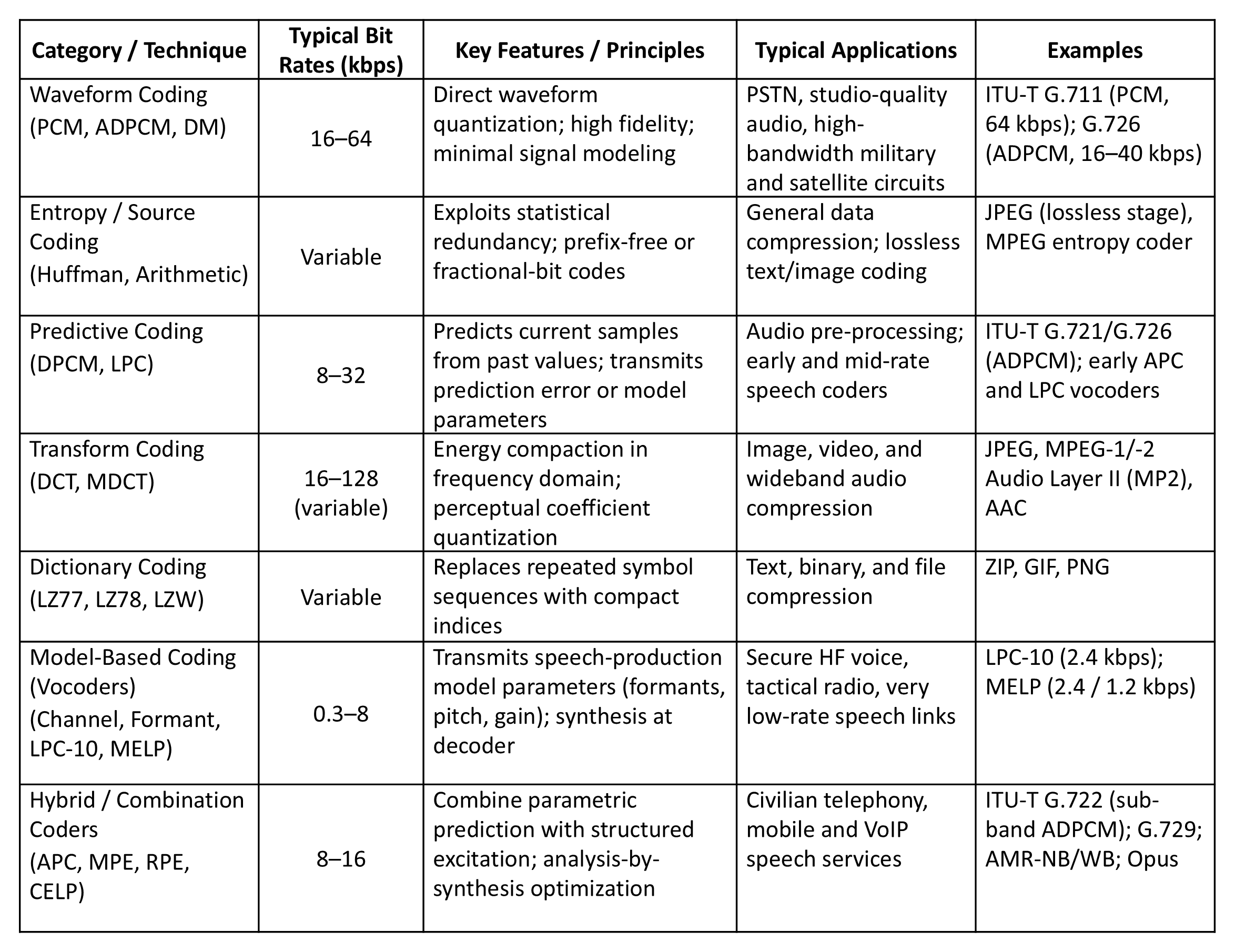
The historical progression from channel and formant vocoders to LPC and ultimately to hybrid techniques such as CELP reflects a fundamental shift from describing the spectral envelope of speech toward perceptually optimized parametric models augmented by carefully structured excitation signals. This evolution enabled substantial improvements in naturalness and robustness at moderate bit rates and forms the basis of virtually all modern speech-coding standards.
In practice, the choice of a speech-coding technique represents a balance between available bandwidth, channel impairments, computational complexity, and required speech quality. Waveform coders exploit temporal redundancy and simplicity, while model-based coders exploit knowledge of the speech production process; hybrid coders combine both approaches to achieve improved perceptual performance within practical bit-rate constraints.
A clear distinction emerges between civilian and military applications. Civilian telephony and multimedia systems typically operate over predictable, relatively high signal-to-noise ratio channels and place a premium on naturalness and transparency. As a result, hybrid coders such as CELP and its derivatives dominate modern civilian standards, including G.729, AMR, and AMR-WB, providing high subjective quality at moderate bit rates. In these environments, basic delta modulation is rarely used; although simple and robust, its limited fidelity and sensitivity to slope overload make it less attractive than ADPCM and hybrid techniques. Nevertheless, the principles underlying delta modulation—differential encoding, step-size adaptation, and robustness to noise—remain fundamental to more advanced waveform and hybrid coders.
Military and tactical communication systems are governed by different priorities. In such systems, bandwidth efficiency, robustness, low probability of interception, and reliable intelligibility under severe channel impairments often outweigh the need for high-fidelity speech reproduction. Adaptive delta-modulation variants, most notably CVSD, have therefore seen widespread use in tactical radios and military voice systems, typically at bit rates on the order of 16–32 kbps, particularly over VHF and UHF links. For more severely constrained and impaired channels—most notably HF links limited to approximately 3.1 kHz and subject to fading and interference—very low-rate model-based coders such as MELP persist, as they provide intelligible speech at bit rates of only a few kilobits per second where hybrid civilian codecs perform poorly.
Modern communication systems increasingly integrate multiple coding and compression techniques within layered architectures. Speech coders are often combined with predictive, transform, and entropy-coding methods and adapted dynamically to channel conditions, enabling efficient and intelligible communication across a wide range of applications—from secure HF voice links and tactical radios to broadband multimedia and VoIP services.
Back to reading