
3.3.6 Speech Coding Techniques
Waveform-coding methods, such as PCM and DM, achieve high quality but require relatively large bandwidths. For example, high-quality PCM voice at 64 kbps or delta-modulated voice at 16 kbps requires equivalent transmission bandwidths of approximately 32 kHz and 8 kHz respectively (see Section 3.1), whereas analog speech occupies only about 3.1 kHz.
This mismatch between the 3.1-kHz source bandwidth and the far greater digital transmission rate can be appreciated by considering the entropy of speech. Human speech comprises roughly forty distinct phonemes—about sixteen vowels and diphthongs and twenty-four consonants. The average information content is approximately 5 bits per phoneme, and at a typical speaking rate of 10 words per second (≈ 100 phonemes per second) the resulting information rate is only on the order of 50 bps. The redundancy of speech therefore suggests that significant compression is possible.
Unlike a waveform coder, a model-based coder does not track the input waveform directly. Instead, it uses knowledge of speech production to model the signal and transmits only a compact description of the model parameters. The receiver then reconstructs the speech using these parameters. Such coders can achieve data rates below 10 kbps—trading off fidelity for compression efficiency.
3.3.6.1 Channel Vocoders
Vocoder-based speech coding techniques may be broadly divided into channel vocoders and parametric vocoders. Channel vocoders represent speech by measuring and transmitting the short-term spectral energy distribution across a set of frequency sub-bands, whereas parametric vocoders model the speech production process itself, explicitly representing features such as vocal-tract resonances, pitch, and excitation type. Channel vocoders are historically the earliest class of vocoder and provide a useful conceptual foundation for understanding later, more efficient parametric approaches discussed in subsequent sections.
A channel vocoder divides the nominal 3.1-kHz voice band into approximately twenty narrow sub-bands using a bank of band-pass filters. Within each sub-band, the signal energy is measured over a short analysis interval and quantized—typically using about 3 bits per band. For a 20-band system this yields roughly 60 bits per analysis frame. Because the fastest perceptually significant spectral variations in speech occur at around 20 Hz, analysis frames are commonly taken every 25 ms (approximately 40 frames per second), resulting in an overall bit rate of about 60×40=2.4 kbps.
At the receiver, a corresponding synthesis filter bank reconstructs speech by exciting the sub-bands according to the received energy parameters. The resulting signal is not a faithful reconstruction of the original waveform, but rather a synthetic approximation whose intelligibility depends primarily on the preservation of spectral envelope information.
Channel-vocoded speech offers the important advantage of enabling digital speech transmission at very low bit rates, compatible with narrowband 3-kHz speech channels. However, speech quality is characteristically synthetic and robotic, and fine spectral and temporal cues associated with speaker identity are largely lost, making speaker recognition difficult.
These properties made channel vocoders particularly attractive for military communications, especially on high-frequency (HF) links where only 3-kHz channels were available that were subject to severe fading, noise, and interference, and provided limited and variable signal-to-noise ratios. Channel vocoders enabled intelligible digital speech to be conveyed over such channels at bit rates compatible with available HF modems, while also allowing the resulting bit stream to be encrypted using contemporary communications security equipment. An additional operational benefit was the inherent suppression of speaker-specific characteristics, which reduced the effectiveness of voice interception and identification. Although later parametric vocoders such as LPC-based and MELP systems eventually supplanted channel vocoders in operational HF radios due to improved intelligibility and robustness, channel vocoders played a foundational role in the early deployment of secure HF voice.
Beyond HF military applications, vocoders have been employed in a variety of other domains where bandwidth efficiency is critical. Early satellite and space communication systems used vocoders to minimize required data rates and transmitter power while supporting secure voice links. Tactical VHF and UHF land-mobile radios adopted vocoder techniques to increase channel capacity and enable encrypted digital voice without increasing occupied bandwidth. Vocoder-based speech parameter transmission has also been explored in extremely bandwidth-limited acoustic channels, such as underwater and diver communications. In addition, channel vocoders were historically important in speech synthesis research and early assistive communication systems, where they contributed to understanding human speech perception and low-rate speech representation.
3.3.6.2 Formant Vocoders
Formant vocoders improve coding efficiency by modeling speech in terms of the major resonant frequencies of the human vocal tract, known as formants, rather than by dividing the spectrum into a fixed set of frequency bands. In voiced speech, the spectral envelope is dominated by a small number of resonances whose center frequencies and bandwidths vary slowly with articulation. For most vowels and many voiced consonants, the first three formants capture the majority of perceptually important information.
In a formant vocoder, analysis algorithms estimate the center frequencies and bandwidths of these principal formants, along with parameters describing voicing, pitch (fundamental frequency), and overall signal energy. At the receiver, speech is synthesized by exciting a small number of adaptive band-pass filters—typically three for voiced sounds—whose center frequencies track the estimated formants. Separate excitation mechanisms are used for voiced and unvoiced speech, reflecting the different production mechanisms of periodic vocal-cord vibration and turbulent airflow.
Because only a small number of slowly varying parameters must be transmitted, formant vocoders achieve substantially lower bit rates than channel vocoders. In early implementations, two sets of three adaptive filters (to represent time-varying formant behavior and transitions) were sufficient, allowing data rates on the order of one-third that of a channel vocoder, typically around 0.8 kbps.
This increased efficiency comes at the cost of reduced speech naturalness. The simplified spectral model captures the gross structure of speech but omits many fine spectral and temporal details associated with timbre, prosody, and individual speaker characteristics. As a result, formant-vocoded speech is often intelligible but highly synthetic, with poor speaker recognizability and limited expressiveness. These limitations, together with sensitivity to analysis errors, ultimately constrained the operational use of pure formant vocoders and motivated the development of more robust parametric techniques, such as linear predictive coding, which are discussed in later sections.
In contrast to channel vocoders, which estimate spectral energy in fixed frequency bands, formant vocoders attempt to track the underlying physical resonances of the speech production mechanism, achieving lower bit rates at the expense of increased modeling sensitivity. These limitations motivated the development of linear predictive coding techniques, which provide a mathematically tractable and more robust means of estimating vocal-tract resonances and form the basis of most modern low-rate speech coders discussed in the following section.
3.3.6.3 Linear Predictive Coding (LPC) Vocoders
Speech production can be modeled mathematically: air from the lungs excites the vocal tract, which acts as an acoustic filter whose shape determines the sound produced. For voiced sounds, the vocal cords vibrate periodically, generating a quasi-periodic pulse train. For unvoiced sounds, such as s or t, turbulent airflow produces a noise-like excitation.
In linear predictive coding (LPC), this process is represented by an all-pole digital filter whose coefficients model the time-varying shape of the vocal tract. The excitation signal—either an impulse train for voiced sounds or noise for unvoiced sounds—is scaled by a gain factor controlling loudness. Each output sample is generated by forming a weighted sum of past samples, using the LPC filter coefficients to predict the current sample. Figure 3.19 shows a block diagram of a basic LPC speech synthesizer.
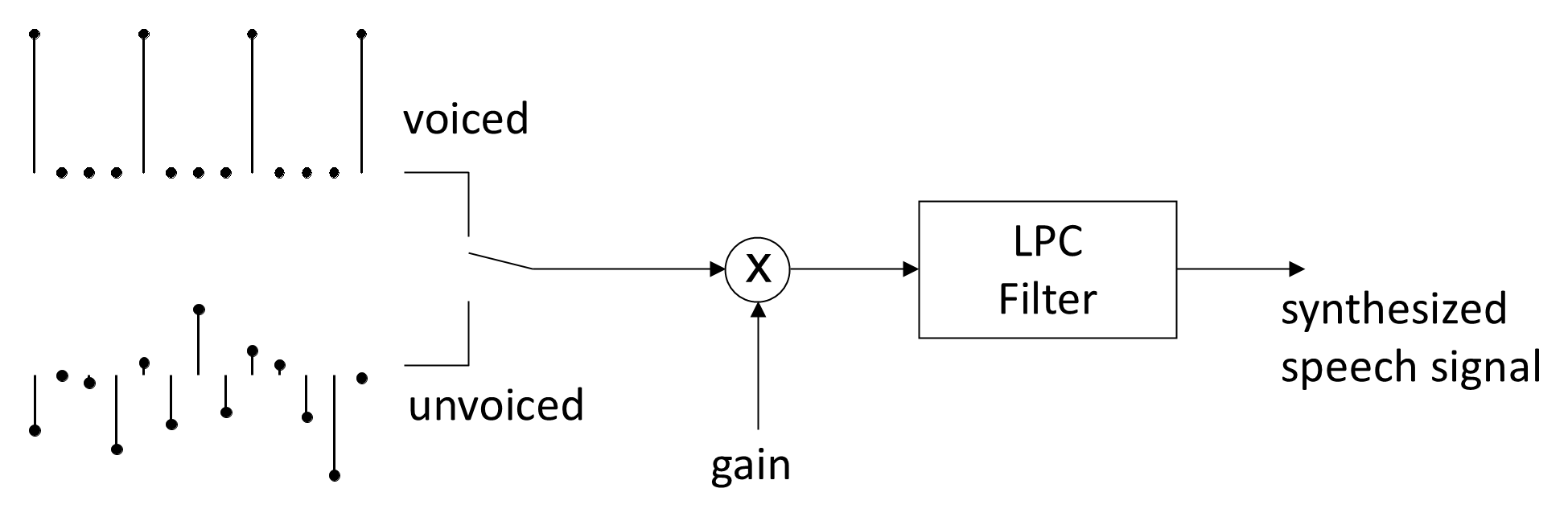
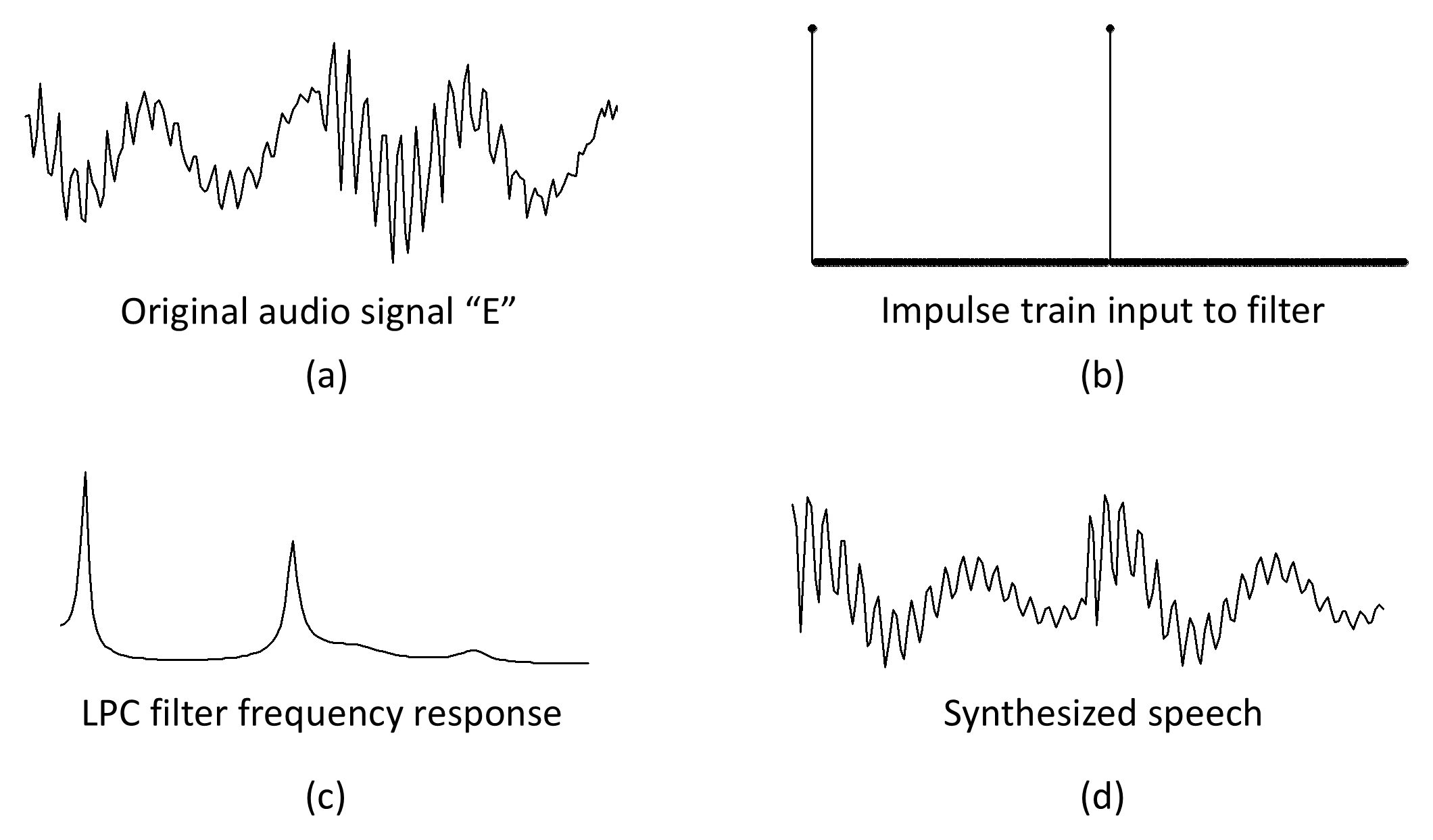
Figure 3.20 illustrates the LPC modeling process using the vowel sound e. An example of an original audio waveform is shown in Figure 3.20(a). The impulse train excitation signal used to synthesize this waveform is shown Figure 3.20(b) and the frequency response of the LPC filter is shown in Figure 3.20(c). This response exhibits two dominant resonances corresponding to the principal formants of the vowel. The synthesized speech waveform shown in Figure 3.20(d) consists of a superposition of sinusoidal components whose frequencies correspond to these resonances. The waveform exhibits a repeating pattern whose duration is determined by the spacing of the impulses in the excitation signal, which in turn defines the pitch of the synthesized sound. The synthesized waveform sounds like the original e because it reproduces the same formant structure and pitch, even though the instantaneous waveform samples differ from those of the original signal.
Code-Excited Linear Prediction (CELP) Coder
LPC vocoders use such a speech synthesizer as part of a system that efficiently represents speech as a digital bitstream. Figure 3.21 shows a block diagram of a Code-Excited Linear Prediction (CELP) speech coder, which is the most common and widely deployed form of LPC-based vocoder. Unlike earlier LPC vocoders, which estimate parameters in an open-loop manner, CELP employs a closed-loop analysis-by-synthesis approach, in which the encoder generates candidate synthetic speech signals from a model, compares each to the original speech using a perceptually weighted error criterion, and selects the model parameters that minimize the difference for transmission.
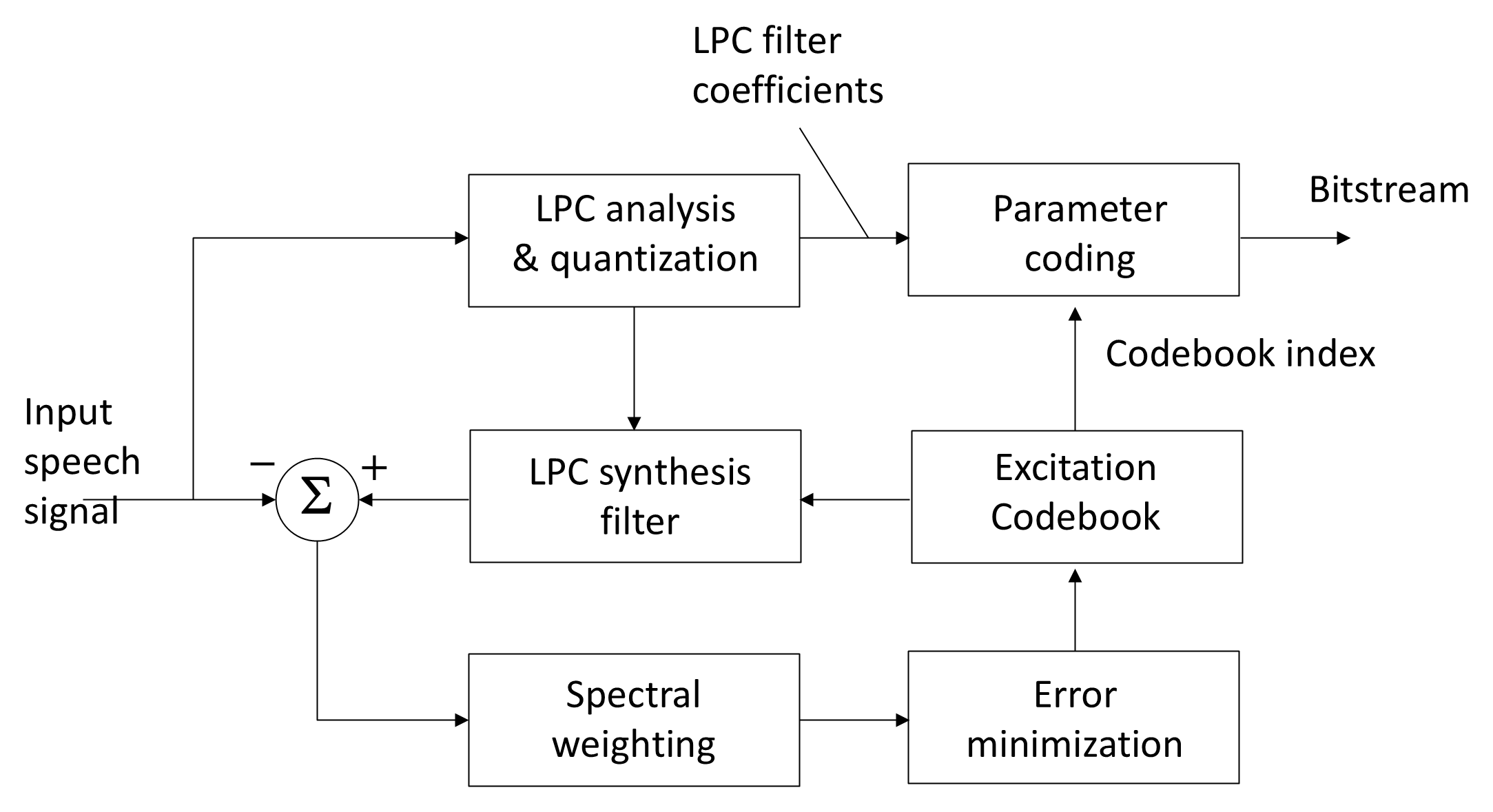
CELP coders combine LPC analysis with a perceptually optimized excitation model. The encoder derives LPC filter coefficients, synthesizes candidate waveforms, compares them with the original speech using a perceptually weighted error measure, and selects the best excitation vector from a stored codebook. The index of the selected vector, together with quantized LPC parameters, is transmitted as a compressed bitstream, typically using entropy coding techniques such as Huffman coding.
CELP is a parametric (model-based) speech coder: it transmits no direct time-domain waveform samples, but instead conveys model parameters such as linear predictive coefficients, excitation codebook indices, pitch delay, and gain values. Bit rates in the range of 6–8 kbps can provide near-toll-quality speech. The principal disadvantage is its substantial computational complexity, arising from the closed-loop analysis-by-synthesis process and the exhaustive (or near-exhaustive) perceptually weighted search of the excitation codebook. Nonetheless, advances in digital signal processing and VLSI technology have enabled real-time implementation, and CELP or CELP-derived architectures underpin numerous modern standards, including Adaptive Multi-Rate (AMR), ITU-T G.729, the SILK mode of Opus, and many Voice-over-IP (VoIP) systems.
Mixed Excitation Linear Prediction (MELP) Coder
While CELP and related LPC-based coders are widely used in commercial and packet-based voice systems, military and tactical communications—particularly over high-frequency (HF) radio links—have driven the development of specialized low-rate LPC variants. One of the most significant of these is mixed excitation linear prediction (MELP), which extends the LPC framework by employing a combination of periodic and noise-like excitation components to more accurately model both voiced and unvoiced speech.
MELP vocoders were specifically designed to maintain intelligibility at very low bit rates, typically around 2.4 kbps and below, under the severe fading, interference, and burst-error conditions characteristic of HF radio channels. By improving robustness to channel impairments and reducing sensitivity to analysis errors, MELP became the standard vocoder in many military HF and tactical radio systems, effectively superseding earlier channel vocoders and LPC-10 implementations. Although MELP speech remains synthetic, it provides substantially improved intelligibility and operational robustness compared to earlier low-rate vocoders.
Together, LPC and its derivatives represent the transition from early spectral-envelope vocoders to modern model-based speech coders that balance efficiency, intelligibility, and robustness across both civilian and military communication systems.
Back to reading