
3.2.4 Delta Modulation
One disadvantage of conventional PCM is the relatively high bit rate required to transmit high-quality speech signals. Greater efficiency can be achieved by DM, which reduces the transmitted information by encoding only the change in signal amplitude from one sample to the next, rather than the absolute amplitude itself. In this sense, DM may be viewed as an extreme, one-bit form of DPCM.
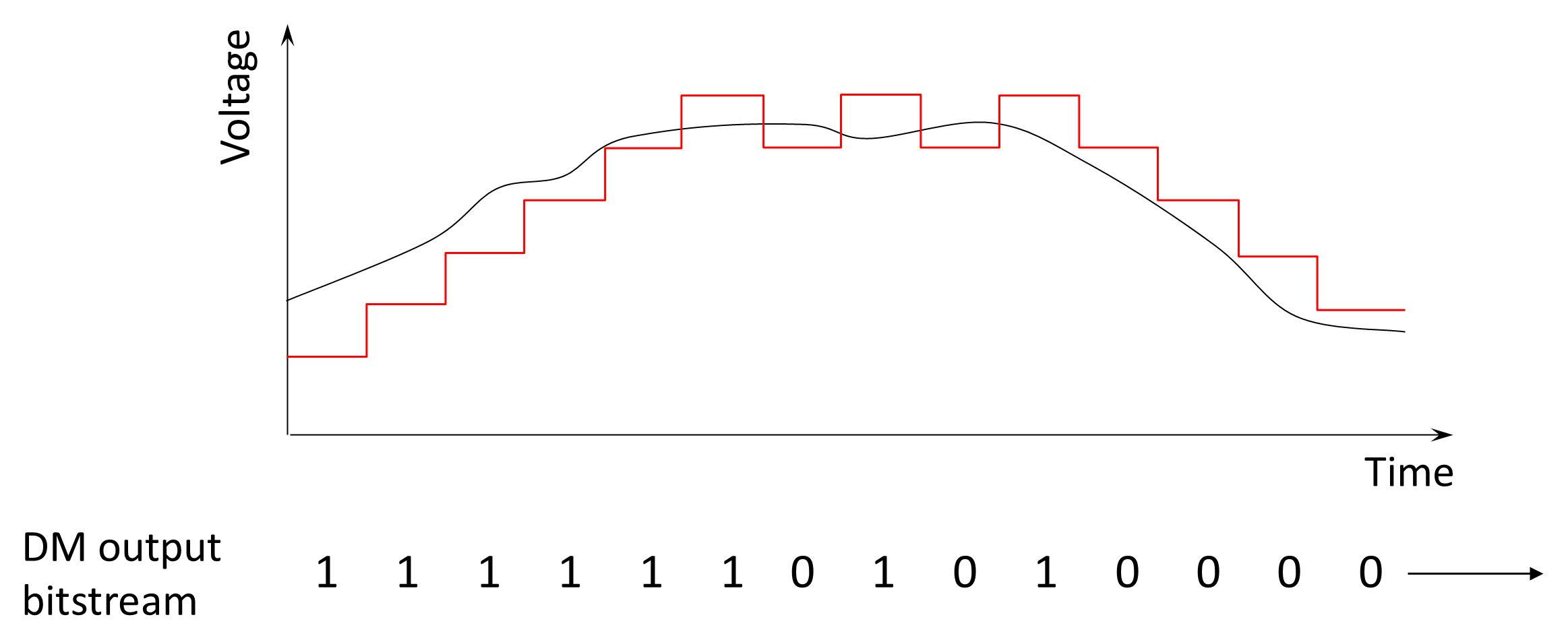
As illustrated in Figure 3.8, the delta modulator compares the current input sample with the previously reconstructed sample. If the input amplitude has increased, a binary ‘1’ is transmitted; if it has decreased, a binary ‘0’ is transmitted. At the receiver, each bit causes the reconstructed signal to increase or decrease by a fixed amount known as the step size, denoted by Δ (the Greek letter delta, the equivalent of the English ‘d’—see Appendix A). This incremental reconstruction process gives delta modulation its name.
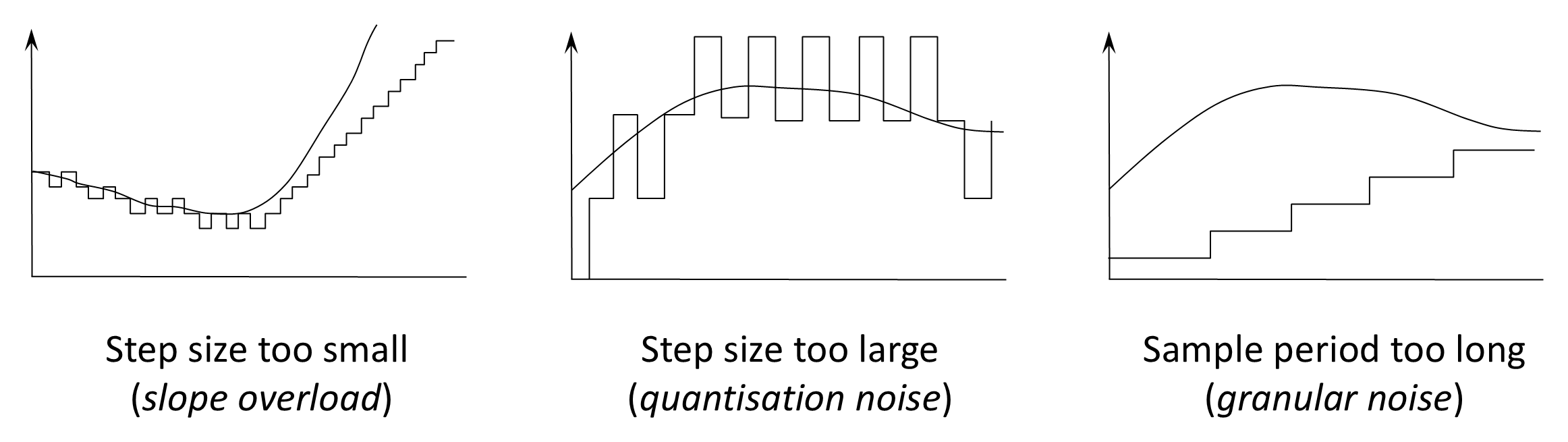
As with PCM, the performance of a delta modulation system depends critically on parameter selection. If the step size Δ is too small relative to the slope of the input waveform, the modulator cannot track rapid signal changes, resulting in slope overload distortion. Conversely, if Δ is too large, the reconstructed signal oscillates around slowly varying portions of the input waveform, producing granular noise. Similarly, if the sampling period is too long, the modulator again fails to follow the waveform accurately. These error mechanisms are illustrated in Figure 3.9.
To transmit digitized speech reliably, delta modulation systems typically operate at sampling rates significantly higher than the Nyquist rate in order to reduce the likelihood of slope overload. For voice signals, a common sampling rate is approximately 16,000 samples per second. Because only one bit is transmitted per sample, the resulting bit rate is 16 kbps—only one quarter of the 64 kbps required for standard PCM telephony.
A fixed step size is rarely optimal for real-world signals such as speech, whose amplitude and slope vary continuously over time. With a constant Δ, quantization noise tends to be most severe for low-amplitude signals unless the step size is made very small. However, a small step size increases the likelihood of slope overload during rapid signal transitions. This fundamental trade-off limits the performance of basic delta modulation.
The solution is to allow the step size to vary dynamically in response to the signal characteristics. By using smaller step sizes when the signal changes slowly and larger step sizes when the signal changes rapidly, both granular noise and slope overload can be reduced. This adaptive process is conceptually equivalent to companding: the effective signal amplitude is compressed before transmission and expanded at the receiver.
When applied to delta modulation, this technique is known as adaptive delta modulation (ADM) or variable-slope delta modulation (VSDM). Step-size adaptation in ADM plays a role analogous to μ-law and A-law companding in PCM systems and to step-size adaptation in ADPCM systems. In each case, efficiency is improved by matching the quantization process to the statistical and temporal properties of the signal.
Back to reading