
3.2.1 Sampling
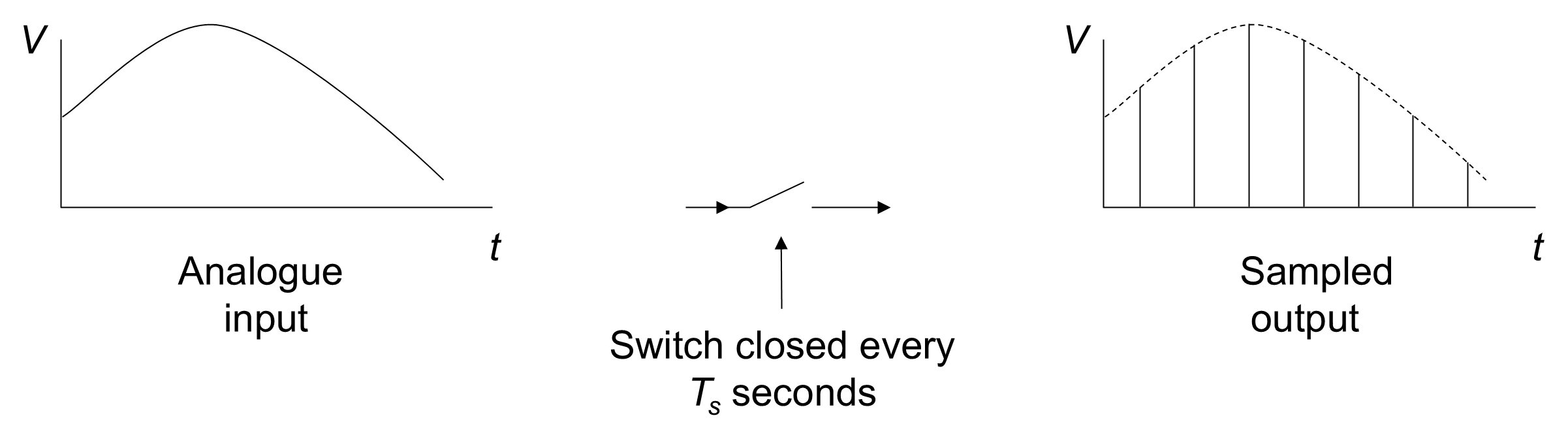
When the input to a voice communication system is an analog signal, it must first be converted into digital form before the advantages of digital transmission can be realized. Analog-to-digital conversion begins by sampling the amplitude of the signal at uniform time intervals. As illustrated in Figure 3.1, a simple sampling arrangement consists of a switch which is closed instantaneously every Ts seconds (corresponding to a sampling frequency of fs=1/Ts). Each time the switch closes, the instantaneous amplitude of the analog waveform at that moment appears at the output as a sampled voltage level.
According to sampling theory, the original analog signal must be sampled at a rate at least twice the highest frequency (fmax) present in the signal being sampled. This condition ensures that the samples contain sufficient information to reconstruct the original waveform without ambiguity. Mathematically:
This minimum sampling rate is known as the Nyquist rate. Sampling below this rate results in aliasing, in which higher-frequency components of the input signal appear as lower-frequency components in the sampled signal, making different signals indistinguishable.
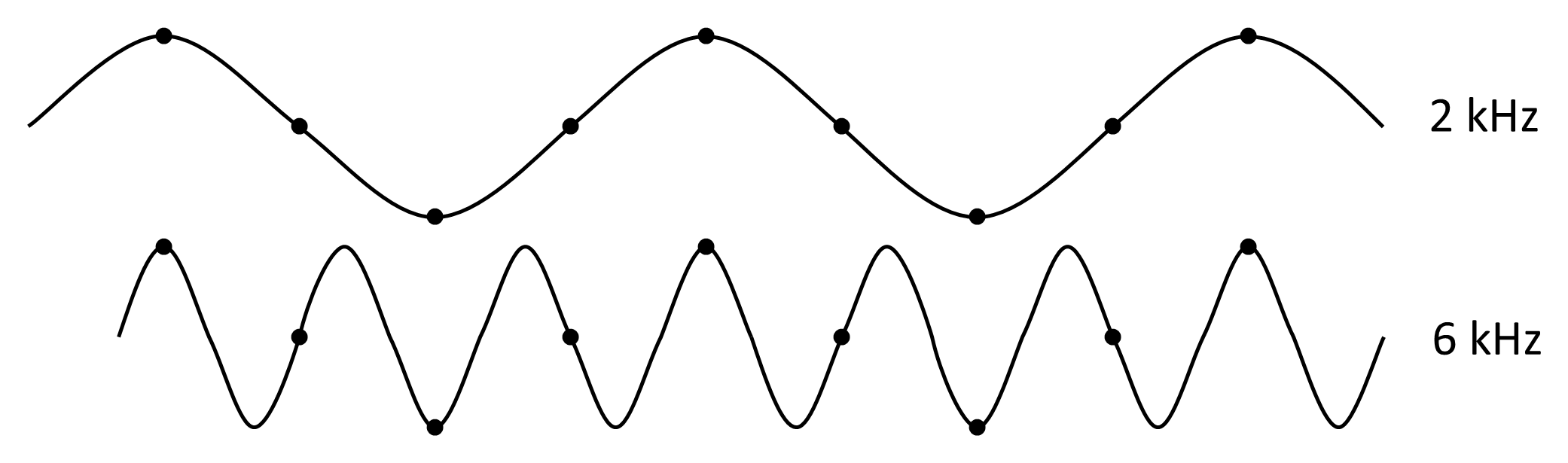
Figure 3.2 illustrates this effect for two sine waves at 2 kHz and 6 kHz sampled at 8,000 samples per second. In both cases, the samples coincide, producing identical sampled values and preventing correct reconstruction of the original waveform.
To prevent aliasing, the input signal is usually passed through an anti-aliasing filter before sampling. This low-pass filter limits the signal bandwidth to below fₛ / 2, ensuring that the Nyquist criterion is satisfied.
Once sampling has been performed at an adequate rate, each discrete sample must be represented by a value chosen from a finite set of amplitude levels—a process known as quantization. Quantization introduces a small error, referred to as quantization noise, which is discussed in Sections 3.2.3 and 3.2.3.3.
Back to reading