
3.2.2 Pulse Modulation Methods
Pulse modulation techniques represent an analog signal using a sequence of discrete pulses whose characteristics vary in accordance with the signal amplitude. Earlier, modulation was defined as the translation of a frequency band from one range to another. In pulse modulation, however, the signal is not translated in frequency but transformed in representation—from a continuous waveform to a discrete-time pulse sequence. Although this does not strictly constitute modulation in the frequency-translation sense, the term is retained by convention.
The most common techniques are: pulse-amplitude modulation (PAM); pulse-duration modulation (PDM); pulse-position modulation (PPM); pulse-code modulation (PCM); and delta modulation (DM). illustrates the first three of these techniques (PAM, PDM and PPM), which are summarized here. PCM is described in detail in Section 3.2.3 and DM is discussed in Section 3.2.4.
- Pulse-amplitude modulation. In PAM, the analog signal is sampled to produce a sequence of pulses whose amplitudes are proportional to the instantaneous amplitude of the input signal. As shown in Figure 3.3, a DC bias is often added so that all pulses remain positive, simplifying circuit implementation. The principal disadvantage of PAM is its susceptibility to additive noise, since the information is conveyed directly by pulse amplitude. In addition, the varying pulse amplitudes result in irregular transmitter power demand, reducing efficiency and complicating power amplifier design. Despite these limitations, PAM is an important intermediate step in PCM systems, where sampled amplitudes are subsequently quantized and encoded.
- Pulse-duration modulation. In PDM—also known as pulse-width or pulse-length modulation—the information is conveyed by the duration of each pulse rather than its amplitude. As shown in Figure 3.3, all pulses have constant amplitude, and only the pulse width varies in proportion to the sampled signal amplitude. Because amplitude does not carry information, PDM is less sensitive to additive noise than PAM. It also allows some degree of operation even if transmitter–receiver synchronization is degraded. However, like PAM, PDM produces irregular power demand, limiting transmitter efficiency.
- Pulse-position modulation. As illustrated in Figure 3.3 all pulses have constant amplitude and duration, and information is conveyed by varying the temporal position of each pulse relative to a reference timing instant. Since neither pulse amplitude nor width carries information, PPM is highly resistant to additive noise. The principal disadvantage of PPM is its strong dependence on accurate timing synchronization. Timing jitter or distortion can obscure pulse positions, making reliable demodulation difficult without precise clock recovery.
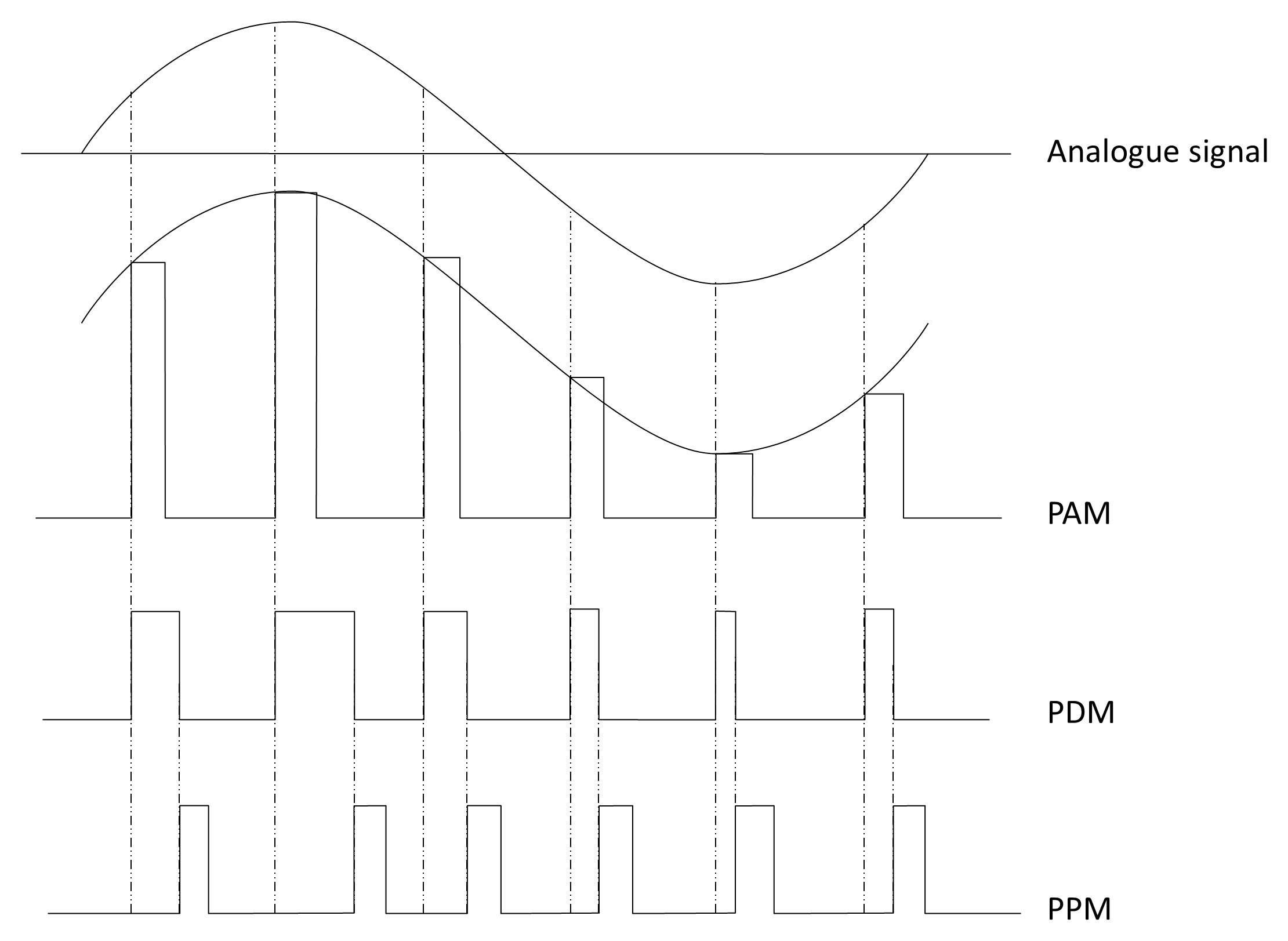
PAM, PDM, and PPM represent progressively refined methods of encoding analog information into pulse form. PAM is simple but highly noise-sensitive; PDM improves noise immunity by encoding information in pulse width; and PPM further enhances robustness by encoding information in pulse timing.
PCM and DM extend these concepts into the fully digital domain, in which pulse characteristics are quantized and represented as binary codewords rather than continuous variations. These techniques form the foundation of practical digital waveform coding and are discussed in detail in the following sections.
Back to reading