
15.4.1 Packet Encapsulation
As information passes through an internetwork, the network-layer packet remains largely unchanged, but the data-link frame surrounding it is replaced at every network boundary.
For example, a packet transmitted from a computer on an Ethernet LAN may be encapsulated within an Ethernet frame. When that frame reaches a router, the router removes the Ethernet header and trailer, examines the IP packet, determines the appropriate outgoing interface, and then encapsulates the same IP packet within a new frame suitable for the next network. The outgoing frame may again be Ethernet, or it may use Wi-Fi, fiber-optic Ethernet, a point-to-point link, or another Layer-2 technology. This process is illustrated conceptually in Figure 15.5 illustrates this process schematically.
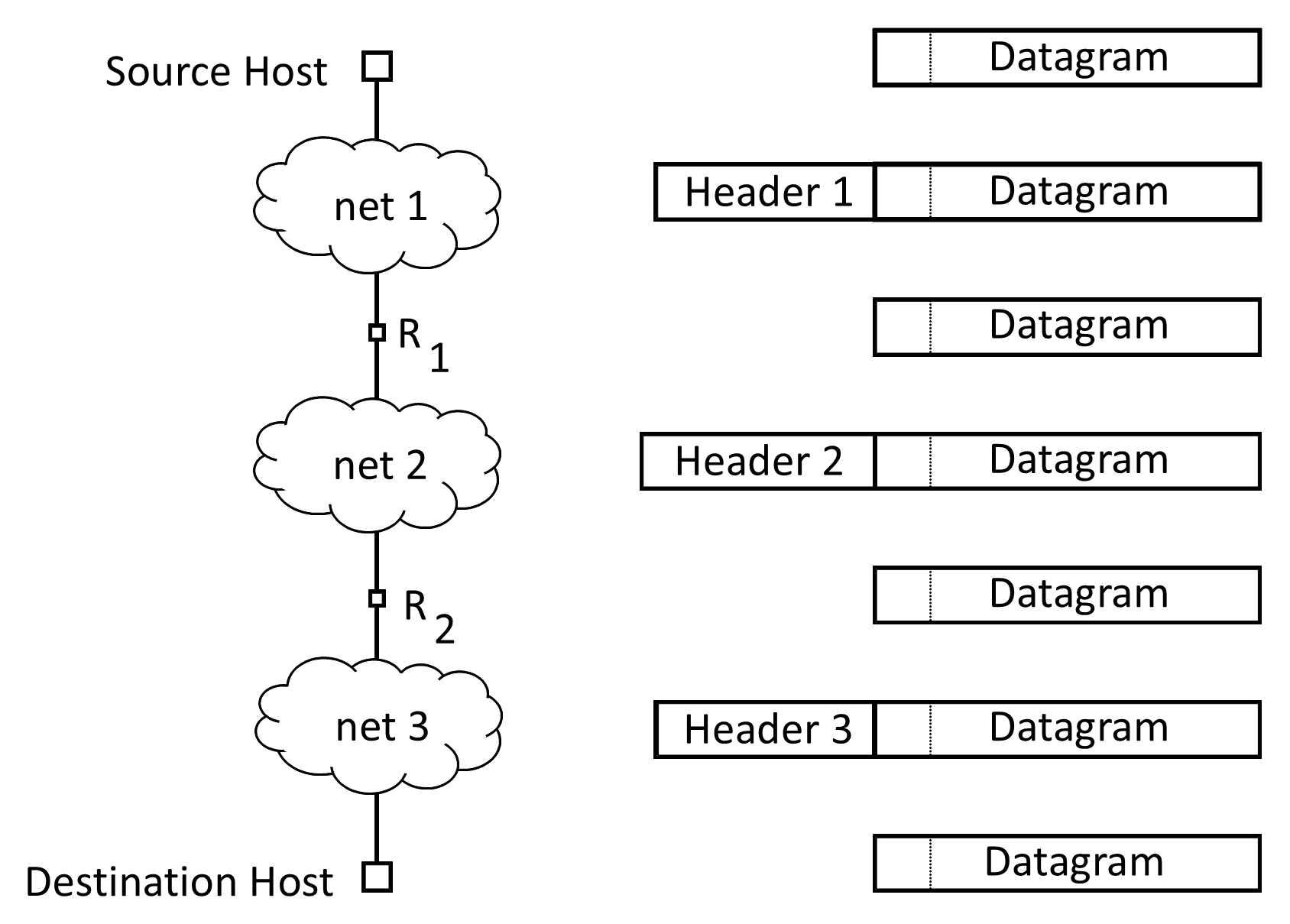
The distinction between Layer 2 and Layer 3 is fundamental. Ethernet, Wi-Fi, and other local networking technologies provide communication only within a single network segment. The Internet Protocol provides the common addressing system that allows packets to move between those networks.
Back to reading