
15.2.5 Architectural Development
Figure 15.1 summarizes the principal devices that emerged as networks evolved from shared media to routed internetworks. Their development reflects practical engineering responses to scaling limitations rather than strict adherence to architectural purity.
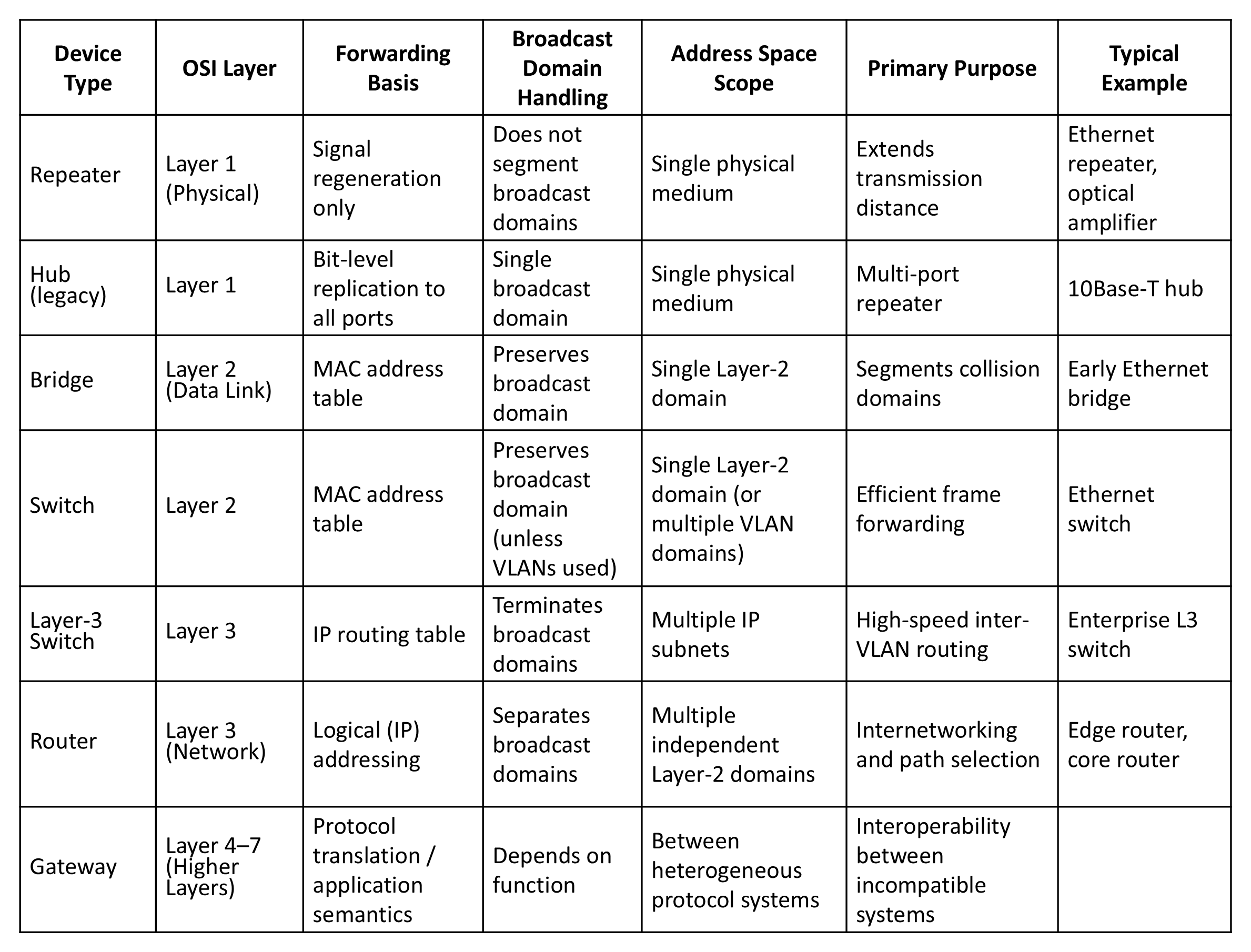
The progression from repeater to bridge to switch to router and gateway reflects the increasing complexity of computer networks as they evolved from small local installations to today's global Internet. Each new device addressed limitations encountered as networks grew in size, performance, and diversity.
Although these devices emerged historically, they also correspond naturally to the layered protocol architecture Figure 15.2 illustrates the highest protocol layer at which each device operates. As the operating layer increases, the amount of protocol information examined by the device also increases, enabling progressively more sophisticated forwarding and translation decisions.
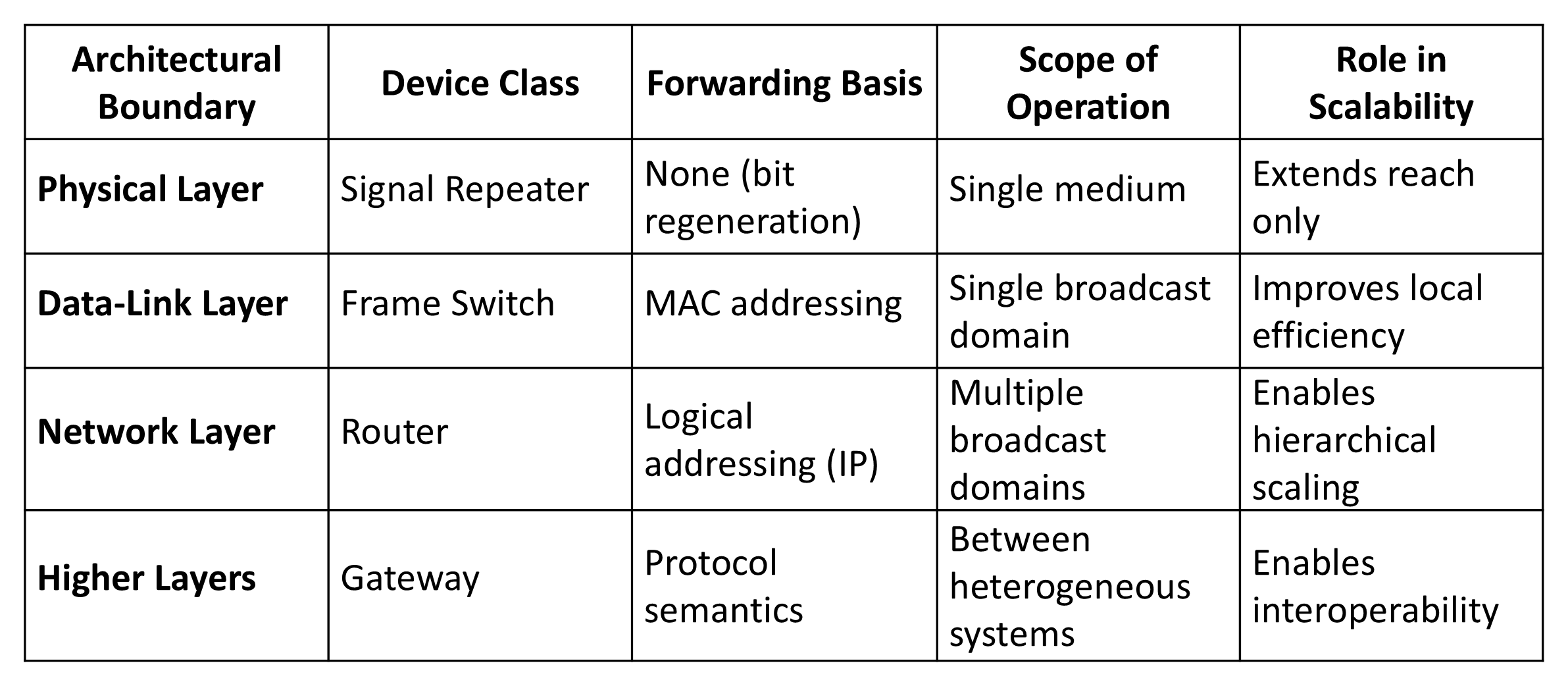
Architecturally, the decisive transition occurs between Layer-2 switching and Layer-3 routing. Switches efficiently forward frames within a single local network using MAC addresses, while routers interconnect independent networks using logical addressing and routing tables. This distinction separates networking within a LAN from internetworking across many interconnected networks.
The following sections examine the Internet Protocol (IP), the addressing schemes that enable internetworking, and the routing techniques that allow packets to travel across the global Internet.
Back to reading