
7.5 ORTHOGONAL FREQUENCY DIVISION MULTIPLEXING (OFDM)
In orthogonal frequency division multiplexing (OFDM) a high bit-rate data stream (such as a digital television bitstream) is time division de-multiplexed into many lower bit-rate streams which are then transmitted simultaneously using frequency division multiplexing (FDM). This technique provides superior noise performance as the symbol periods are longer in each of the lower rate signals.
To demonstrate the effect of using OFDM on the signals that are transmitted over a channel, consider the example shown in Figure 7.15. First consider the time-domain waveform shown at the top left of Figure 7.15. This is an example of the type of waveform that would be transmitted using a QAM digital modulation scheme. In this type of modulation, a set of bits are represented by transmitting a carrier sinusoid with a particular amplitude and phase. The length of time for which the carrier remains at the same amplitude and phase is known as the symbol period, T. The term symbol period is used rather than bit period because each symbol may represent more than one bit. The symbol rate (or baud rate) of this waveform is 1/T symbols/second and the minimum bandwidth required to transmit this signal is (1/T) Hz. The simplified spectrum for the QAM waveform is shown at the top right of Figure 7.15.
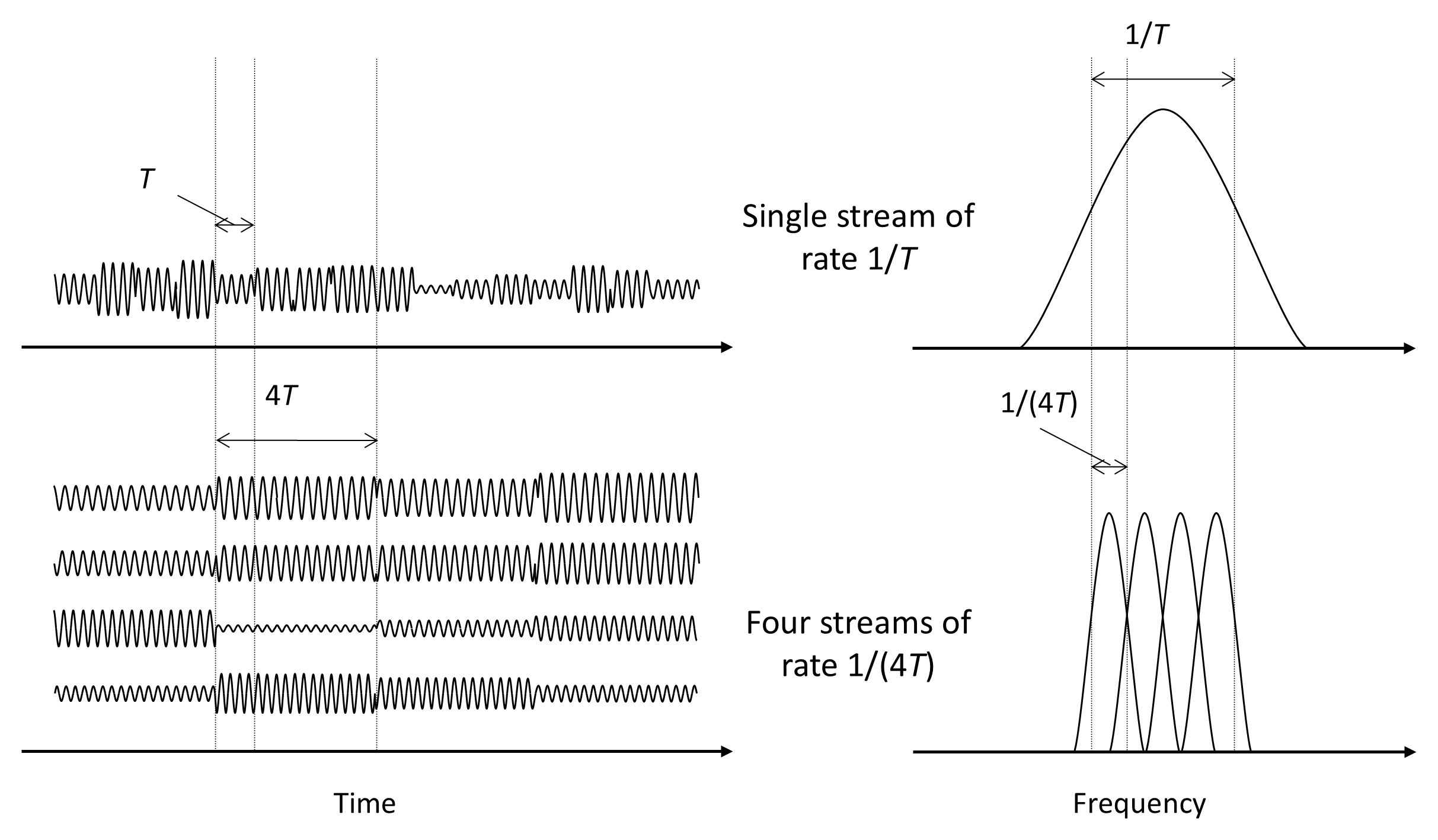
Now consider transmitting the same number of symbols using an OFDM system with four sub-carriers. The waveforms shown at the bottom left of Figure 7.15 illustrate this situation. The same 16 symbols can be transmitted in the same amount of time. However, in the OFDM system, the symbols are transmitted as four symbols using four different sub-carrier frequencies rather than all 16 symbols being transmitted using one carrier. The symbol periods for the symbols on each of the four subcarriers are now four times as long as the symbol periods in the single-carrier system. This longer symbol period is useful for removing the effect of inter-symbol-interference (ISI). Notice also from the simplified spectrum of the OFDM signal shown at the bottom right of Figure 7.15 that the bandwidth required to transmit the OFDM signals has not increased. In fact, the OFDM signal has a more constant power over all frequencies in the channel and therefore makes more efficient use of the available bandwidth.
Back to reading