
7.3.4 SONET And SDH
At higher bit rates, the lack of exact synchronism in PDH necessitates complex justification (bit-stuffing) mechanisms and makes the extraction or insertion of lower-rate channels increasingly inefficient. The widespread adoption of optical fiber transmission, with its vastly greater bandwidth and low attenuation, created both the opportunity and the requirement for a fully synchronous multiplexing framework capable of supporting very high data rates with simplified network management.
To address these requirements, synchronous optical multiplexing standards were developed in the late 1980s. In North America this framework is known as the Synchronous Optical Network (SONET), while internationally it is standardized as the Synchronous Digital Hierarchy (SDH). Although defined by different standards bodies, SONET and SDH are technically aligned and interoperable.
Unlike earlier TDM hierarchies, SONET and SDH employ a single, network-wide timing reference so that all multiplexed signals are frequency-locked. This fully synchronous operation eliminates the need for extensive bit stuffing and greatly simplifies multiplexing, demultiplexing, and the direct access to lower-rate tributaries within high-rate streams. Because lower-rate tributaries are byte-aligned within a globally synchronized frame, they can be accessed without full demultiplexing.
SONET defines a family of optical carrier (OC-N) signals, where N denotes an integer multiple of the basic OC-1 rate of 51.84 Mbps. SDH defines equivalent STM-N signals, with STM-1 corresponding closely to OC-3. Typical SONET line rates and their equivalent capacities in terms of 64-kbps channels are summarized in Figure 7.13.
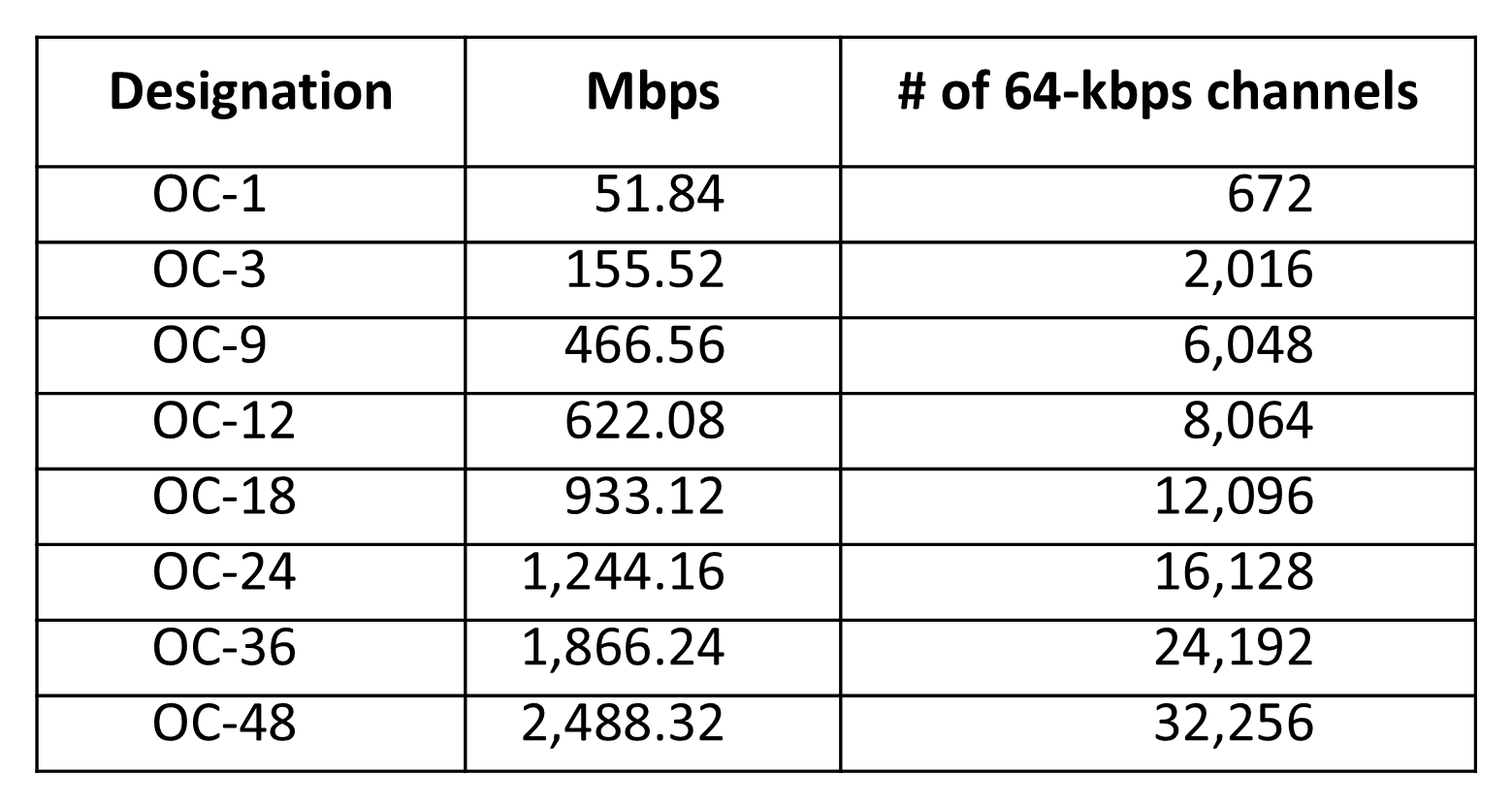
Conceptually, SONET and SDH can be viewed as synchronous extensions of time-division multiplexing optimized for optical transmission. Rather than interleaving individual voice channels directly, complete lower-rate digital streams are multiplexed into higher-rate optical frames with precise timing alignment.
This architecture enables efficient add/drop multiplexing, rapid reconfiguration, and standardized protection and restoration mechanisms, making SONET and SDH well suited to long-haul and metropolitan fiber-optic networks. These systems formed the backbone of global digital transport networks for several decades and continue to underpin many modern packet-based transmission systems.
Although SONET and SDH dramatically increased transmission capacity through fully synchronous time-division multiplexing over optical fiber, further growth in network demand required techniques capable of exploiting the enormous spectral bandwidth available within a single fiber strand. This led to the development of wavelength-division multiplexing, in which multiple optical carriers coexist simultaneously within the fiber’s low-loss transmission window.
Back to reading