7.4 WAVELENGTH DIVISION MULTIPLEXING
Wavelength-division multiplexing (WDM) is a form of frequency-division multiplexing applied to optical fiber systems. Instead of assigning different electrical frequency bands to different users, WDM assigns different optical wavelengths (or equivalently optical frequencies) to independent data channels. Multiple optical carriers, each operating at a distinct wavelength, are combined onto a single fiber, transmitted simultaneously, and separated again at the receiver by wavelength-selective devices. In effect, each wavelength behaves as an independent transmission channel sharing the same physical medium.
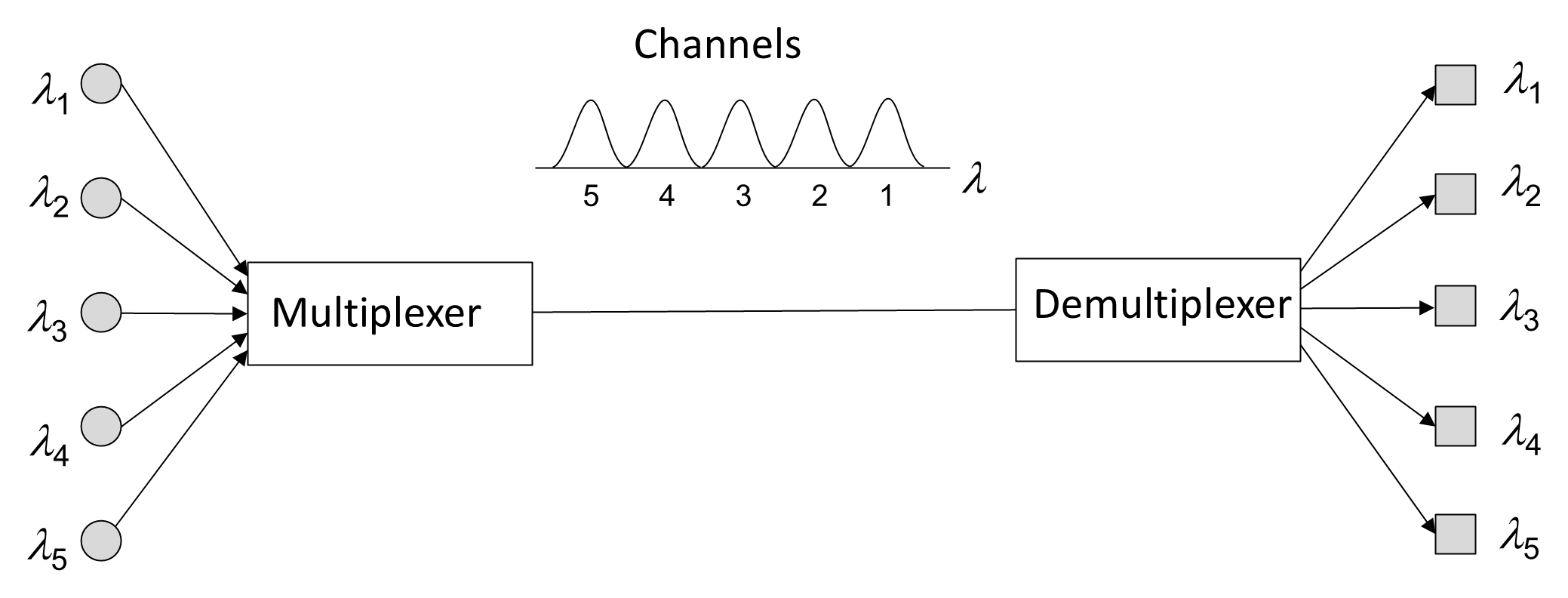
The principle is illustrated conceptually in Figure 7.14. Separate transmitters generate optical carriers at wavelengths l1, l2, l3, …, each modulated with an independent data stream. An optical multiplexer combines these wavelengths into a composite optical signal. At the far end, a demultiplexer separates the wavelengths and directs each to its corresponding photodetector and receiver.