2.3.8 Serial / Parallel Transmission
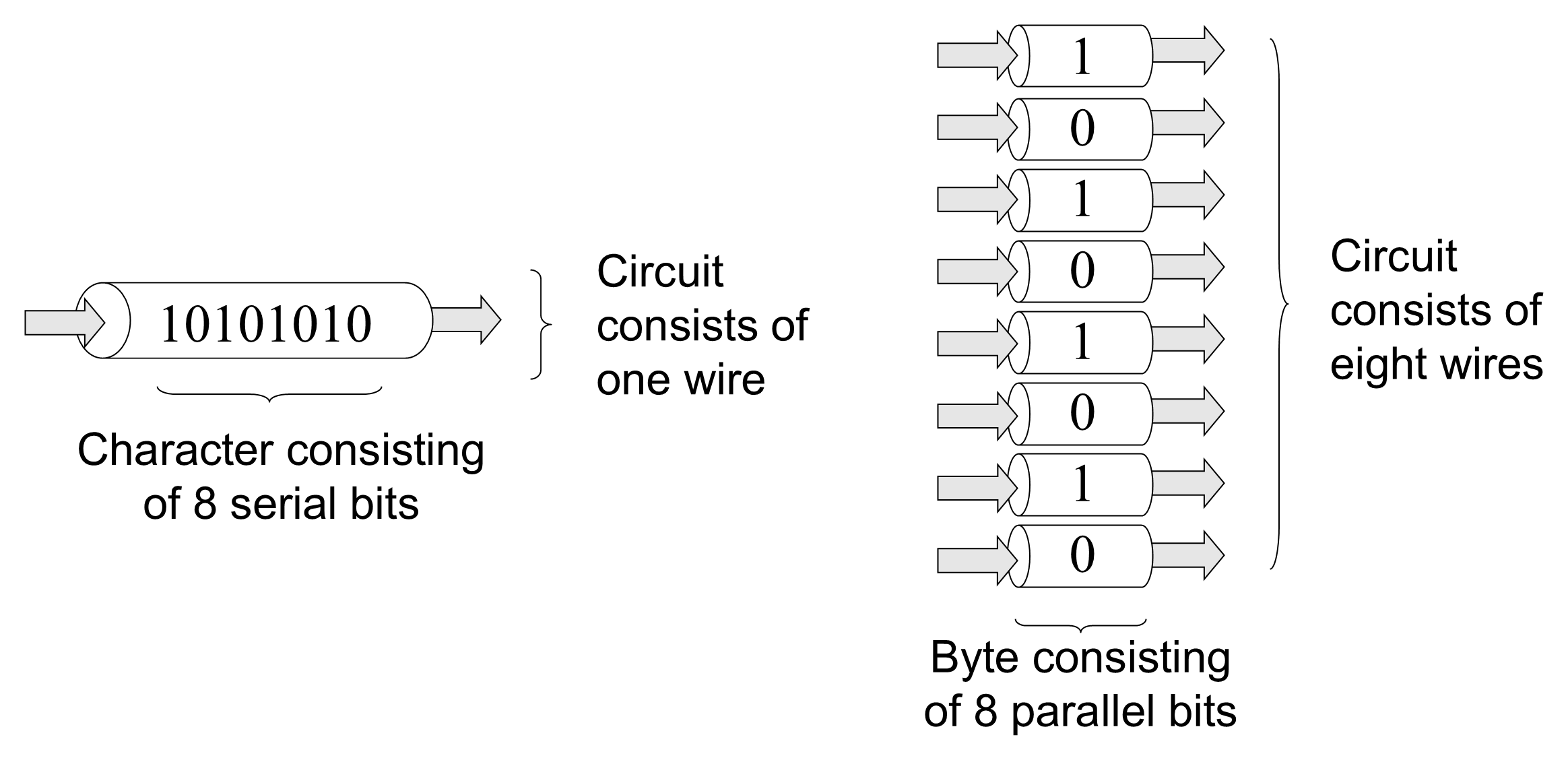
Data transmission can also be broadly categorized as serial or parallel, depending on how individual bits are conveyed from a source to a destination. In serial transmission, as illustrated in Figure 2.33(a), bits are sent sequentially, one after another, over a single communication path. Although this may seem slower in principle, serial transmission is highly efficient and robust, particularly over long distances or at high data rates. Modern serial links exploit very high symbol rates and sophisticated encoding and clock-recovery techniques, making them the dominant approach in most contemporary communications systems, from long-haul fiber-optic links to satellite and wireless networks.
In parallel transmission, as illustrated in Figure 2.33(b) for an 8-bit byte, multiple bits are transmitted simultaneously over separate, parallel paths—each path carrying one bit of a multi-bit byte. This approach can achieve high throughput over short distances and was historically common in internal computer buses and peripheral interfaces. However, parallel transmission becomes increasingly problematic as data rates and distances grow, due to issues such as timing skew, crosstalk, and electromagnetic interference between adjacent paths. As a result, parallel transmission is now largely confined to short, tightly controlled interconnections, while serial transmission is preferred for most external, high-speed, and long-distance data links.