
2.3.4 Baseband Digital Signals And Noise
When analog signals propagate through a communication channel, they are attenuated and degraded by noise and interference. While attenuation can be compensated by amplification, noise and interference are amplified along with the signal. Consequently, there is a practical limit to the number of amplifiers that can be cascaded before the signal becomes unusably distorted.
At first glance, digital signals appear equally vulnerable, since they are also analog waveforms that experience attenuation and noise. However, digital signals are far less sensitive to distortion because information is not conveyed in the precise instantaneous waveform but rather in the average value of the waveform over a bit or symbol period. In an analog signal, information is encoded in small variations of amplitude, frequency, or phase; any distortion directly corrupts the information. In a digital signal, by contrast, information is represented by the average signal level over a bit or symbol interval.
As long as the receiver can still distinguish between logical levels, the original digital information can be recovered without error. This is achieved through regeneration, in which the received waveform is compared with a threshold and reshaped into clean, ideal pulses. The process can be repeated at regular intervals along a transmission path, effectively preventing the accumulation of noise.
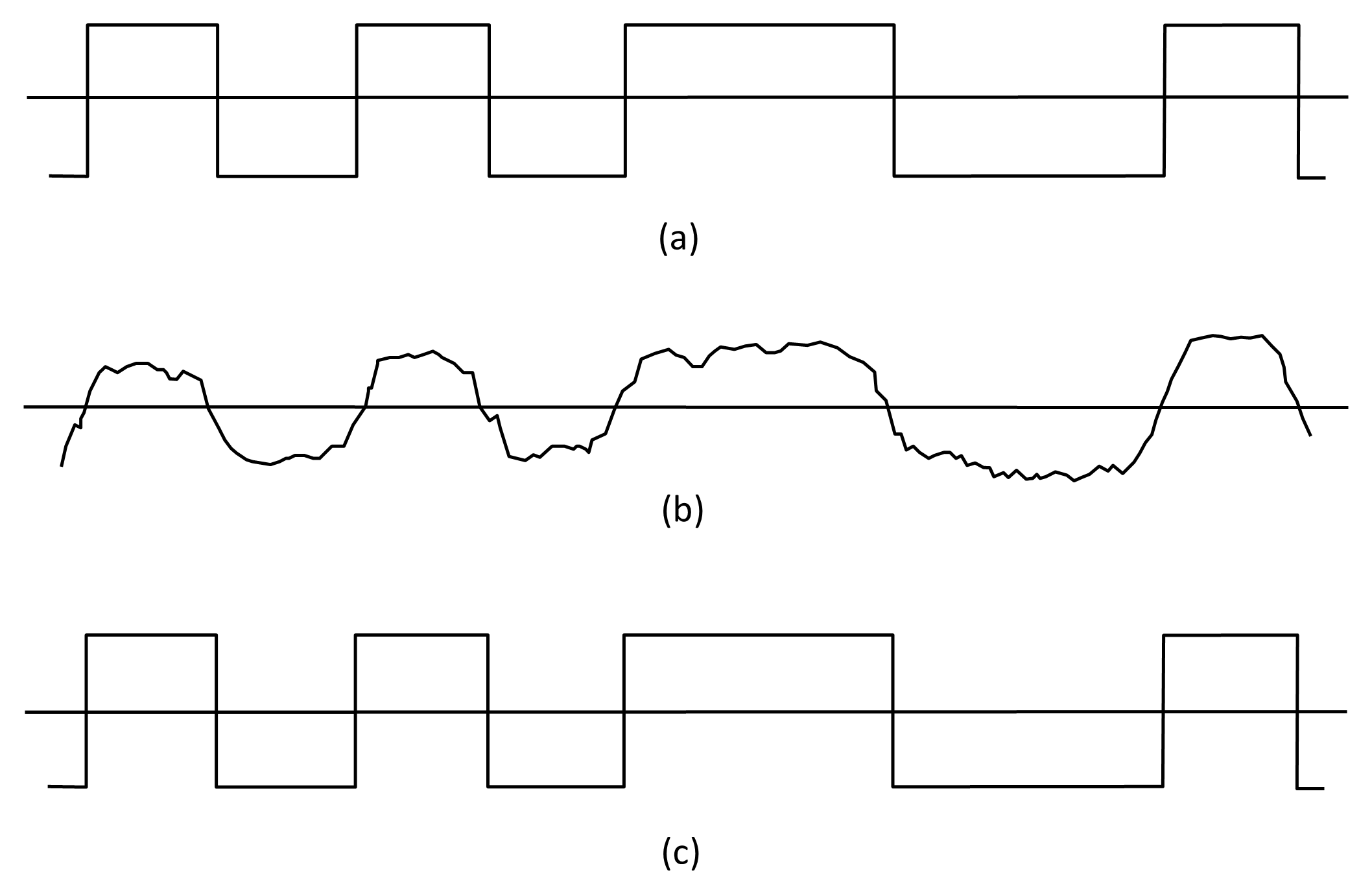
Figure 2.30 illustrates this concept: Figure 2.30 (a) shows the original transmitted waveform, Figure 2.30 (b) shows the same signal after attenuation and noise, and Figure 2.30 (c) shows how a regenerative repeater can perfectly reconstruct the signal, provided the logical states remain distinguishable. This ability to restore digital signals to their ideal form underpins the reliability and scalability of modern digital communication systems, from local networks to undersea optical links.
Baseband channel limitations. The channel cannot support an infinite data rate. Rather, signaling speed in a given channel is limited by two key factors: the channel bandwidth that is available, and the noise that is added to the signal. For a noiseless baseband channel, the Nyquist criterion defines the maximum symbol rate imposed by bandwidth alone. When noise is present—as it always is in real systems—the ultimate limit on information transfer is given by the Shannon–Hartley theorem:
This expression shows that channel capacity increases with bandwidth and signal-to-noise ratio (SNR), but neither can be increased indefinitely in practice.
Back to reading