
2.3.7 Asynchronous Transmission / Synchronous Transmission
Data transmission can be either asynchronous or synchronous depending on whether the source and the sink share a common view of timing.
In asynchronous communication, each block or character of data is sent independently, and there may be significant idle intervals between blocks. Because the receiver’s clock is not continuously synchronized with the transmitter’s clock, it must be assisted in identifying where each block begins and ends. This is achieved by adding framing bits—a start bit at the beginning and a stop bit at the end of each character or block.
Asynchronous transmission has the advantage of simplicity and is well suited to intermittent or low-speed links, such as computer terminals and legacy serial connections (for example, RS-232). However, the additional overhead of start and stop bits introduces inefficiency, making asynchronous transmission unsuitable for high-speed data links or continuous data streams.
In synchronous transmission, the source and sink operate with clocks that are kept continually synchronized, so that only a small number of synchronization (sync) pulses or timing characters are required. Data is transmitted in large, continuous blocks or frames without start and stop bits for every character. Because synchronization is maintained by clock recovery circuits or periodic synchronization sequences, the overhead is much lower than in asynchronous systems, and much higher data rates can be achieved.
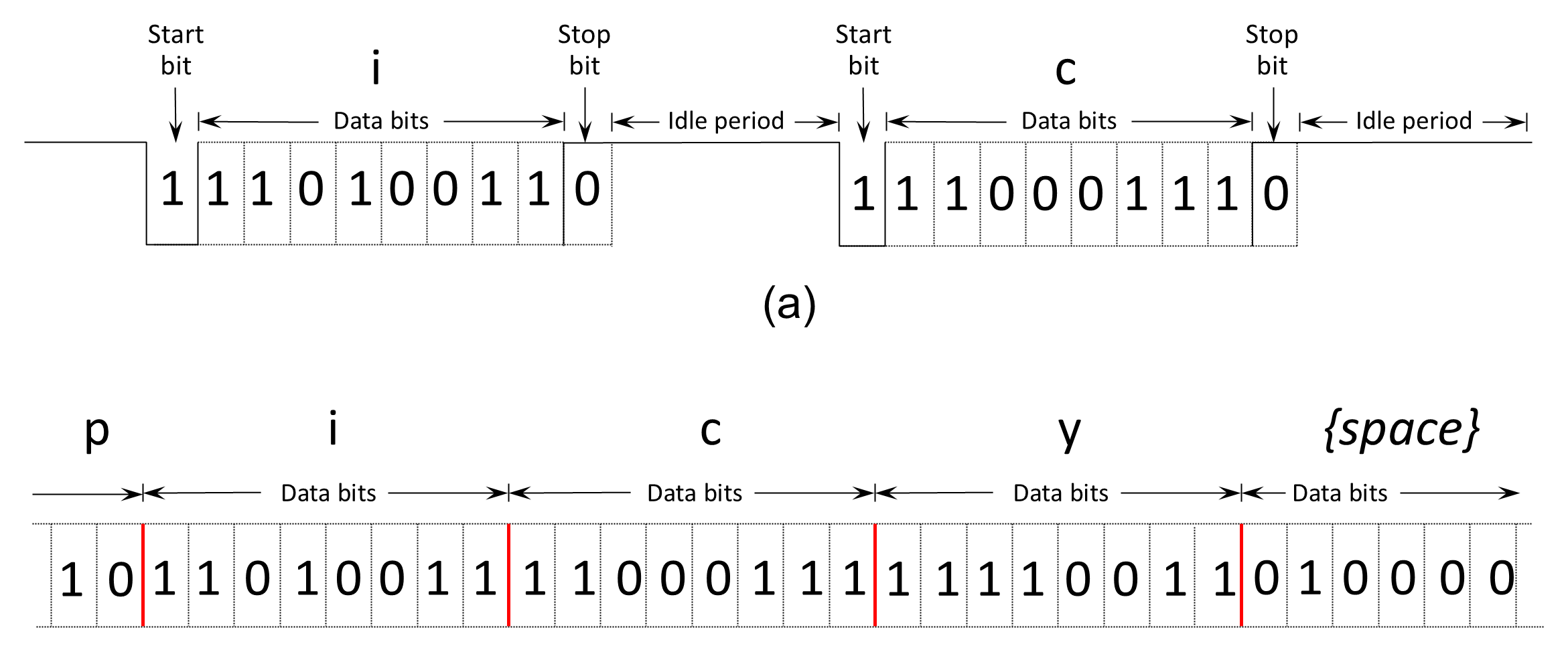
Figure 2.32 illustrates asynchronous and synchronous transmission methods for eight-bit blocks. Figure 2.32 (a) shows the asynchronous case, where each 8-bit character is preceded by one start bit and followed by one stop bit. Any number of start and stop bits may be used, but the more that are included, the greater the overhead. The one-start/one-stop configuration illustrated represents the minimum asynchronous framing overhead of 2 bits per 8-bit character, or 20%, meaning that the maximum information rate is 80 % of the gross data rate.
By contrast, Figure 2.32 (b) shows the synchronous case, where data blocks are transmitted back-to-back, allowing nearly full utilization of the available bandwidth. Synchronization is achieved by extracting the shared clock from the incoming data stream, that had been embedded by the transmitter in the data sequence via a form of line coding (see Appendix D) before transmitting.
Well-known examples of asynchronous transmission include classic serial interfaces based on the universal asynchronous receiver–transmitter (UART). Legacy computer ports such as RS-232, RS-422, and RS-485 operate asynchronously, framing each character with start and stop bits and allowing arbitrary idle periods between characters. Early computer terminals, dial-up modems, teletypewriters, and simple embedded systems commonly used these interfaces. Even today, asynchronous serial links remain widespread in low-speed or intermittent applications such as industrial control, instrumentation, and microcontroller debugging, where simplicity and tolerance to irregular data timing are more important than spectral efficiency.
By contrast, most modern high-speed communication systems employ synchronous transmission. Local area networks such as Ethernet transmit data in continuous frames, with synchronization maintained through preambles and clock recovery at the receiver. Optical transport systems such as synchronous optical networking (SONET/SDH)—see Chapter 7—are explicitly designed around globally synchronized framing structures. High-speed peripheral interconnects—including USB, SATA, PCI Express, and memory buses—also rely on synchronous or mesochronous operation, using embedded clocks, training sequences, or periodic synchronization symbols to maintain alignment between transmitter and receiver. In digital broadcasting, cellular systems, and satellite communications, synchronous framing is essential to support continuous high-rate data streams with minimal overhead.
Back to reading