
2.3.6 Information Rate
In addition to understanding the rate at which data or symbols are transmitted, it is also important to consider the information rate—that is, the rate at which useful information is transferred from the source to the sink. It is quite rare for the information rate to be the same as the signaling or data rate, because some portion of the transmitted data is used for control or management rather than information content.
For example, consider a link operating at a data rate of 50 bits per second (bps). The signaling rate describes how many bits per second are transmitted, but it does not necessarily describe how fast information is being delivered, since some of those bits may be used for synchronization, framing, error detection, or other protocol functions. We will examine these in later chapters, but for now, consider the simple hypothetical data frame illustrated in Figure 2.31.
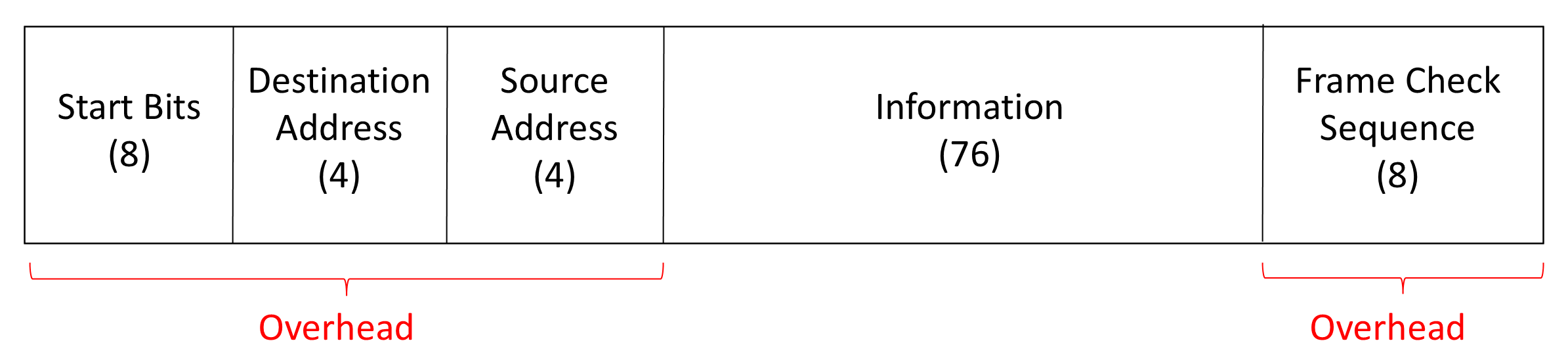
In total, there are 100 bits to be transmitted at our transmission rate of 50 bps, which will take two seconds. Only 76 bits of the frame contain information, however, since the remaining bits are required to ensure that the information bits arrive. This additional overhead data is essential but does not contain any information. In the two seconds that it takes to transmit the 100 bits of data, only 76 bits of information is sent, so that the information rate is only 38 bps (even though the transmission rate is 50 bps).
This example illustrates that specifying only the transmission rate of a channel—whether in bits per second (bps) or baud—is not sufficient to describe how efficiently information is being transferred between the source and the sink. The information rate depends on the protocol overhead and the efficiency of the transmission method used. In practical systems, the information rate is therefore lower than the raw transmission rate, and in some cases, it may be less than half.
Back to reading