2.3.1 Baseband Digital Signals
Within digital devices, logical states may be represented by voltage levels such as 0 V for a logical ‘0’ and +2 V for a logical ‘1’. Such unipolar signals are poorly suited to transmission through communication channels because they possess a non-zero average (DC) value. This would require channel components—such as transformers or coupling capacitors—to operate down to DC, which is impractical in most systems.
To avoid this problem, digital signals are commonly transmitted using polar line codes, in which positive and negative voltage levels are used so that the average signal value is zero. One widely used example is polar non-return-to-zero (NRZ) encoding. Other baseband line codes, such as Manchester encoding, deliberately include a transition within each bit period to assist receiver synchronization. A range of line coding techniques is described in Appendix D. For simplicity, we focus here on polar NRZ baseband signaling.
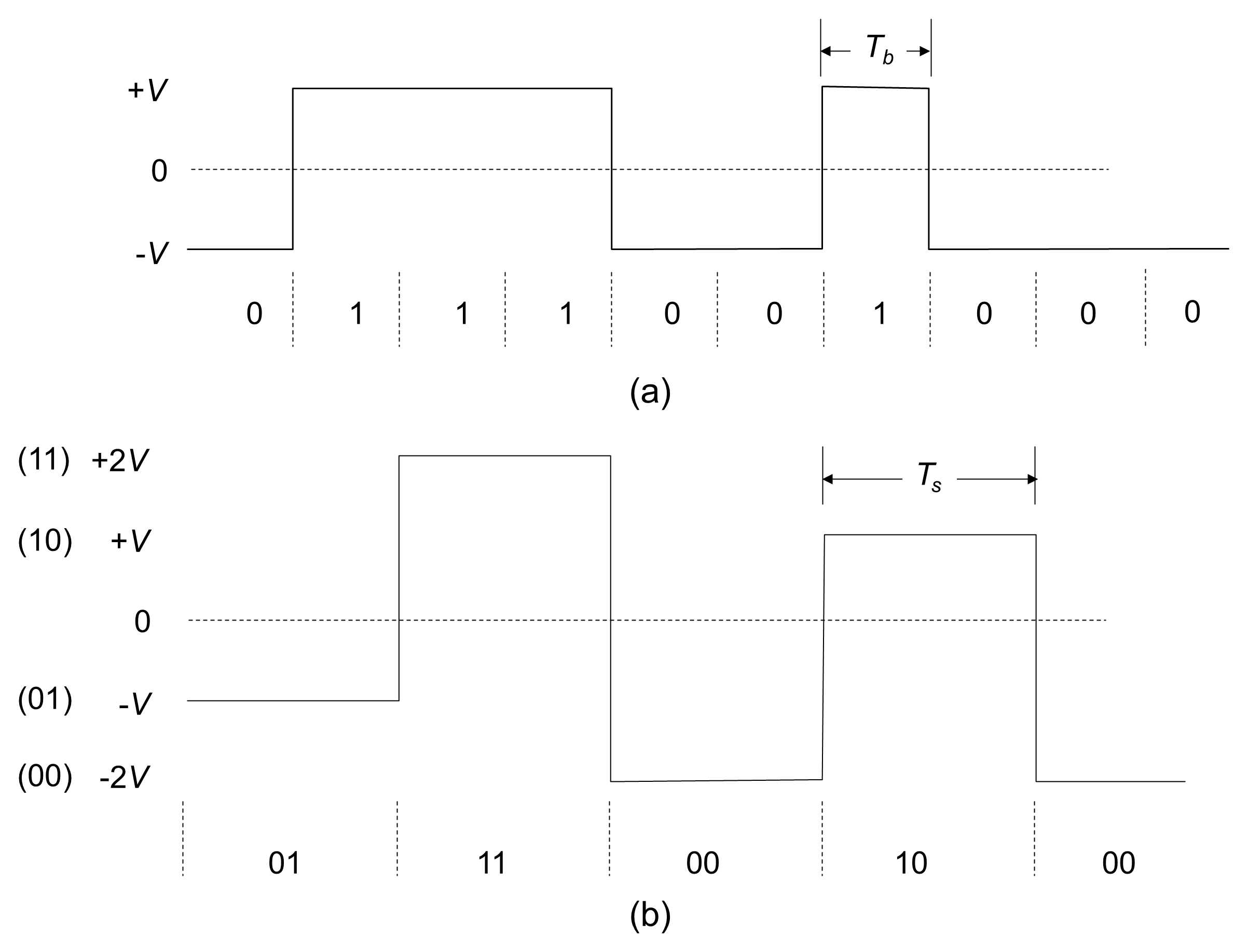
Figure 2.24 illustrates two examples of baseband digital signaling. Figure 2.24(a) shows a binary signal in which a logical ‘1’ is represented by +V volts and a logical ‘0’ by −V volts. Figure 2.24(b) shows a quaternary signal with four distinct voltage levels, each representing one of the two-bit symbols ‘00’, ‘01’, ‘10’, or ‘11’. Signals with M distinct levels are generically referred to as M-ary signals.
The binary signal in Figure 2.24(a) has a bit period of Tb seconds and a corresponding bit rate of:
The quaternary signal in Figure 2.24(b) has a symbol period of Ts seconds and therefore has a symbol rate of:
The symbol rate is often called the baud rate, named after Emile Baudot. Because each quaternary symbol represents two bits the bit rate is twice the symbol rate or, the symbol rate is half the bit rate. For the same bit rate, therefore the quaternary signal therefore requires only half the symbol rate—and, correspondingly, less bandwidth—than the binary signal.
In general, an M-ary signal conveys:
bits per symbol. The symbol period is therefore:
and the symbol (baud) rate, is:
Although higher-order signaling reduces symbol rate, it generally requires a higher signal-to-noise ratio for reliable detection. We discuss these issues further in Chapter 6.