2.2.7 Filtering
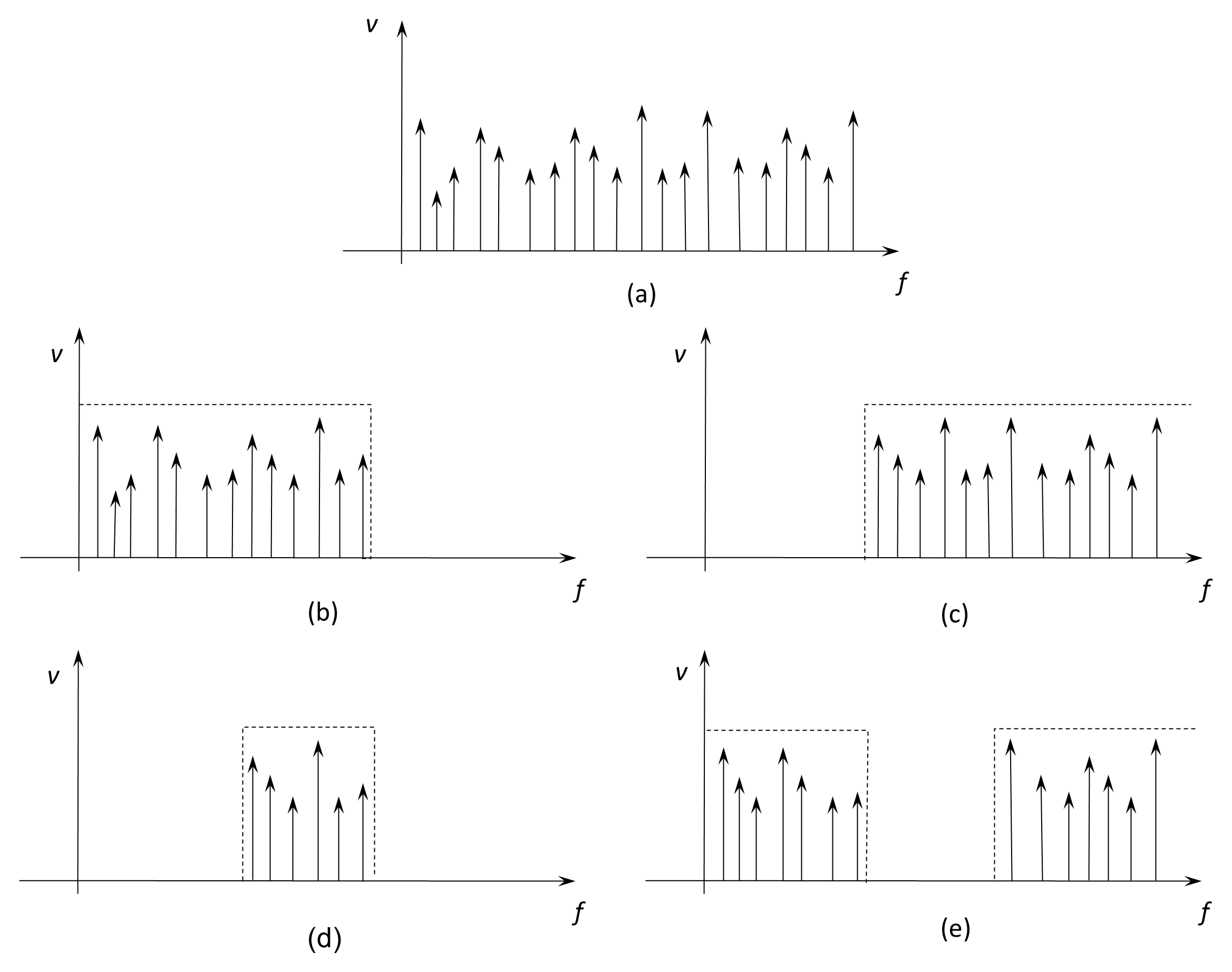
In many cases, we may not wish to transmit or process the entire range of frequencies generated by a source. To select a specific portion of the frequency spectrum, we use a filter—an electronic circuit that passes certain frequencies while attenuating or rejecting others. For example, Figure 2.20(a) shows a range of frequency components in a transmitted signal. Figure 2.20 (b) illustrates the effect of a low-pass filter (LPF), which passes only the lower frequencies and suppresses the higher ones. Conversely, a high-pass filter (HPF), shown in Figure 2.20 (c), passes the high frequencies and rejects the low ones. Bands of frequencies can also be selected or suppressed using a band-pass filter, as illustrated in Figure 2.20 (d) and a band-stop (notch) filter as in Figure 2.20 (e).
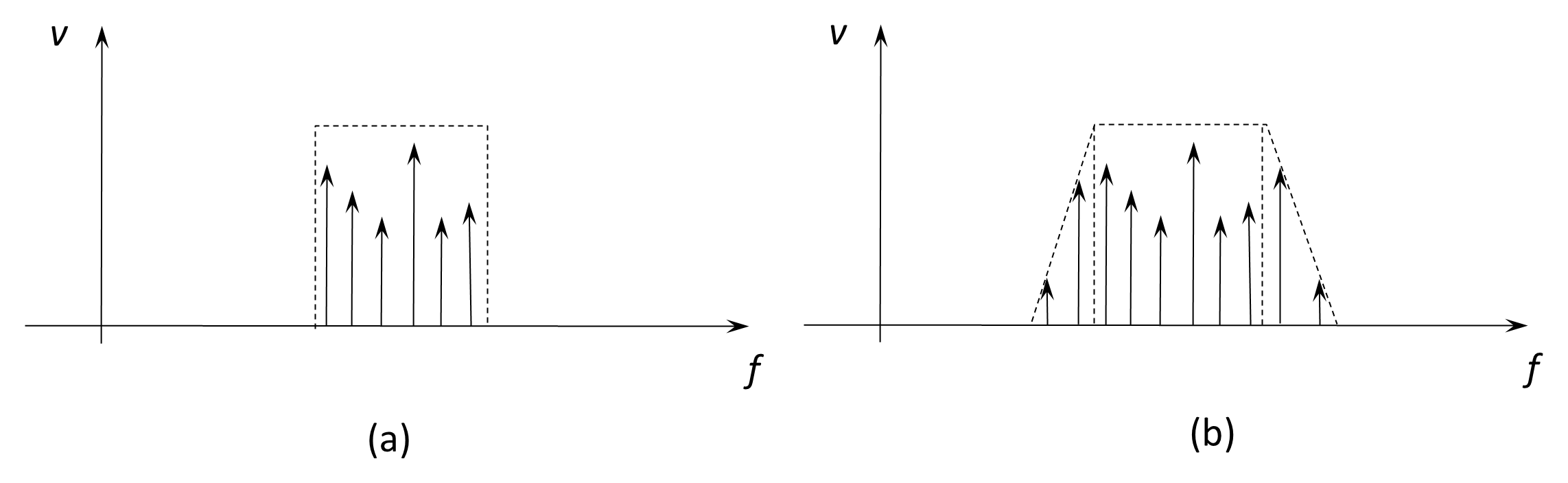
Although the ideal filter would have a perfectly sharp transition between the passband and stopband (a vertical response at the cut-off frequency), perfect filters cannot be realized in practice. Real filters exhibit a roll-off region within which attenuation increases gradually rather than instantaneously. As a result, some unwanted frequency components are partially passed at reduced amplitude. Figure 2.21(a) illustrates a perfect band-pass filter response, while Figure 2.21 (b) shows the response of a practical filter with finite roll-off.