
2.2.6 Speech Signals
Sound waves are produced by the compression and rarefaction of air molecules as an object moves through the air. When we speak, our vocal folds (or vocal cords), throats, mouths, and tongues act together to generate complex combinations of sine waves within the audio-frequency range. Each combination corresponds to the sound of a vowel or consonant, and their successive combination forms words. The vocal folds vibrate to produce the fundamental tones of speech, the frequency of which is determined by their vibration rate. The amplitude (or loudness) of the sound depends on the force with which air is expelled from the lungs, while the resonant shape of the mouth, tongue, and lips controls the tone and timbre of the sound.
The sounds of speech occupy frequencies primarily within the voice frequency (VF) band 100 Hz to 10 kHz, although the human ear can perceive sounds in the audio frequency (AF) range from roughly 20 Hz to 20 kHz. Although speech frequencies extend to 10 kHz as shown in the time domain in Figure 2.19(a), most of the intelligible energy lies between 300 Hz and 3,400 Hz, as illustrated in Figure 2.19(b). This range is normally regarded as the useful range of voice frequencies (commonly called the voiceband), with 3,400−300 Hz = 3.1 kHz bandwidth.
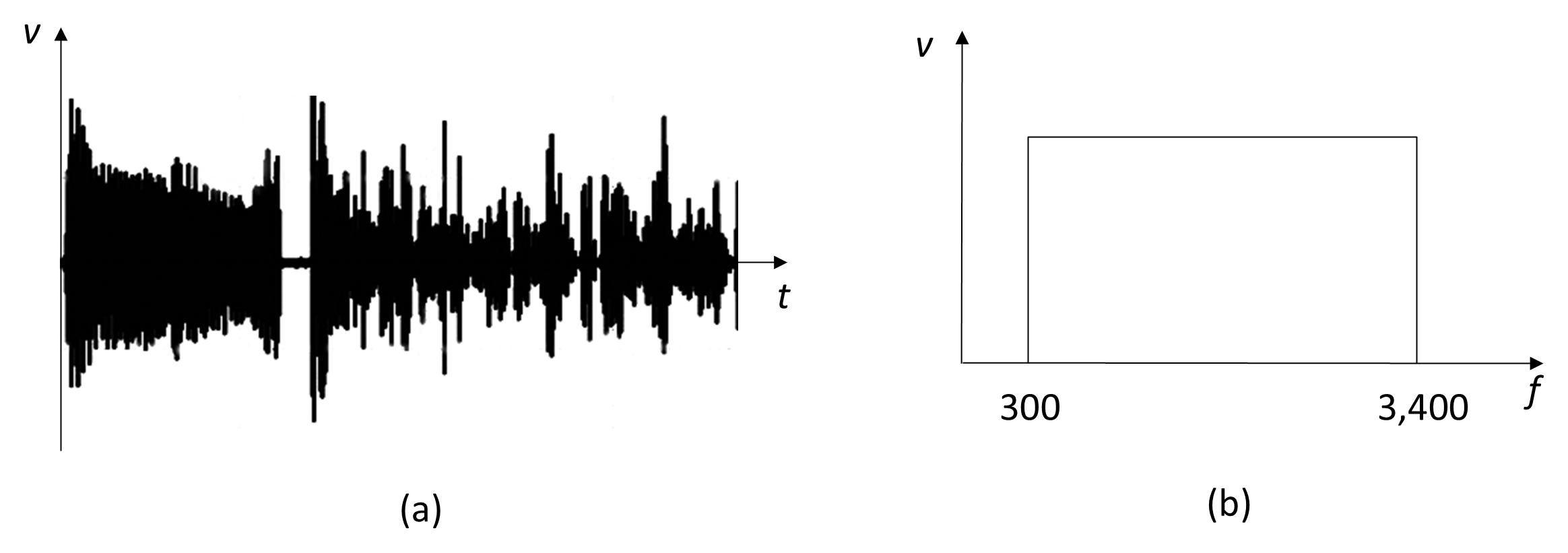
If necessary, the useful range of speech frequencies can be restricted further because the principal components of intelligible speech are concentrated in two regions: 300–900 Hz, containing the lower-frequency vowel sounds that carry most of the power; and 2,000–2,200 Hz, containing the higher-frequency consonant sounds that contribute most to intelligibility. Although it is not practical to transmit only these minimal frequency bands, recognizing where these components occur is valuable in designing systems for speech coding, bandwidth limitation, and voice-channel transmission.
It should be noted that when we are considering the bandwidth required for a communication system to suit human sources and sinks we need to consider the appropriate frequency ranges. If the system is just to suit voice conversation, then the appropriate band is VF (and even then, the 3.1 kHz subset from 300 Hz and 3,400 Hz); if, however, the system is to support the broader range of those frequencies that a human can hear (such as the full range of orchestral music) then AF is the appropriate band.
Back to reading