2.2.3 The Frequency Domain
We have seen that an electromagnetic wave can be expressed as a sinusoidal function of either the distance travelled or the time taken to travel that distance. We also noted that the frequency of the wave is one of its most important characteristics and therefore that the frequency components of a wave are of most interest to us. It is therefore often more useful to examine the waveform in the frequency domain rather than in the time domain.
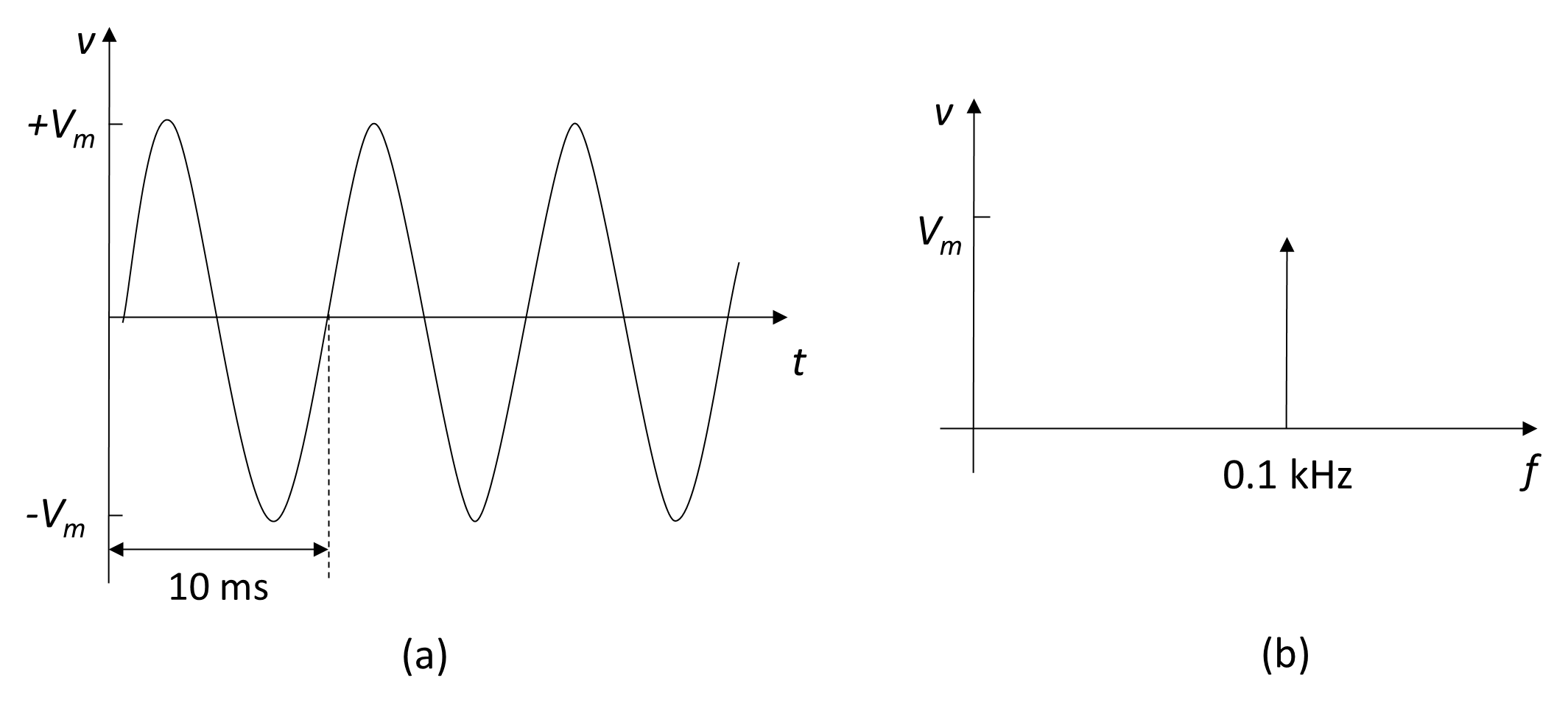
In the frequency domain, a single sine wave is represented as a spike of appropriate amplitude at its corresponding frequency. This is illustrated in Figure 2.11 where a sine wave with a period of 1 ms (and therefore a frequency of 0.1 kHz) is shown in (a) the time domain and (b) the frequency domain. In the frequency-domain view, a single-frequency sine wave appears as a single spike of amplitude Vₘ located at 0.1 kHz on the frequency axis. Even this simple illustration shows the utility of the frequency domain in being able to describe the salient features of the sine waves in a much simpler form.
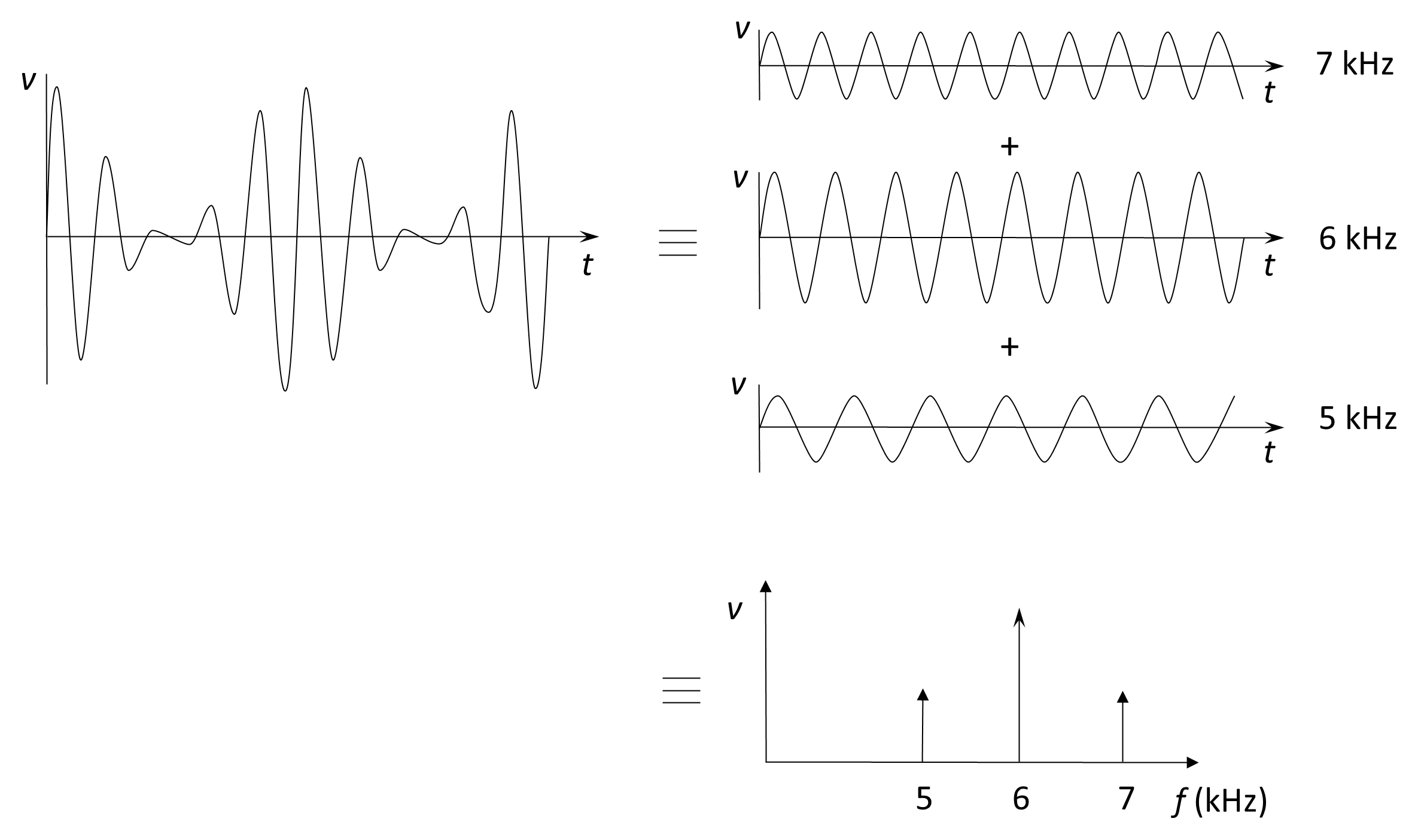
The frequency-domain representation is even more useful for signal analysis in terms of being able to examine complicated signals can be represented as combinations of sine waves—something that is difficult to visualize in the time domain. For example, Figure 2.12 shows how the complex waveform in Figure 2.9 (repeated in Figure 2.12(a)), which was expressed as a sum of a number of sine waves in the time domain (repeated in Figure 2.12(b)), can now be represented more much conveniently in the frequency domain in Figure 2.12(c).
2.2.3.1 Example Square-Wave Waveform In The Time Domain And Frequency Domain
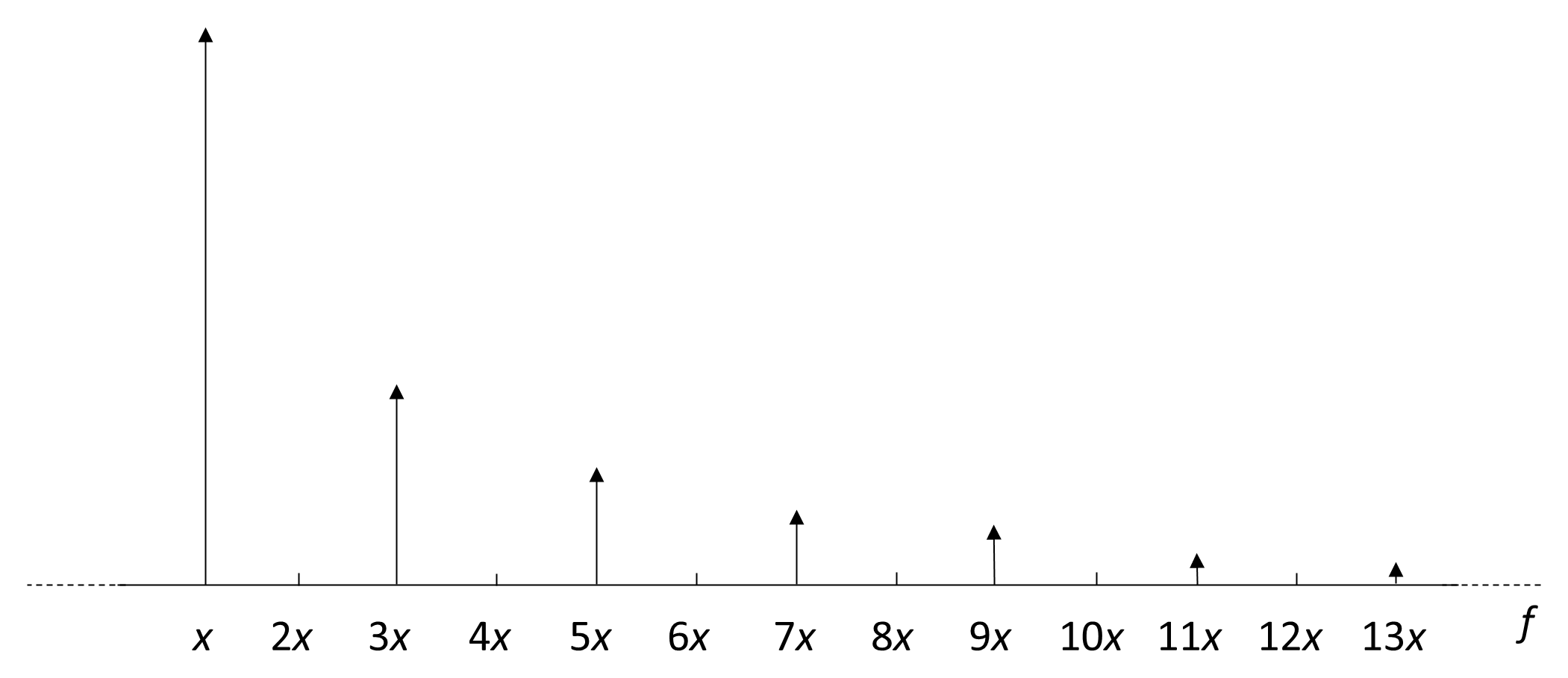
One of the waveforms we will consider when discussing digital signals is the square wave. It is worth introducing here because it is a good illustration of the relationship between the time and frequency domains but also of how a complex waveform is the sum of simple sine waves—in this case, the sum of the odd harmonics of a sine wave. Mathematically, the sum can be written as a Fourier series:
or more completely by the summation:
Figure 2.13 illustrates how the summation produces a square wave, by showing: (a) the fundamental (black) plus the one-third of the third harmonic (red) and their sum (blue), (b) this blue sum now in black plus the one-fifth of the fifth harmonic (red) to their sum (blue), (c) this blue sum now in black plus the one-seventh of the seventh harmonic (red) to their sum (black) and (d) the complete waveform once approximately twenty harmonics have been included in the summation.
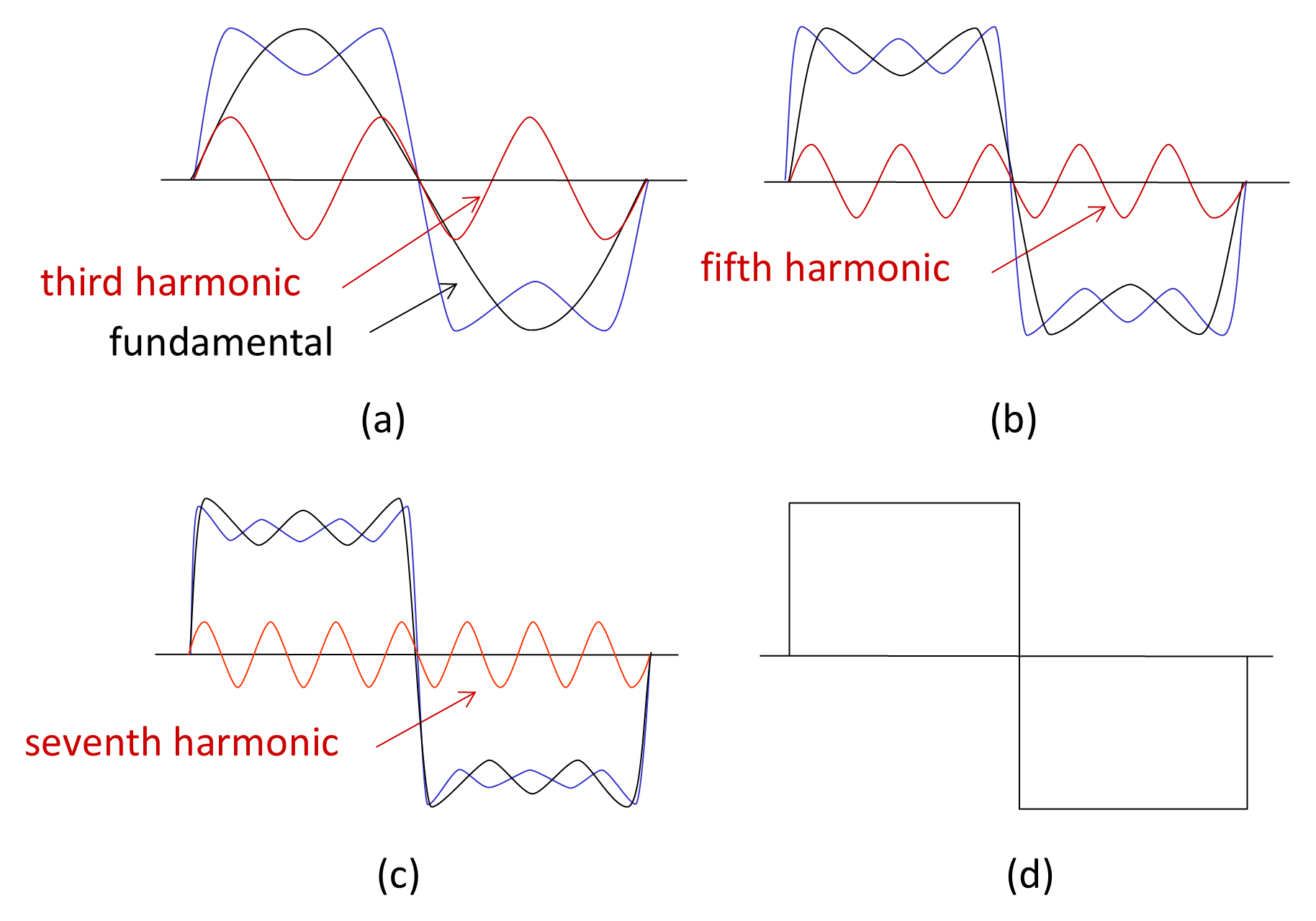
Figure 2.14 illustrates the frequency domain view of Equations (2.13) and (2.14). We will return to this spectral view (frequency-domain view) of the square wave a number of times throughout the remaining chapters.
2.2.3.2 Bandwidth
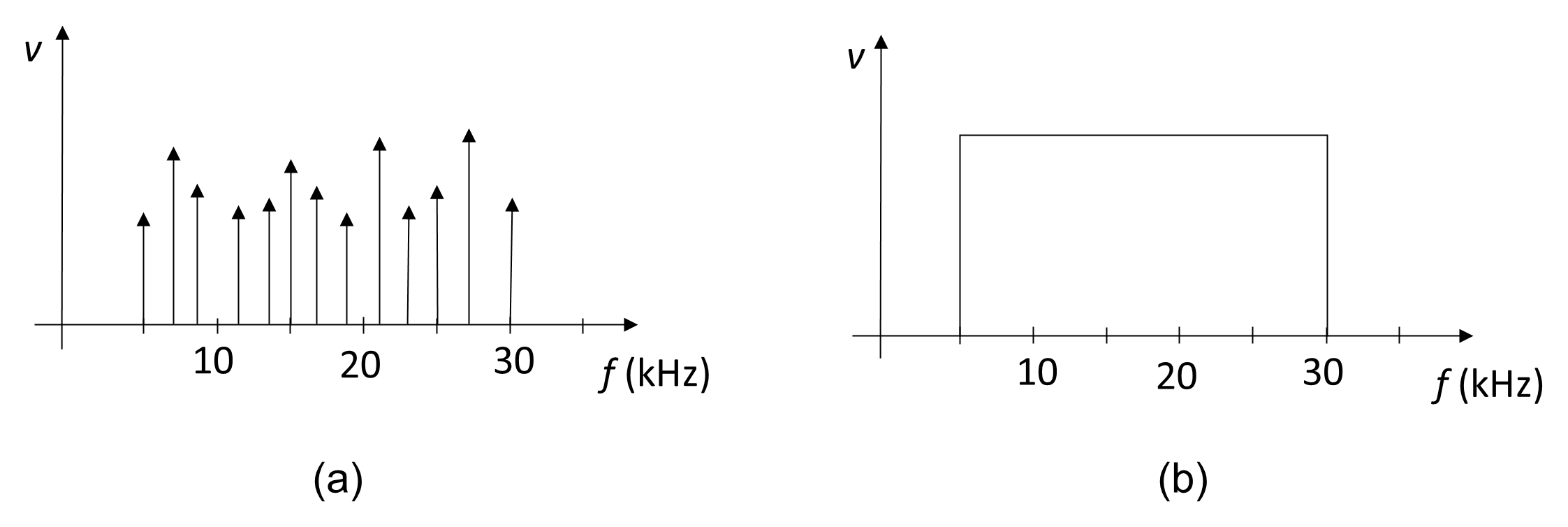
If we have an even more complicated waveform composed of a large number of sine waves, we can depict it in the frequency domain as shown in Figure 2.15(a) or by an equivalent collective representation in Figure 2.15(b). The collective form is particularly useful when we wish to consider the range of frequencies as a band rather than as individual components. The band is defined by the upper and lower limits of the frequencies present and, in many cases, we do not need to specify the individual amplitudes of the constituent frequencies.
In the example of Figure 2.15, the frequencies extend from 5 kHz to 30 kHz, so the signal is said to have a bandwidth of 25 kHz. An important issue to note is that, since the summation in Equation (2.14) continues to infinity, there are an infinite number of odd harmonics in a square wave, which means that the bandwidth of a perfect square wave extends to infinity. We will see in Section 2.3 that there are significant advantages to the employment of digital signals, but we can note here that significant bandwidth will be required.
Bandwidth is one of the most important concepts in communications systems and is defined as the difference between the highest frequency that must be passed by the system and the lowest frequency that must be passed.