2.2.2 Complicated Waveforms
Earlier we noted that the sine wave is the basic building block of signal analysis. Throughout this text we examine the transmission of voltages and currents along conductors and of electromagnetic waves as they propagate through space. Readers unfamiliar with basic circuit concepts such as voltage, current, impedance, and power should refer to Appendix B. For now, it is sufficient to recognize that a sinusoidally varying waveform is the fundamental building block of all signals, regardless of complexity.
That is, we can express a complex waveform as the sum of a number of sine waves at different frequencies. An example of this is demonstrated in Figure 2.9, where a complicated wave is expressed as the sum of a three sine waves: 7 kHz wave, a half-height 5 kHz wave, and a half-height 6 kHz wave.
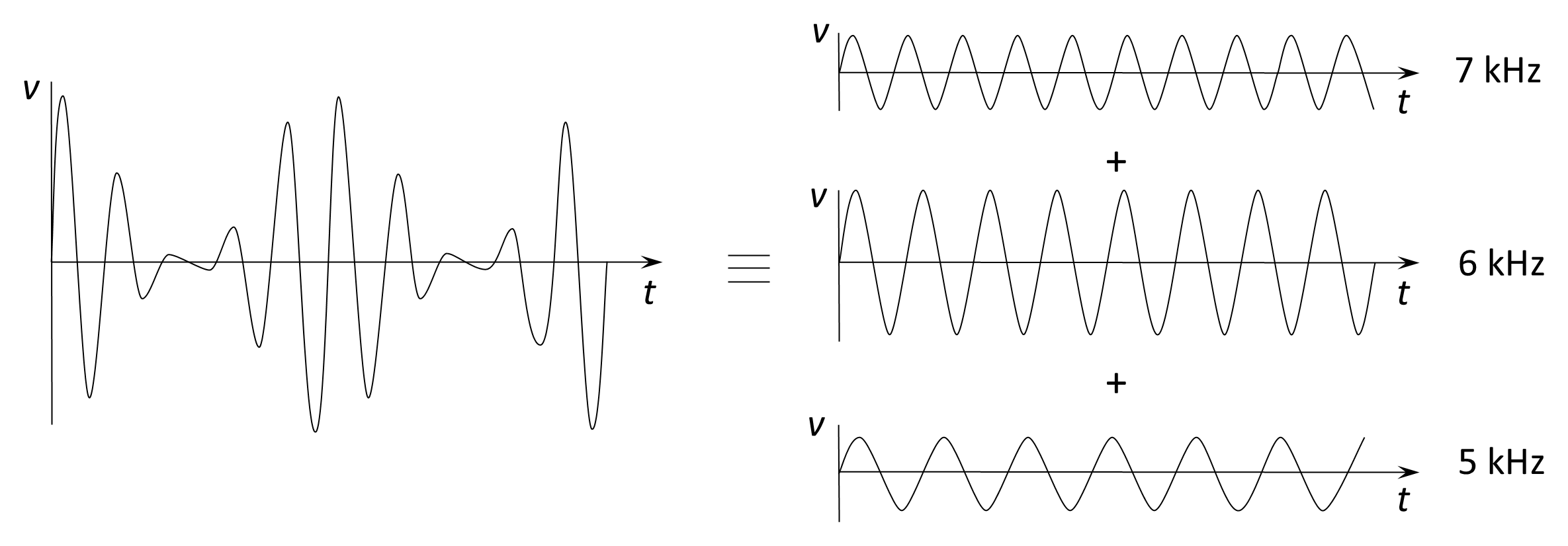
We meet this type of waveform in Chapter 6 when we look at amplitude modulation. We take note of it here so that you can see that sine waves can be combined to form complicated waveforms and, as a corollary, complex waves can be considered as a combination of simple sine waves. The process of determining the sine wave components of a waveform is called Fourier analysis named after Jean-Baptiste Joseph Fourier who developed the Fourier series and the Fourier transform . The mathematics of Fourier transform and its inverse are beyond us here; it is sufficient to note that, as illustrated in Figure 2.9, sine waves can be added to create a complex waveform which makes it possible to accept that there is a mathematical way to decompose a complex waveform into its constituent sine wave components.
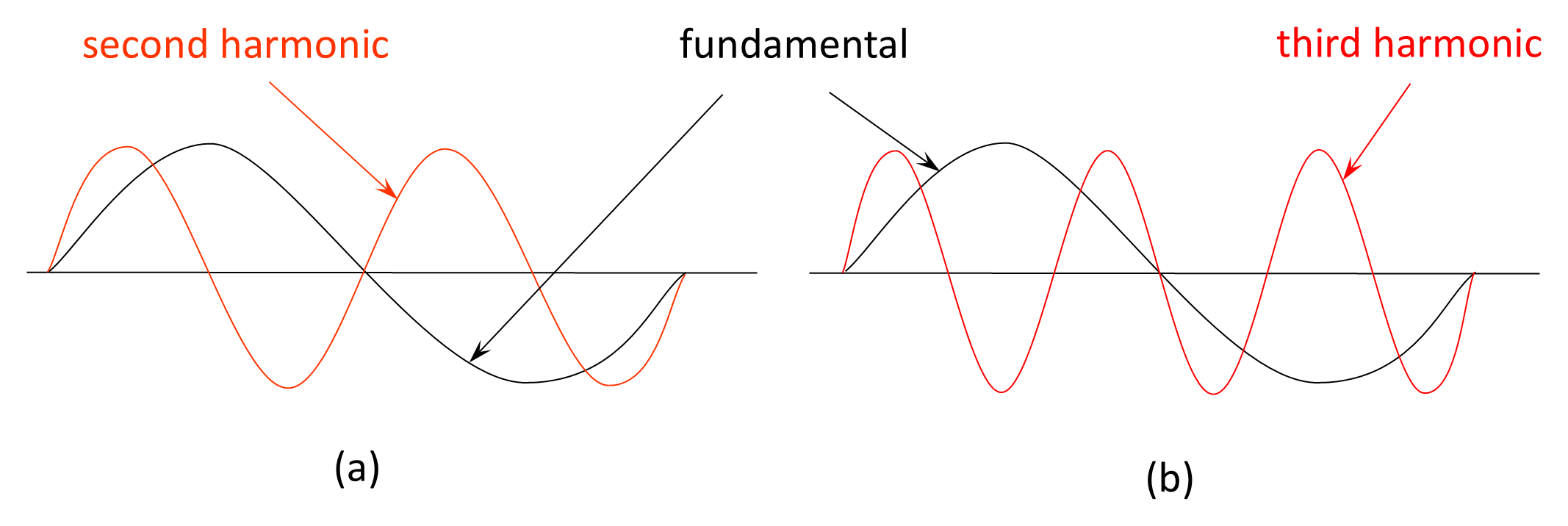
Often, a waveform can be considered as the combination of a fundamental frequency and a number of multiples of the fundamental frequency. Integer multiples of the fundamental frequency are called harmonic frequencies, or harmonics. For example, for a fundamental (or first harmonic) frequency, f, the second harmonic is 2f, the third harmonic 3f, the fourth harmonic 4f, and so on. Figure 2.10 illustrates a fundamental frequency and its first two harmonics.