
5.2.2 Planck’s Radiation Formula
Planck’s explanation of the Rubens-Kurlbaum measurements, when reformulated in terms of Einstein’s 1905 photon hypothesis, revealed the manner of being of radiant heat as a syndosis of field and particle. The electromagnetic field which, according to Planck, explained the manufacture of radiant heat by a black body, was to be given together from unity with the collection of photons which, according to Einstein, explained its spectral energy distribution. Unawares that he was dealing with a syndosis, Planck was bound to think of radiant heat as a synthesis of two objects of experience, waves and particles. But, actual waves and actual particles form a dichotomy. Consequently, putting them together would be sheer nonsense. The strange notion that the energy of a corpuscle would depend upon the frequency of a wave emerges therefore as the direct consequence of the mismatch between the proper ontology of radiant heat and the classical language used to describe it. The way around this dilemma was, as we described in Chapter 2, both long and tortuous and we shall not repeat it here. Rather, we shall paraphrase the argument given there in such a way as to reveal the ontological content of Planck’s strange energy quantization hypothesis. Specifically, we shall imagine that radiant heat is a synthesis of particle and wave.
The simplest way to describe the corpuscular side of the synthesis is to conceive in our mind that monochromatic radiant heat enclosed within the walls of a container is a collection of massless particles, each possessing the same energy, say . How many such particles should we assume? If a finite number, the total energy would be proportional to the total number. But, there is nothing in the phenomenology of radiant heat to naturally correspond to such a quantity. Hence, we consider an infinite number. But, then, the total energy of the collection would be infinite. To avoid this difficulty, we weigh states with higher energies, that is, states with higher number of particles, less than those with smaller energy. The natural way to do so is to introduce a probability distribution over the number of particles, a distribution that would assign a vanishingly small probability to a state of infinite energy. We shall therefore assume that the probability of having exactly such particles inside the container is proportional to
where β, a constant characterizing the radiant heat system under consideration, is related to its temperature. Indeed, using the general thermodynamic definition of the absolute temperature T, we can write:
Furthermore, on equally general grounds, the entropy of any system is related to its energy by way of Boltzmann’s equation:
where  is the conventional Boltzmann constant. Therefore, using our choice for the probability distribution over energy states given above:
which determines β as a function of temperature:
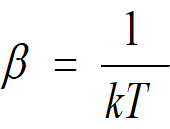
Then, the mean energy inside the container would be given by:
Now let us consider the wave side of the synthesis by assuming that the radiant heat inside the container is a radiation field which contains between the frequencies υ and υ+dυ an energy with density given by . According to Wien’s 1893 paper, this energy density must then satisfy the following displacement law:
where is an arbitrary function of its variable. Conceiving of radiant heat as the synthetic unity of the two objects would however require that these two quantities, the average energy  in the collection of particles and the energy density of the wave contained in the frequency band between υ and υ+dυ, be somehow related to each other. The simplest conception is to assume that they are proportional to each other. The proportionality constant would then have to have the dimensions of , where stands for the dimension of length and for the dimension of time. Since the only physical parameters available to us in a wave picture are the frequency υ and the propagation speed , the relation combining wave and particle would have to look as follows:
where is now a dimensionless constant.
However, as expected when putting together two dichotomous things, the two sides of this equation are manifestly in contradiction with each other because the temperature dependence of the right-hand side does not occur through the combination as required by the left-hand side. Therefore, logical consistency between the two dichotomous pictures which we had put together simply requires:
where stands for Planck’s constant. This leads directly to Planck’s formula for the black body radiation if the numerical constant is taken to be 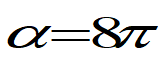 , just exactly what one would expect if the radiation field were homogeneous in all directions and completely unpolarized:
The strange relationship Planck had to introduce between the energy of a particle and the frequency of a wave in order to explain the Rubens-Kurlbaum experiment reflects the true ontology of radiant heat in a language which conceives of the giving together from unity of wave and particle as a putting together of the two. Thus, what appeared to Planck to be a contingent “act of desperation” turns out to be a relationship founded in the proper ontology of radiant heat.