
13.5.5 Very High-Bit-Rate DSL (VDSL)
As broadband applications evolved to include high-definition video streaming, online gaming, cloud services, and video conferencing, even higher transmission speeds became necessary. These requirements led to the development of Very-high-bit-rate Digital Subscriber Line (VDSL) and its successor, VDSL2.
VDSL achieves substantially higher data rates by using a much wider frequency spectrum than ADSL. The additional bandwidth allows downstream speeds approaching 100 Mbps under favorable conditions. However, because attenuation increases rapidly at these higher frequencies, VDSL is effective only over relatively short copper loops, typically a few hundred meters to approximately one kilometer.
For this reason, VDSL is commonly deployed in Fiber-to-the-Cabinet (FTTC) or Fiber-to-the-Node (FTTN) networks, where optical fiber extends to a street cabinet located close to the subscriber. The remaining connection to the customer premises uses the existing copper pair. Figure 13.15 shows a typical VDSL architecture.
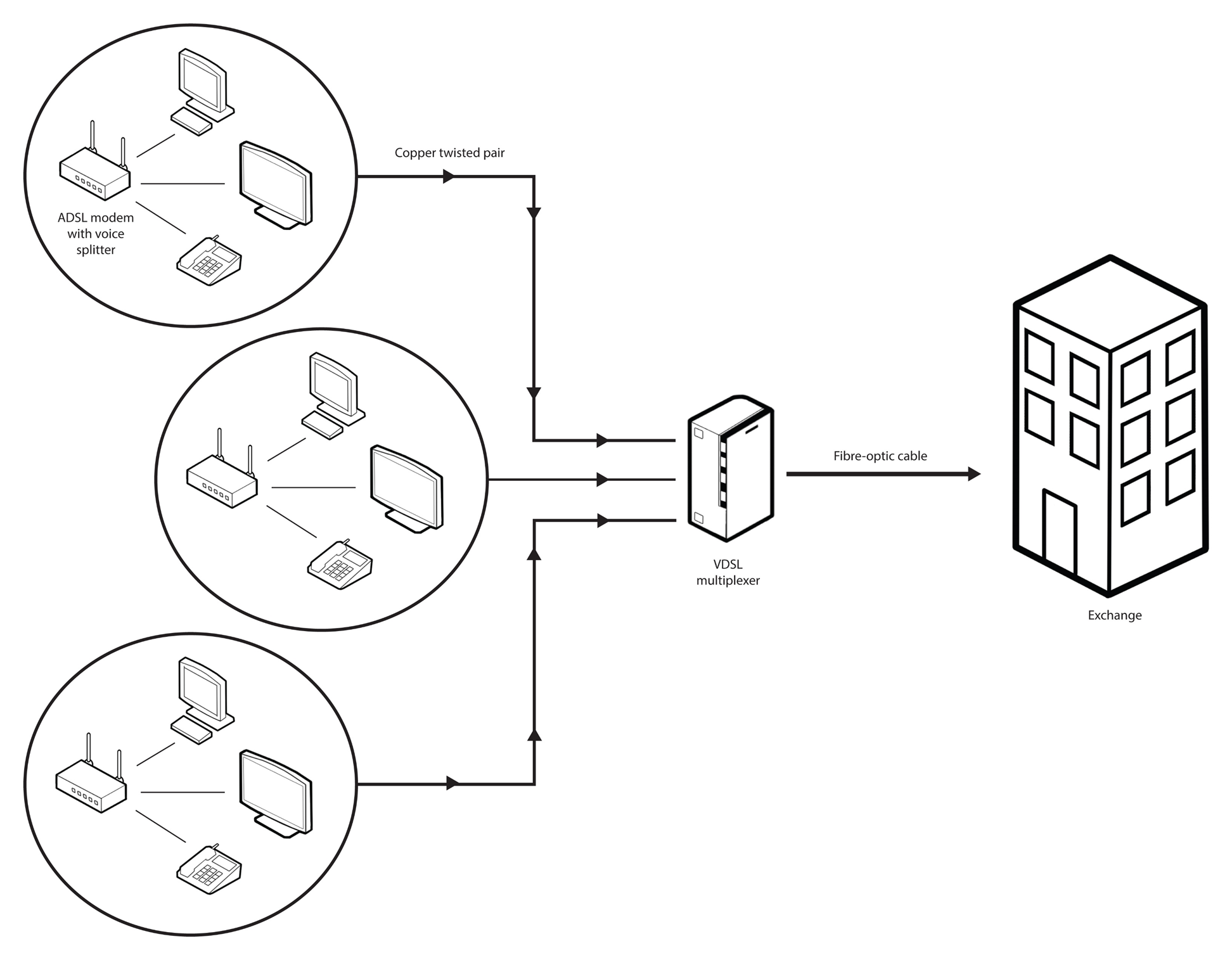
One of the principal limitations of high-speed DSL is crosstalk between adjacent copper pairs within the same cable bundle. Modern VDSL2 systems frequently employ a signal-processing technique known as vectoring, which measures and cancels much of this interference, allowing significantly higher transmission speeds and improved reliability.
13.5.5.1 G.fast
The latest major development in DSL technology is G.fast. Rather than attempting to extend broadband over several kilometers of copper cable, G.fast assumes that optical fiber has already been deployed very close to the customer premises. It therefore operates over extremely short copper lengths, typically less than 250 m.
By exploiting frequencies extending well beyond those used by VDSL2, G.fast can achieve data rates of several hundred megabits per second and, under favorable conditions, close to 1 Gbps. Such performance makes G.fast suitable for applications including Fiber-to-the-Building (FTTB) and Fiber-to-the-Distribution-Point (FTTdp), where replacing the final few meters of copper with optical fiber may not be economically justified.
13.5.5.2 High-Bit-Rate DSL (HDSL) And Symmetric DSL (SDSL)
While ADSL, VDSL, and G.fast were developed primarily for residential broadband access, other DSL technologies were designed for business and carrier applications requiring equal transmission capacity in both directions.
High-bit-rate Digital Subscriber Line (HDSL) was introduced as a replacement for leased T1 and E1 circuits. It provides symmetrical transmission at approximately 1.5–2 Mbps over one or more copper pairs and was widely used to connect telephone exchanges, remote network equipment, and business premises before fiber-optic access became commonplace.
Symmetric Digital Subscriber Line (SDSL) provides similar upstream and downstream data rates over a single copper pair. Although capable of supporting several megabits per second over moderate distances, SDSL has largely been replaced by fiber-optic services and Ethernet-based access technologies.
13.5.5.3 DSL Summary
DSL technology transformed broadband Internet access by demonstrating that existing copper telephone lines were capable of carrying far more information than was required for traditional voice telephony. Through increasingly sophisticated digital signal processing—including discrete multitone modulation, adaptive bit loading, and vectoring—successive generations of DSL significantly increased transmission speeds while continuing to use the existing access network.
Although many telecommunications providers are now replacing copper access networks with full fiber connections, DSL technologies remain in widespread use throughout the world and continue to provide broadband connectivity wherever fiber deployment is incomplete or economically impractical.
Back to reading