
13.3.3 Asynchronous Transfer Mode (ATM)
A further evolution of packet switching was Asynchronous Transfer Mode (ATM), a high-speed cell-switching technology developed during the late 1980s and early 1990s. ATM was selected as the transfer technology for Broadband Integrated Services Digital Network (B-ISDN) with the ambitious objective of carrying voice, data, video, and multimedia traffic across a single integrated broadband network.
Unlike conventional packet-switching systems that employ variable-length packets, ATM divides all information into fixed-length cells. As shown in Figure 13.12, each ATM cell is exactly 53 bytes long, comprising a 5-byte header and a 48-byte payload.
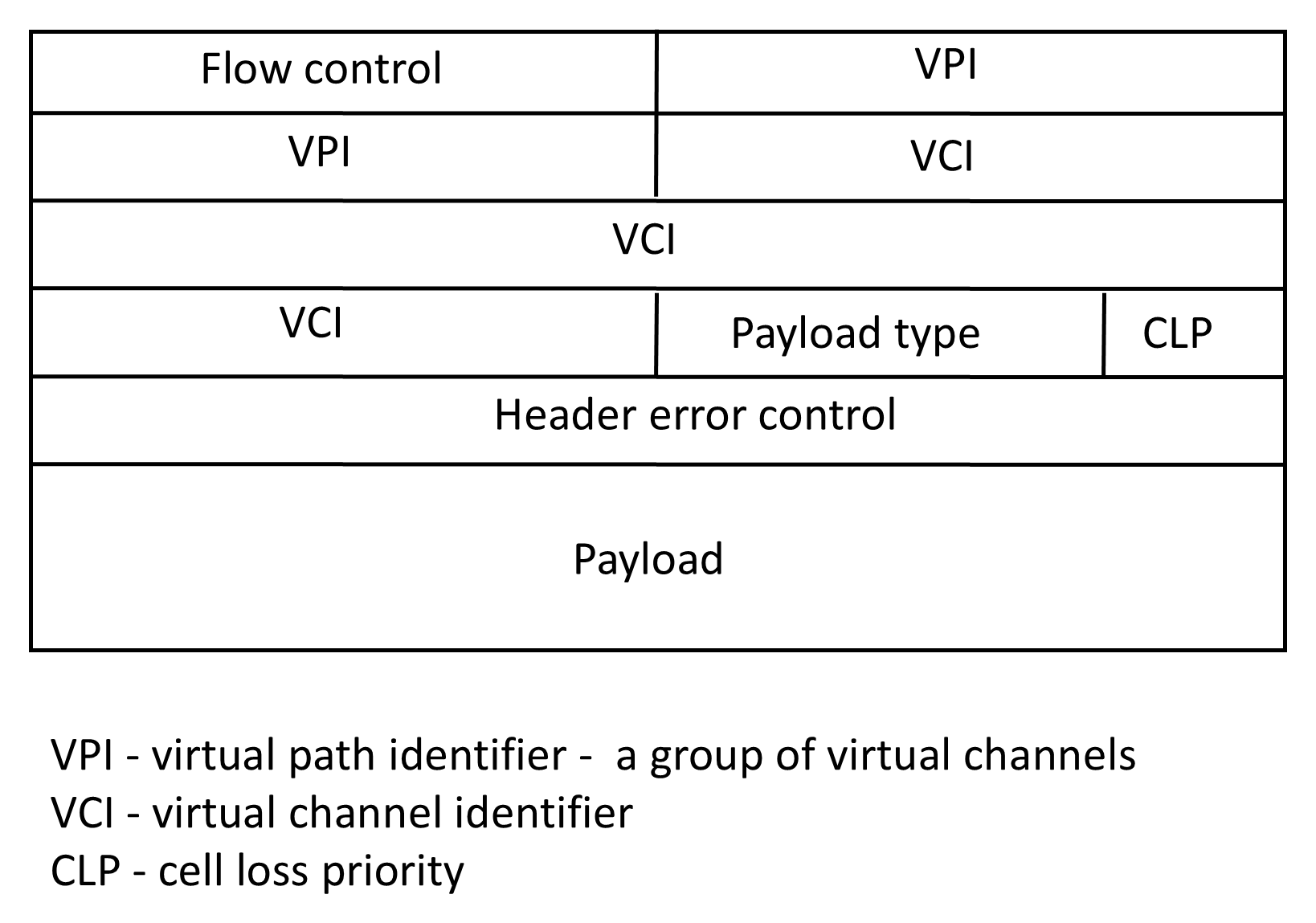
The fixed cell length was chosen as a compromise between competing design objectives. Small cells minimize transmission delay for real-time voice traffic, while larger payloads improve transmission efficiency by reducing protocol overhead. Following considerable international debate, a payload length of 48 bytes was adopted, resulting in the standard 53-byte cell.
The use of fixed-length cells greatly simplifies switching hardware because every cell is processed identically. ATM switches therefore operate at extremely high speeds while introducing very little variation in transmission delay (jitter). These characteristics made ATM particularly attractive for real-time applications such as voice and video.
Unlike traditional synchronous multiplexing systems such as PDH and SDH, which allocate fixed time slots whether or not a user has information to transmit, ATM employs statistical multiplexing. Cells are transmitted only when data are available, allowing network capacity to be shared dynamically among many users and improving overall bandwidth utilization.
ATM also introduced one of the earliest comprehensive Quality of Service (QoS) frameworks. Different categories of service—including Constant Bit Rate (CBR), Variable Bit Rate (VBR), Available Bit Rate (ABR), and Unspecified Bit Rate (UBR)—allowed networks to allocate bandwidth and control delay according to the requirements of individual applications.
ATM supported transmission speeds ranging from approximately 2 Mbps to 622 Mbps in early deployments, with later implementations extending into the multi-gigabit range. It became widely deployed within carrier backbone networks and, for a period, was also used in high-performance local area networks.
Like Frame Relay, ATM assumes highly reliable transmission media and therefore performs only limited error control within the network. Apart from header error checking, no retransmission is performed at the cell level. Reliability is instead provided by higher protocol layers.
Technically, ATM proved highly successful. It provided excellent quality of service, efficient statistical multiplexing, predictable delay characteristics, and extremely high switching speeds. However, the fixed 53-byte cell introduced segmentation and reassembly overhead for larger data transfers, and ATM equipment was relatively expensive and complex. At the same time, Ethernet speeds increased dramatically, IP networking became universal, and Multiprotocol Label Switching (MPLS) introduced many of ATM's traffic engineering and quality-of-service capabilities without requiring fixed-length cells.
As a result, ATM gradually disappeared from most carrier backbone networks during the 2000s. Today it survives primarily in legacy DSL access systems and a small number of specialized telecommunications and industrial applications. Nevertheless, many of its concepts—including virtual circuits, quality-of-service classes, traffic engineering, and statistical multiplexing—continue to influence modern communication networks.
The progression from X.25 to Frame Relay and then to ATM illustrates a clear trend in communications engineering. As transmission links became increasingly reliable, complexity moved away from the network and toward the communicating devices at the network edge. Modern IP networks continue this philosophy, providing a comparatively simple packet transport service while relying on higher-layer protocols and intelligent endpoints to achieve reliable communication.
The discussion so far has focused on how information is switched and transported once it enters the communication network. Equally important, however, is the question of how users gain access to that network. The access segment—often referred to as the last mile—has evolved from analogue telephone circuits to broadband digital technologies including DSL, cable, fiber, fixed wireless, and satellite access. The following section examines the principal access technologies used to connect end users to modern communication networks.
Back to reading