
13.1.2 Half-Duplex Systems
In a half-duplex communication system, the transmission path can carry information in both directions, but only one direction at a time. Each end of the communication link must therefore be capable of acting as both an information source and an information sink. Consequently, both terminals require the ability to transmit and receive information, and each normally incorporates both modulation and demodulation functions. A typical half-duplex communication system is illustrated in Figure 13.2.

Half-duplex systems represent a compromise between the simplicity of simplex communication and the flexibility of full-duplex operation. By allowing communication in both directions while sharing a single transmission path, they minimize infrastructure requirements while still supporting interactive communication. The trade-off is that only one terminal may transmit at any instant, requiring some mechanism to coordinate access to the shared medium.
Half-duplex remains one of the most widely used transmission techniques, particularly in radio communication systems where radio spectrum is scarce and expensive. Only a single radio channel is required, while wireline systems require only one pair of conductors. This simplicity reduces equipment and infrastructure costs but introduces contention and turnaround delays whenever control of the channel passes from one terminal to the other. Consequently, although the peak transmission rate may equal that of an equivalent full-duplex system, the effective throughput is generally lower because time is lost waiting for the channel to become available.
Half-duplex communication is particularly well suited to conversational exchanges, where one user normally speaks while the other listens before responding. Operational radio networks therefore commonly employ half-duplex voice communication. Although modern telephone systems are almost universally full-duplex to allow natural conversational overlap, many land-mobile, maritime, aviation, and military radio systems continue to employ half-duplex operation because it provides an economical use of the available spectrum.
Some applications, however, require information to flow continuously and simultaneously in both directions. Examples include most telephone systems, high-speed computer networks, and interactive data links. In these situations, full-duplex communication provides significantly higher efficiency and lower latency.
13.1.2.1 Single-Frequency, Half-Duplex Systems
Perhaps the best-known example of a half-duplex communication system is the military Combat Net Radio (CNR) network, illustrated in Figure 13.3. In a CNR network all stations operate on the same radio frequency, with each station alternately transmitting and receiving according to an agreed communication protocol.
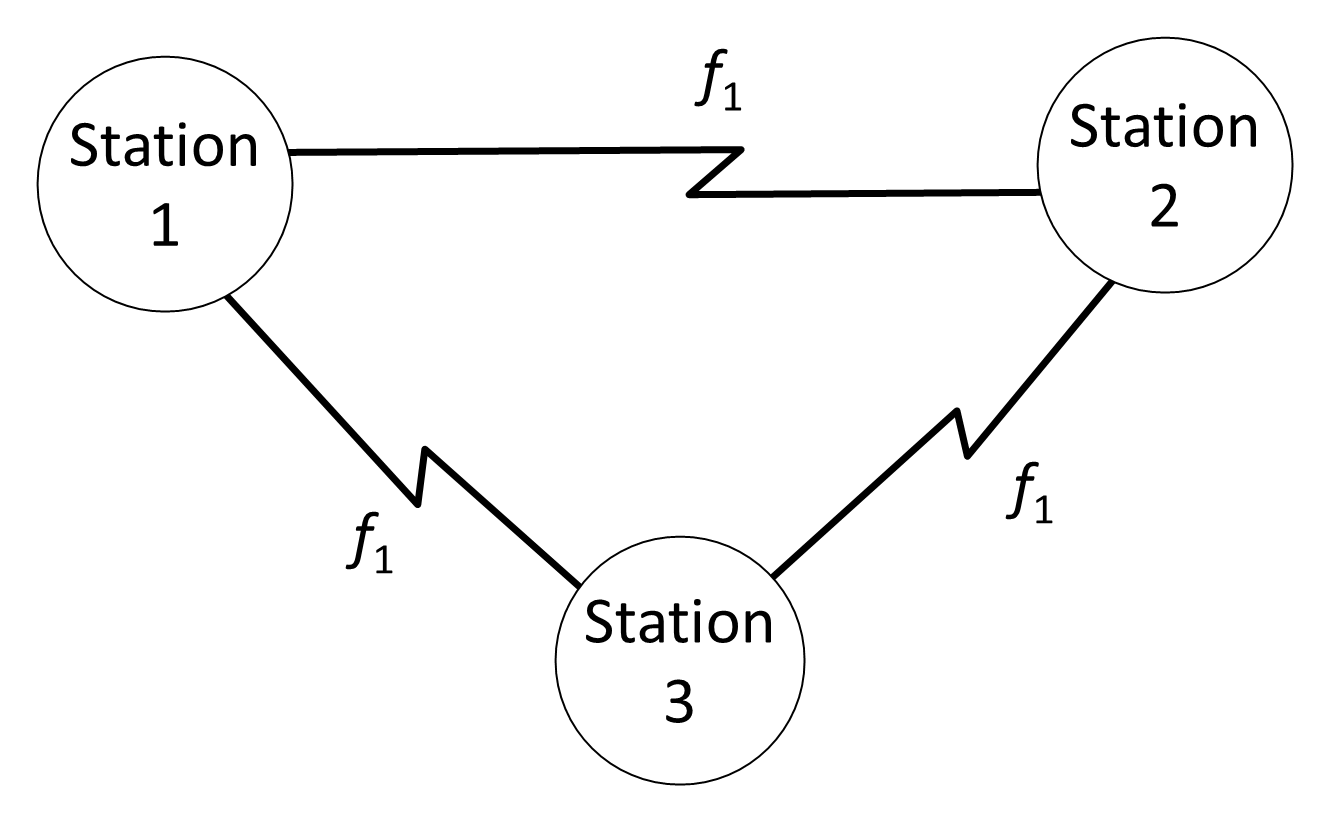
One station normally assumes responsibility for administering the network and is known as the Net Control Station (NCS). The NCS is responsible for maintaining net discipline, supervising operational procedures, coordinating frequency changes, and ensuring orderly communication. Access to the shared channel is governed by a standard voice procedure that employs callsigns together with standard procedural words (prowords) to establish communication, transfer the right to speak, and terminate conversations.
A CNR network is described as all-informed because every station receives every transmission, whether or not it is the intended recipient. This characteristic is particularly valuable in command-and-control applications, where maintaining a common operational picture across the network is often more important than delivering messages only to individual recipients.
Like all shared communication media, single-frequency half-duplex systems are subject to several practical limitations. One is the hidden terminal problem, in which two stations may both communicate successfully with the NCS but cannot hear one another. Each station may therefore believe the channel is idle and begin transmitting simultaneously, resulting in collisions at the receiving station. Another limitation is the near-far problem, in which a nearby high-power transmitter masks a weaker signal from a more distant station. These phenomena reduce network capacity and illustrate fundamental medium-access challenges that also arise in modern wireless data networks such as Wi-Fi and packet-radio systems.
Because every station must normally receive every transmission, the geographical coverage of a single-frequency network is limited by the requirement for mutual radio visibility. Larger coverage areas can be achieved by employing manual relay stations or automatic rebroadcast stations that receive transmissions and retransmit them into neighboring coverage areas. Modern rebroadcast stations frequently employ digital forwarding techniques while preserving the same basic operating principle.
13.1.2.2 Two-Frequency, Half-Duplex Systems
Commercial land-mobile radio systems often employ a variation known as two-frequency half-duplex. As illustrated in Figure 13.4, mobile stations transmit to a central base station on one frequency (f₁), while the base station transmits to all mobile stations on a second frequency (f₂).
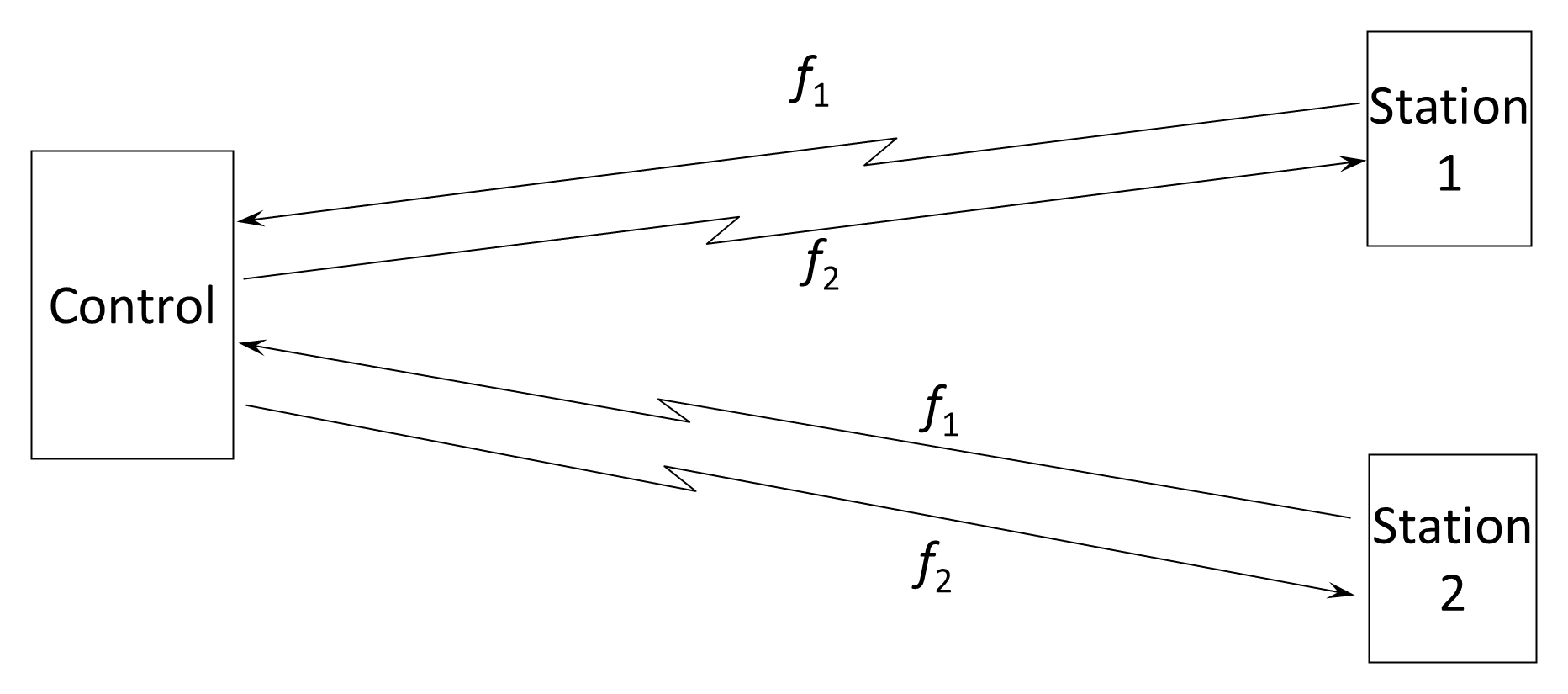
In this arrangement, each mobile station hears only transmissions from the base station because the mobiles transmit on a frequency monitored solely by the base station. Consequently, mobile users cannot normally communicate directly with one another.
Although this arrangement lacks the all-informed capability of military combat net radio, it is well suited to many civilian applications in which communication naturally occurs between individual users and a central dispatcher. Typical examples include taxi dispatch, public transport operations, utility companies, construction sites, and other fleet-management systems. Restricting communication through the control center often simplifies network operation while reducing unnecessary radio traffic.
Talk-through Systems
Some applications require all users to hear one another's transmissions. This capability can be achieved by equipping the base station with an automatic repeater, traditionally known as a talk-through station. The repeater receives signals transmitted by mobile stations on frequency f₁ and automatically retransmits them on frequency f₂, as illustrated in Figure 13.5. Every station monitoring the output frequency therefore receives every transmission, restoring the all-informed characteristic of the network.
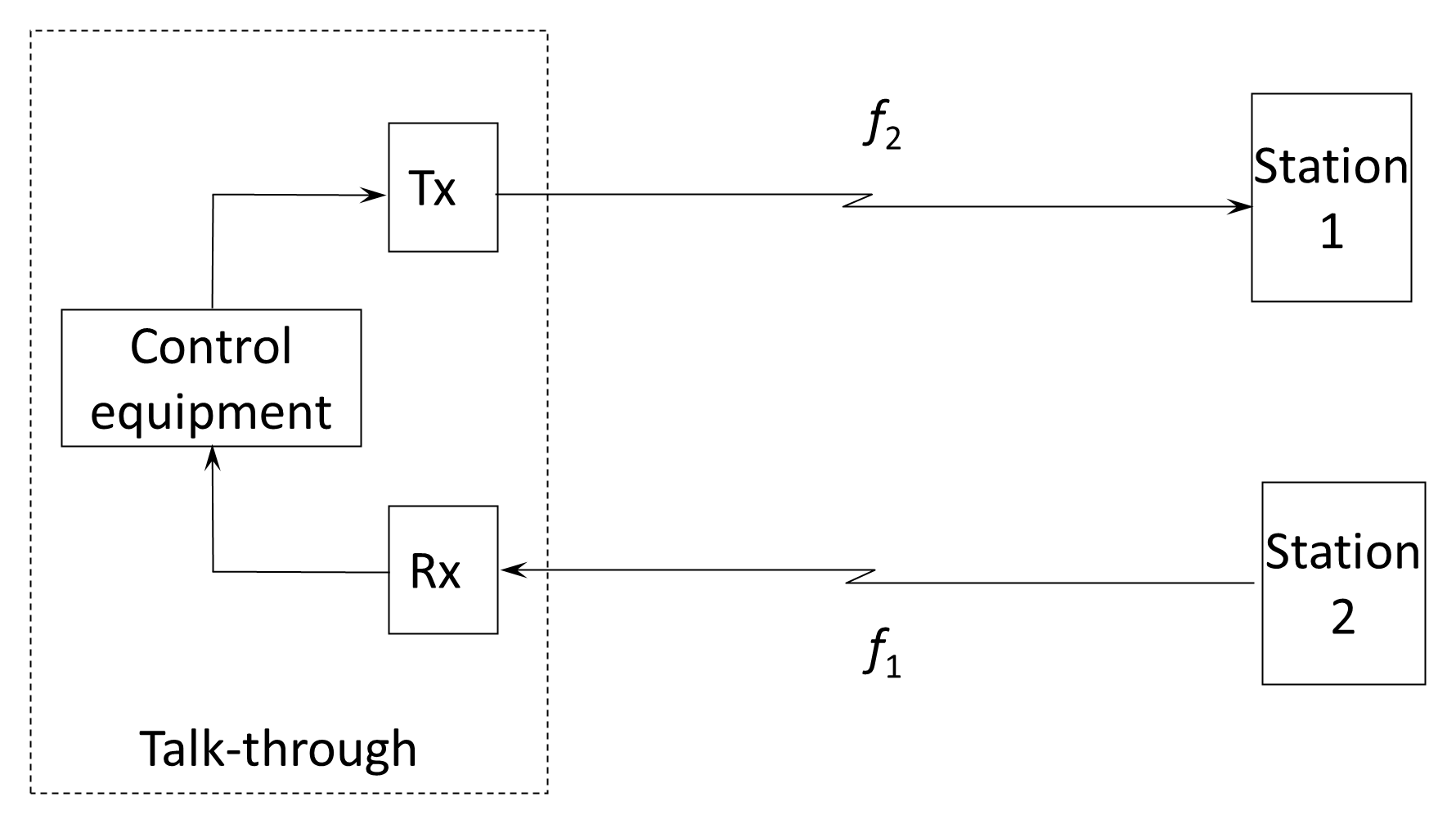
Because the repeater retransmits every valid signal that it receives, any interference or deliberate jamming present on the input frequency may also be repeated onto the output frequency. Early repeaters simply retransmitted whenever a carrier was detected and were therefore described as carrier-operated or open-access repeaters.
Modern repeater systems generally incorporate access-control mechanisms to prevent unintended operation. The most common techniques employ Continuous Tone-Coded Squelch System (CTCSS) signaling or Digital-Coded Squelch (DCS), allowing only authorized users transmitting the correct access code to activate the repeater. Digital land-mobile radio systems extend these principles further by incorporating digital signaling, encryption, user authentication, and dynamic channel management while retaining the fundamental half-duplex operating philosophy.
Half-duplex communication therefore provides an efficient and economical solution wherever users naturally communicate in turn and infrastructure or spectrum must be conserved. However, when simultaneous two-way communication is required, the limitations imposed by channel sharing become unacceptable. In the next section we examine full-duplex systems, in which information can flow continuously in both directions at the same time.
Back to reading