
13.3.1 X.25
X.25 is an ITU-T standard defining the interface between user equipment and a public packet-switched network. First introduced in 1976, it became the world's first widely adopted international packet-switching standard and formed the basis of many public data networks throughout the 1970s, 1980s, and early 1990s.
X.25 was developed when long-distance communication links were relatively unreliable and transmission errors were common. To compensate, the network itself assumed responsibility for ensuring reliable communication. Every packet received at a switching node was checked for errors, acknowledged, stored temporarily, and then forwarded to the next node. If errors were detected, retransmission was requested immediately. This hop-by-hop error recovery ensured highly reliable communication, even over poor-quality transmission links.
X.25 supports both connectionless (datagram) services and connection-oriented virtual circuits, including both Switched Virtual Circuits (SVCs) and Permanent Virtual Circuits (PVCs). Packets are variable in length, subject to a negotiated maximum packet size.
As illustrated in Figure 13.10, X.25 was accompanied by a family of Packet Assembler/Disassembler (PAD) standards that enabled simple character-based terminals to communicate transparently with packet-switched networks. The PAD accepted asynchronous character streams from low-speed terminals, assembled them into X.25 packets for transmission, and performed the reverse operation at the receiving end. This allowed users with relatively simple terminals to access remote computer systems through public packet-switched networks.
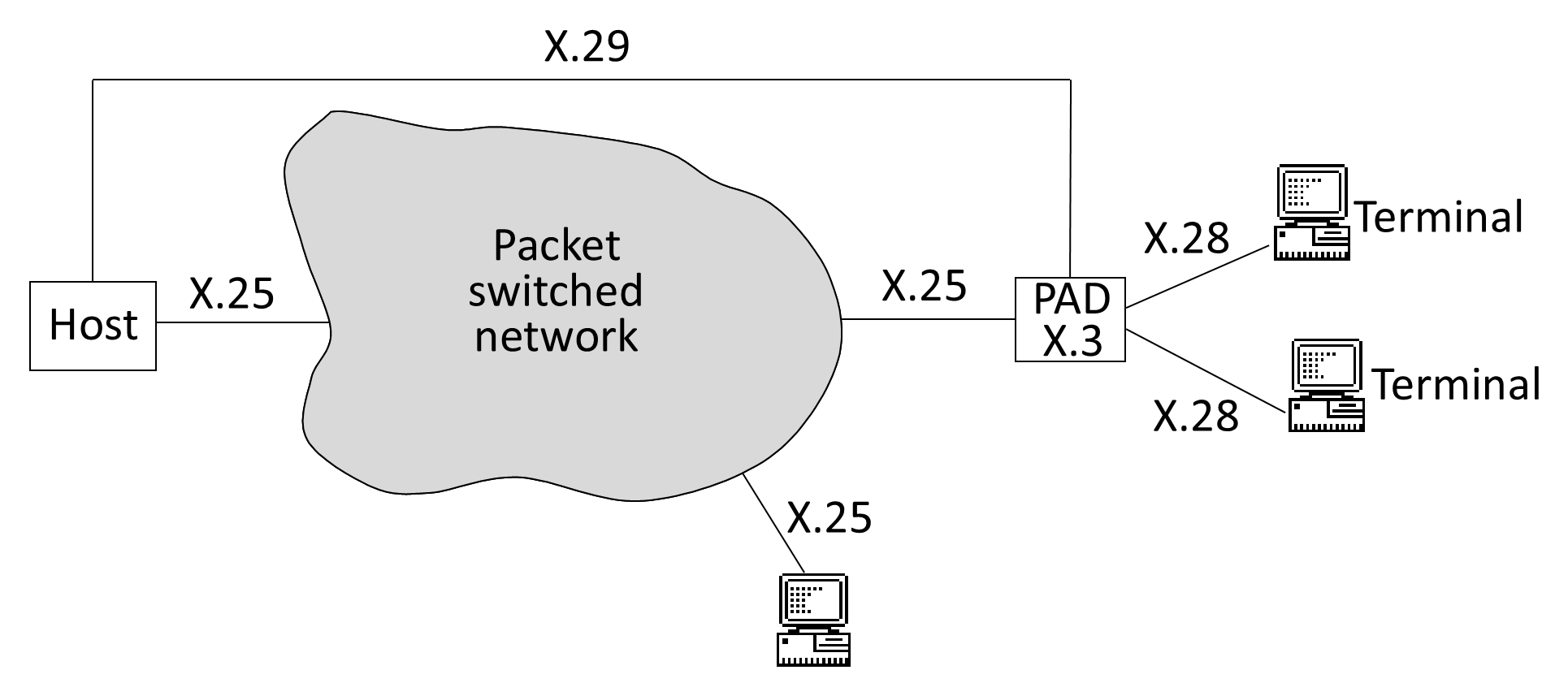
Early X.25 services typically operated at access speeds between 9.6 kbps and 64 kbps, although later implementations supported higher-rate digital circuits such as E1 (2.048 Mbps). X.25 found widespread use in banking, airline reservation systems, military communications, government networks, and international public data services because of its exceptional reliability.
The principal disadvantage of X.25 was that its comprehensive error checking, acknowledgements, flow control, and retransmission mechanisms introduced significant processing delays at every switching node. As transmission media improved and digital circuits became increasingly reliable, much of this processing became unnecessary. The result was the development of faster packet-switching technologies.
Back to reading