
13.5.3 Asymmetric Digital Subscriber Line (ADSL)
The first widely deployed broadband DSL technology was Asymmetric Digital Subscriber Line (ADSL). As illustrated in Figure 13.13, ADSL enables high-speed digital communication over an existing telephone line while allowing conventional voice telephone service to operate simultaneously. One end of the subscriber line is connected to a DSL modem at the customer premises, while the other terminates at a Digital Subscriber Line Access Multiplexer (DSLAM) located in the local exchange or roadside cabinet. The DSLAM aggregates traffic from many subscribers before forwarding it into the broadband network.
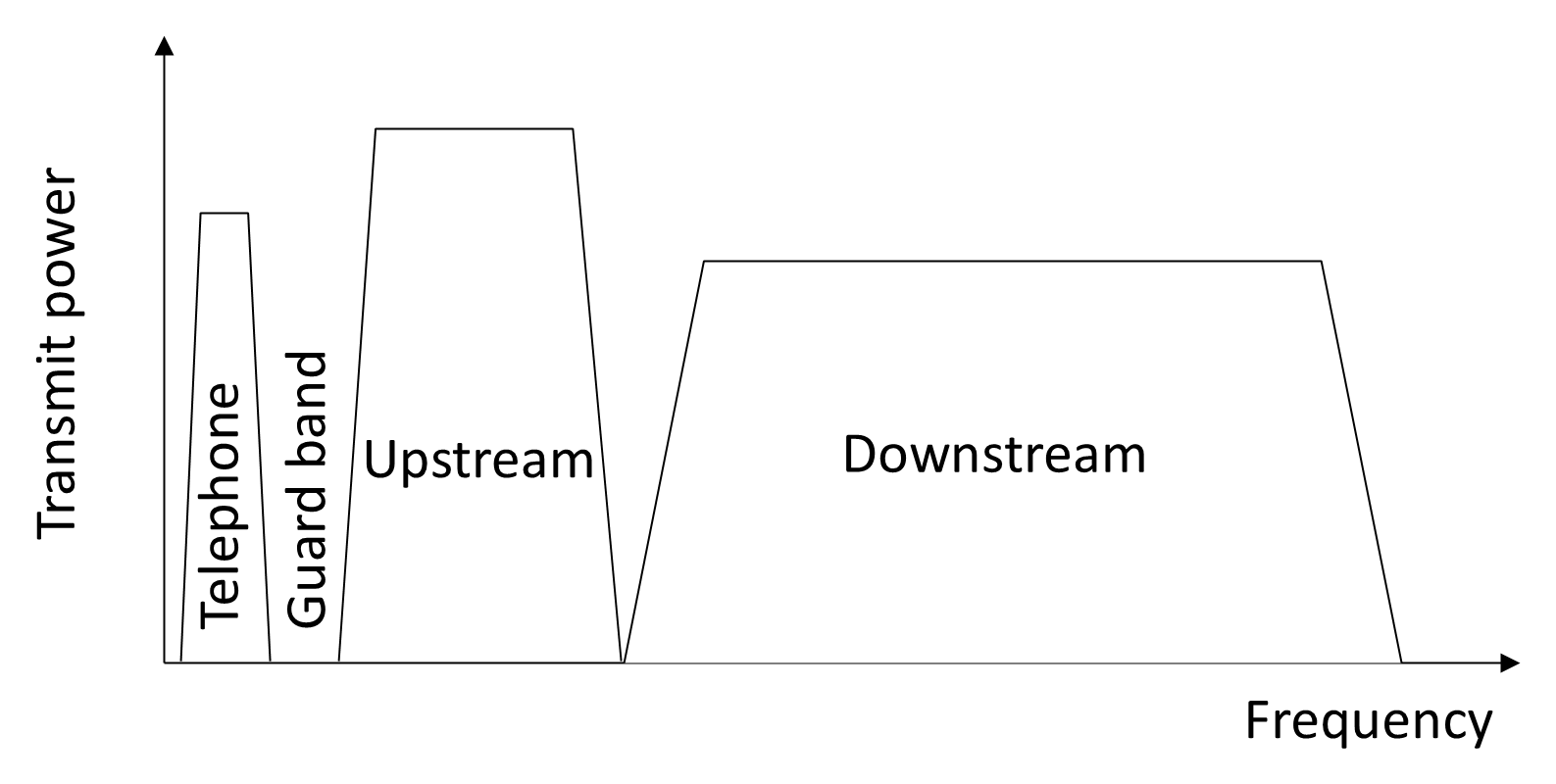
ADSL is described as asymmetric because it allocates significantly more bandwidth to downstream traffic than to upstream traffic. This reflects typical residential Internet usage, where users generally download much more information than they upload. Depending on the quality and length of the copper pair, the original ADSL standard supports downstream data rates of up to approximately 8 Mbps and upstream rates approaching 1 Mbps.
Unlike conventional dial-up modems, which were restricted to the voice frequency band of approximately 300–3400 Hz, ADSL exploits much higher frequencies available on the copper pair. The voice service continues to occupy the lowest frequencies, while DSL signals are transmitted at higher frequencies. Low-pass filters, commonly called splitters or microfilters, separate the voice and DSL signals so that telephones and broadband equipment can operate simultaneously without interfering with one another.
The standard ADSL spectrum extends from approximately 25 kHz to 1.1 MHz. The available bandwidth is divided into many narrow sub-channels, each approximately 4.3 kHz wide. Some channels are allocated to upstream transmission, others to downstream transmission, while a small guard band separates the voice and data services. Pilot tones are also included to assist modem synchronization.
Rather than transmitting all information on a single carrier, ADSL employs a modulation technique known as Discrete Multitone (DMT), defined in ITU-T Recommendation G.992.1. DMT is closely related to Orthogonal Frequency Division Multiplexing (OFDM), which is now widely used in Wi-Fi, LTE, 5G, digital television, and many other broadband communication systems. The principal difference is that DSL operates over relatively stable wired channels, allowing each sub-channel to be individually optimized according to its measured transmission quality.
During the initial connection process, known as training, the DSLAM and the customer modem exchange test signals to determine the signal-to-noise ratio (SNR) of every sub-channel. The modem then allocates an appropriate number of bits to each sub-channel according to its measured quality. This process is known as adaptive bit loading.
Sub-channels with a high SNR can carry more bits per symbol by employing higher-order Quadrature Amplitude Modulation (QAM), while noisier sub-channels carry fewer bits or may be disabled altogether. Frequencies affected by strong interference—for example, local AM radio transmissions—may therefore carry little or no user data.
Figure 13.14 illustrates the principle of adaptive bit loading. Because attenuation generally increases with frequency, lower-frequency channels usually carry more bits than higher-frequency channels. This adaptive allocation allows DSL to make the most efficient use of the available copper bandwidth.
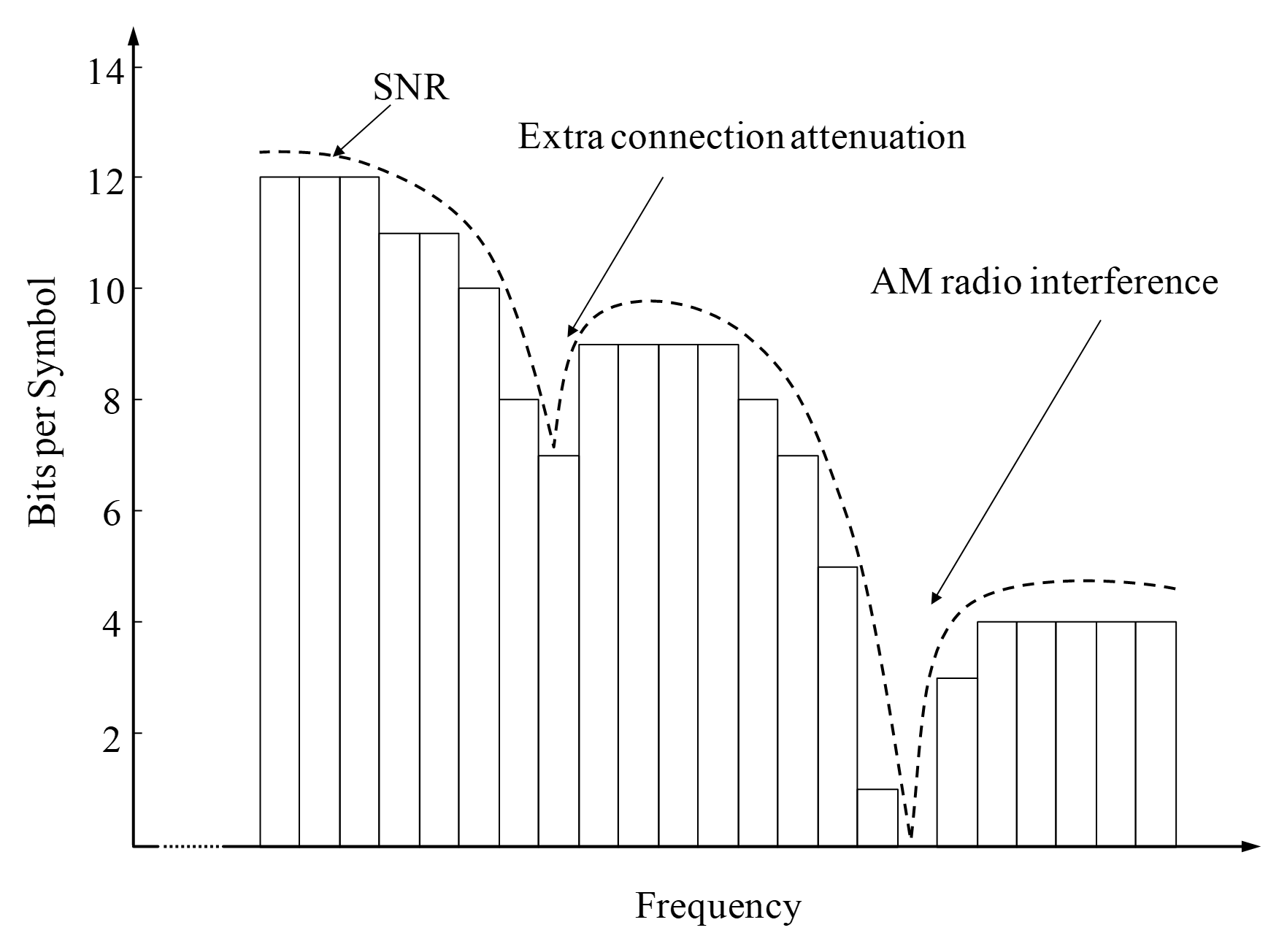
The achievable data rate depends primarily on the length and quality of the copper pair. Signal attenuation increases with both frequency and distance, reducing the number of bits that can be transmitted on each sub-channel. Consequently, subscribers located close to the DSLAM generally achieve significantly higher data rates than those located several kilometers away.
Back to reading