
13.2.1 Circuit Switching
A circuit is a logical end-to-end communication path established between two users for the duration of a communication session. Once the circuit has been established, the required network resources are reserved exclusively for that connection until the communication ends.
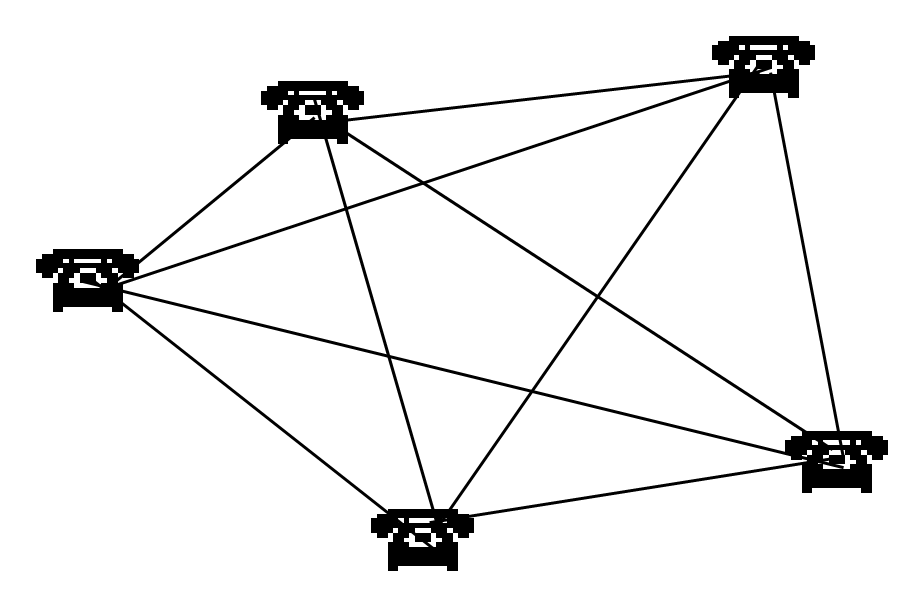
The need for switching becomes apparent when considering a network in which every user is connected directly to every other user. Such an arrangement is practical only for very small networks. For a fully interconnected network containing n users, the number of separate communication links required is n(n−1)/2.
As the number of users increases, the number of required links grows approximately as the square of the number of users. For example, a network of ten users requires 45 direct links, while one hundred users require 4,950 links. A network containing one thousand users would require almost half a million separate connections. Such an arrangement rapidly becomes impractical in terms of cost, installation, and maintenance.
This concept is illustrated in Figure 13.8, where every user is directly connected to every other user.
A far more efficient solution is to connect each user to a common switching node, as shown in Figure 13.9. Instead of requiring direct links between every pair of users, each user requires only a single connection to the switch. The switch then establishes a communication path between any two users whenever required.
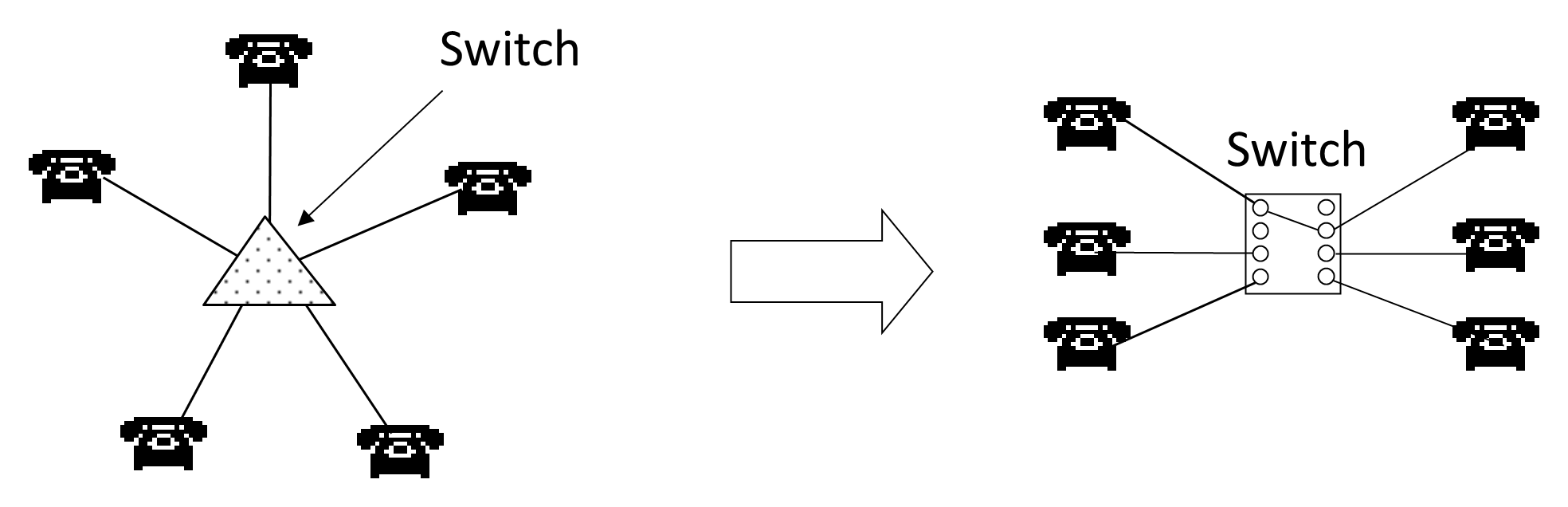
In this arrangement, only n access connections are required for n users. When a communication session begins, the switch establishes a dedicated end-to-end path between the two communicating parties. Once the communication has finished, the connection is released, allowing the same network resources to be reused by other users.
For voice communications, the circuit traditionally connected two telephone handsets. In data communications, it connected two items of data terminal equipment. Modern circuit-switched systems may also carry video, multimedia, or other digital services over a temporarily established logical connection.
Larger circuit-switched networks are created by interconnecting many switches, as illustrated in Figure 13.10. Individual users connect to a local exchange, while exchanges are interconnected by high-capacity trunk links. Historically, these trunk links formed the backbone of the public switched telephone network (PSTN), carrying traffic between towns, cities, and countries. Although modern telecommunications networks increasingly employ digital and IP-based technologies, the concepts of access networks, switching nodes, and backbone links remain fundamental.
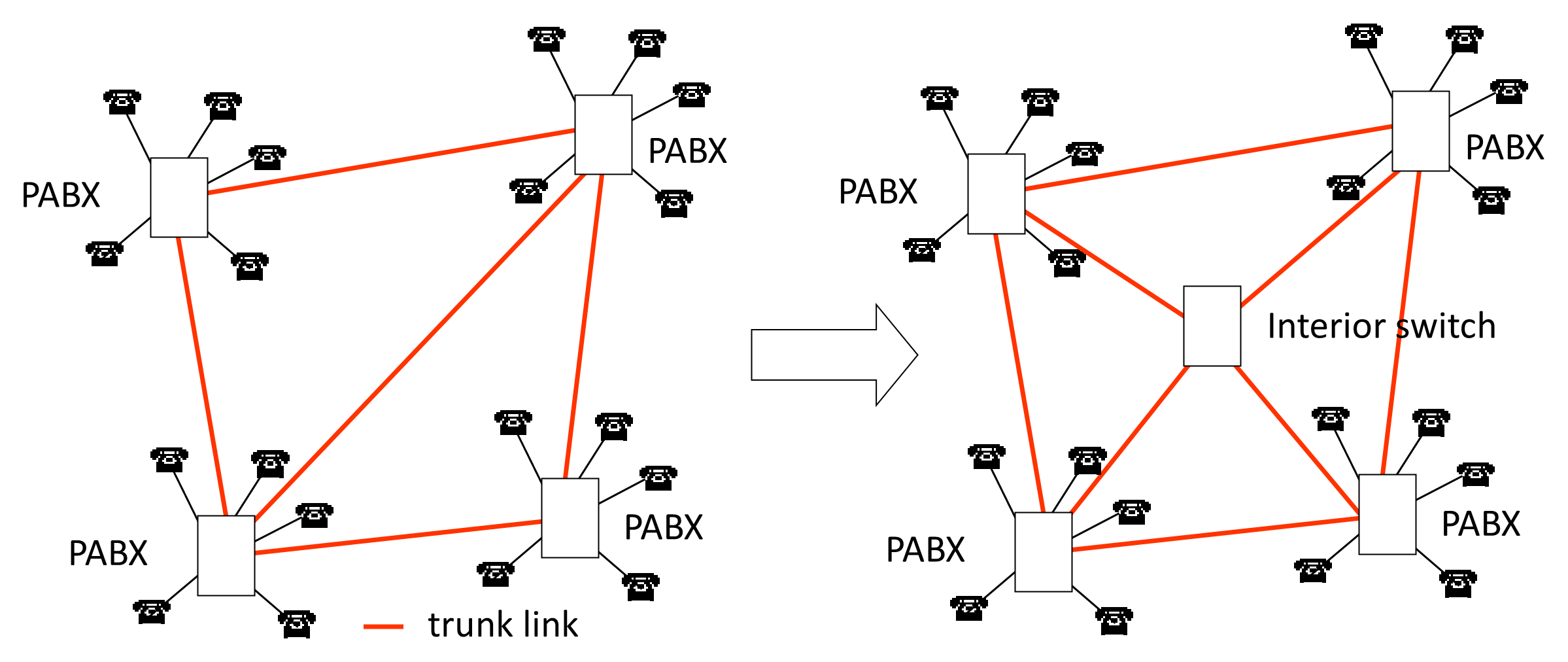
Private organizations often operate their own internal telephone systems known as Private Automatic Branch Exchanges (PABXs) or, more commonly today, Private Branch Exchanges (PBXs). These systems perform the same switching functions as public telephone exchanges but serve only users within a single organization while providing controlled access to the public telecommunications network.
The principal advantage of circuit switching is that, once the circuit has been established, communication resources are reserved exclusively for that connection. The available bandwidth is guaranteed, transmission delay is predictable, and delay variation (jitter) is extremely small. These characteristics made circuit switching ideally suited to traditional telephone networks, where continuous real-time voice communication requires a steady and uninterrupted flow of information.
Circuit switching also performs well when transferring large, continuous streams of information because the dedicated communication path remains available for the entire session. However, it is generally inefficient for bursty or intermittent traffic such as web browsing, e-mail, or machine-to-machine communications. During periods when little or no information is being transmitted, the reserved circuit remains unavailable to other users, resulting in poor utilization of network resources.
Another disadvantage is the requirement to establish and release the circuit before and after every communication session. For voice calls this setup delay is usually insignificant, but for short data transfers the signaling overhead may represent a substantial proportion of the total communication time. Furthermore, if the called party is busy or does not answer, the connection attempt fails and must be repeated later.
Although the traditional public switched telephone network was built almost entirely on circuit-switching principles, most modern communication networks now employ packet-switching techniques. Nevertheless, circuit switching remains important wherever guaranteed bandwidth, predictable delay, and continuous real-time communication are required. Even many modern Voice over IP (VoIP) systems establish temporary logical connections that provide many of the characteristics traditionally associated with circuit-switched networks.
13.2.1.1 Facsimile
One of the best-known historical applications of circuit-switched networks is facsimile, more commonly known as fax. The word facsimile means faithful copy and refers to the electronic transmission of documents from one location to another. Before email and digital document exchange became widespread, fax machines were extensively used by businesses, government agencies, hospitals, and legal offices to send signed documents quickly over the public switched telephone network (PSTN).
A fax machine is essentially a combination of a document scanner, a modem, and a printer. The transmitting machine scans the original document and converts it into a matrix of picture elements (pixels). The resulting image is compressed, encoded, and transmitted over the telephone network. At the receiving end, the fax machine demodulates the received signal, reconstructs the image, and prints a copy of the original document.
Traditional fax transmission was well suited to circuit-switched networks because a dedicated end-to-end connection was established for the duration of the transmission. This provided a continuous communication path with predictable delay and low error rates, allowing documents to be transferred reliably over ordinary telephone lines.
The International Telecommunication Union (ITU) defines several fax standards. The most widely adopted is Group 3 (G3), which was designed for analogue telephone networks and supports signaling rates of up to 14.4 kbps. Before transmitting a document, the two fax machines perform a handshaking procedure during which they negotiate the highest mutually supported signaling rate, compression method, image resolution, and error-control options. If line conditions are poor, the machines automatically reduce the transmission rate to improve reliability.
Although Group 3 fax remains the dominant legacy standard, fax traffic has declined dramatically with the widespread adoption of scanners, email, PDF documents, cloud storage, and electronic document management systems. Nevertheless, fax technology continues to be used in some industries—particularly healthcare, legal services, finance, and government—where established workflows or regulatory requirements still favor document transmission by fax. In many modern networks these transmissions are no longer carried over dedicated circuit-switched telephone lines but instead use Fax over IP (FoIP) technologies, such as the ITU-T T.38 protocol, which transport fax signals across packet-switched IP networks while maintaining compatibility with existing fax equipment.
Back to reading