
13.1.4 Summary Of Transmission Types
The direction of information flow is one of the most fundamental characteristics of any communication system. The choice between simplex, half-duplex, and full-duplex operation influences equipment complexity, spectrum utilization, communication efficiency, protocol design, and ultimately the user experience.
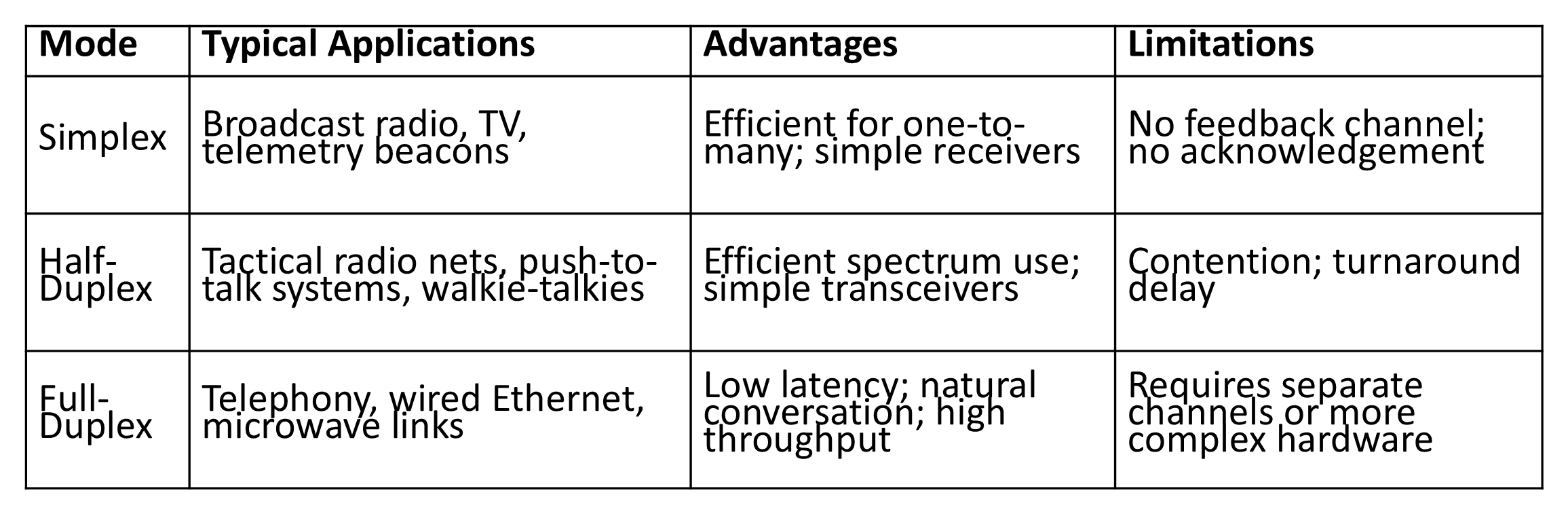
In simplex systems, information flows in only one direction. These systems are particularly effective for broadcasting, telemetry, remote monitoring, and navigation applications where no return path is required. Their simplicity allows inexpensive receivers while concentrating system complexity at the transmitting end.
Half-duplex systems permit communication in both directions, although only one terminal may transmit at any instant. They provide an economical compromise between simplicity and flexibility and remain widely used in land-mobile radio, tactical communications, maritime radio, and other shared-spectrum applications. Because the communication channel is shared, some form of access-control protocol is required to coordinate transmissions.
Full-duplex systems support simultaneous transmission and reception, providing the highest performance for interactive communication. They are the preferred choice for modern telephone systems, computer networks, fiber-optic links, microwave systems, and many broadband communication networks where low latency and continuous bidirectional communication are essential.
The choice between the three transmission modes depends upon the engineering trade-offs associated with the application. Important considerations include infrastructure cost, spectrum availability, bandwidth, latency, user density, coverage requirements, power consumption, and operational complexity. No single transmission mode is universally superior; each provides the most effective solution under particular operational and economic constraints.
Figure 13.7 provides a brief comparison of the three transmission modes.
The discussion so far has focused on the behavior of individual communication links. In practice, however, communication systems rarely consist of isolated links. Instead, they comprise many interconnected links serving large numbers of users who must share limited communication resources.
This introduces a new engineering challenge. While the transmission mode determines how information flows across an individual link, another mechanism is required to determine how links are interconnected, how communication paths are established, and how limited network resources are shared efficiently among many users. These functions are collectively known as switching.
The following section examines the principal switching techniques used in communication systems and traces their evolution from dedicated circuit-switched networks to the packet-switched architectures that underpin today's Internet and modern broadband communication systems.
Back to reading