
A suitable back-up system
Although satellite-based communications systems have vulnerabilities, there are methods available for reducing those vulnerabilities. These include satellite hardening, launching larger numbers of satellites to provide redundancy, and making satellites more maneuverable to avoid kinetic-energy weapons. However, satellite systems are expensive to develop and maintain, and these additional mechanisms simply exacerbate those aspects. If the high vulnerability of satellite communications is accepted, then the inevitable subsequent concern is with the availability of a suitable back-up communication system to take its place even if only for a short period.
As can be seen in Figure 7, if satellite communications are not available, there is no longer a single high-capacity, long-range system available for mobile users or for deployments at all ranges to areas without suitable terrestrial infrastructure. Consequently, the desired range has to be selected and the consequent maximum capacity must be accepted for that range.
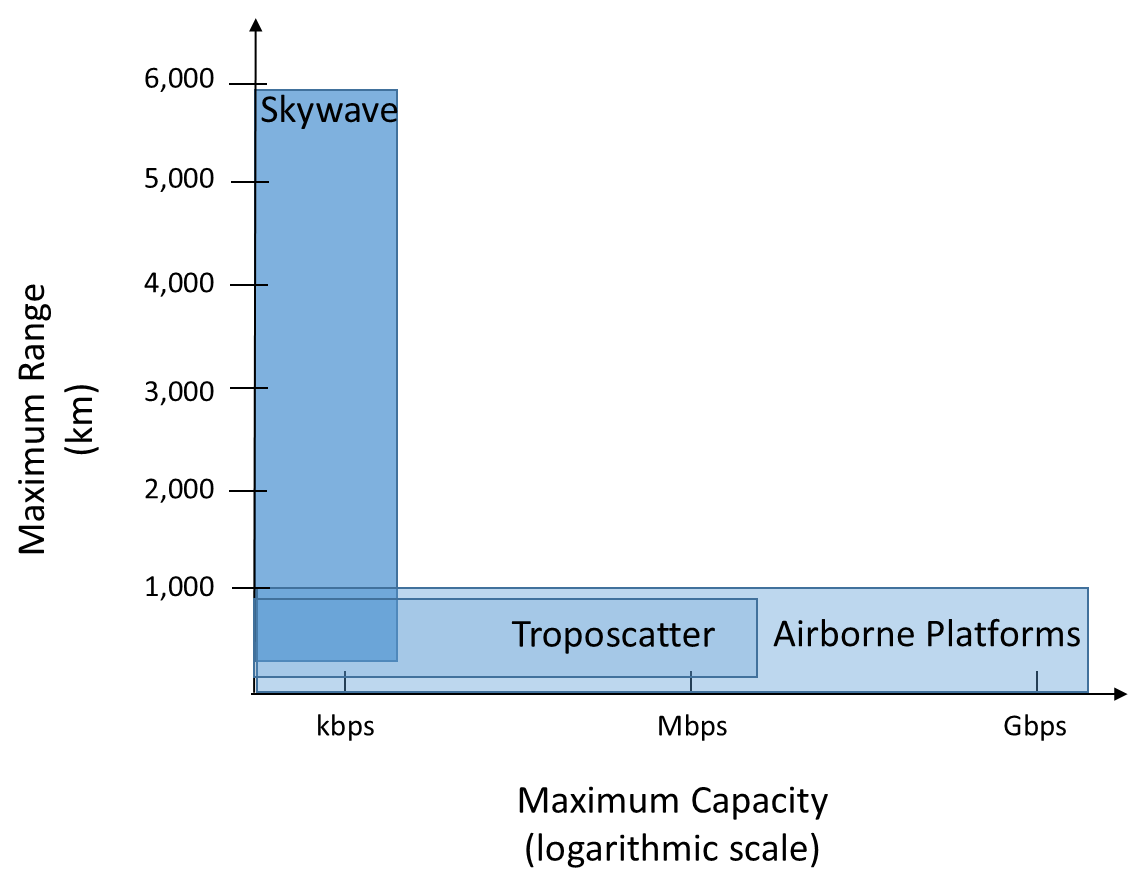
Figure 7 shows that, in the absence of satellite communications, BLOS communications are divided into two range brackets in which a different system is best suited:
- <1000 kms. Figure 7 shows that an airborne platform is best suited to this range if high capacity and high mobility are desired. It should be noted, however, that troposcatter is also useful for ranges of greater than 100 kilometers, albeit with lower terminal mobility, and considerably reduced capacity. The airborne platform can support small handheld terminals whereas the mobility of troposcatter terminals is constrained by the size of the transmit and receive antennas (although modern phased-array antennas will do much to alleviate this constraint). Longer ranges require fixed systems with very large antennas (30-40 meters) with current vehicle-borne terminals are limited to some 100 kilometers at 20Mbps data rates.
- >1000 kms. For ranges greater than 1,000 kilometers, only sky wave is available, although single-hop sky wave is limited to 3,500 kilometers during ideal ionospheric conditions. Multi-hop transmissions can allow world-wide communications given favorable ionospheric conditions but require the use of higher powers and larger antennas, with a subsequent reduction in terminal mobility.
It should be noted that while alternative back-up systems are available, the loss of satellite communications has a dramatic effect on the capacity available for longer ranges. As illustrated in Figure 7, airborne platforms can provide similar capacity as satellite communications (at a considerably reduced cost) but only at ranges less than 1,000 kilometers; troposcatter can provide similar ranges but at some one thousandth of the capacity of satellite communications and HF sky wave can provide potentially worldwide ranges but with one millionth of the capacity of satellite communications.
The conclusion from Figure 7 is that only HF sky wave is available as a suitable back-up system for long-range BLOS communication, should satellite communications not be available. Unfortunately, however, the available capacity drops dramatically to one millionth of the capacity of satellite communications.
Further, sky-wave communications have a number of disadvantages, other than the limited spectrum: channels are available worldwide with a large number of possible users; bandwidth is limited on each channel, leading to very low data rates of a few kilobits per second; the ionosphere is difficult to predict accurately and contains noise and interference; and HF signals can be jammed. The long wavelengths at sky wave require large antennas, and considerable management is required for the efficient use of frequencies. The effect of those disadvantages is not further addressed here, other than noting that such aspects must be managed to make use of HF sky wave as a back-up system.