5.6.1 Private And Public Key Pairs
Asymmetric encryption algorithms use different keys for encryption and decryption. The most important class of such algorithms is public-key encryption, in which one key (the public key) may be openly distributed without compromising the security of the corresponding private key.
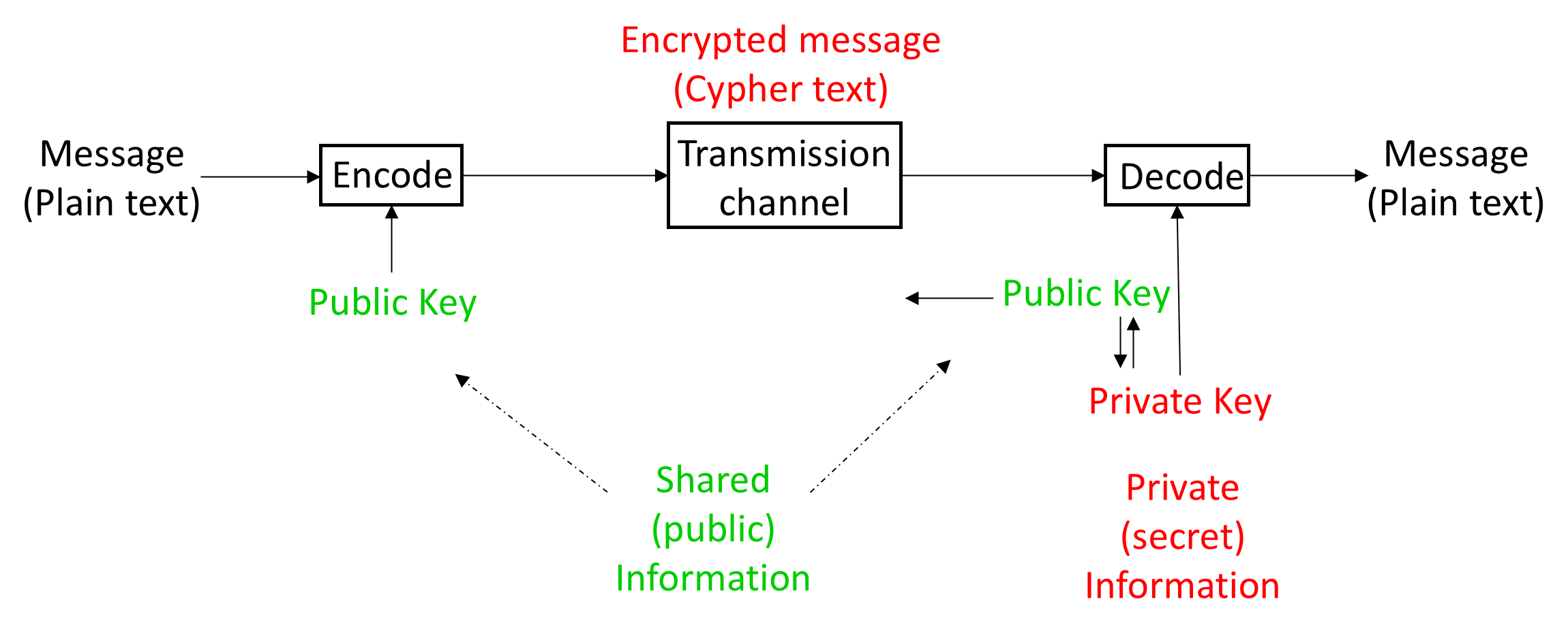
The fundamental security of public-key systems derives from the computational asymmetry between certain mathematical operations and their inverses. For example, while it is trivial to compute that 57 × 61 = 3,477, factoring 3,477 into its prime components requires testing divisibility by many candidates—an operation that becomes computationally prohibitive for very large numbers. This property underpins the security of modern public-key cryptosystems such as RSA, which is described in the next section.
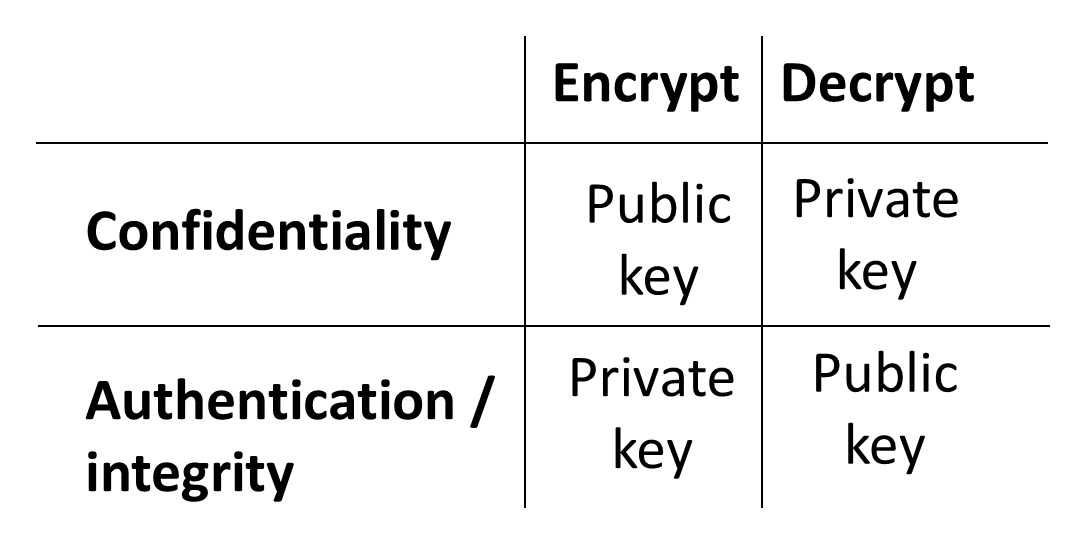
The dual use of key pairs in asymmetric encryption is illustrated in Figure 5.13. When data are encrypted using the public key and decrypted using the private key, confidentiality is achieved—only the intended recipient (who alone holds the private key) can read the message. Conversely, when data are encrypted with the private key and decrypted by anyone holding the public key, the operation provides authentication and message integrity: the receiver can confirm that the message could only have originated from the private-key holder. This principle forms the basis of digital signatures and public-key infrastructures used in modern secure communications protocols such as TLS, Pretty Good Privacy (PGP), and Secure/Multipurpose Internet Mail Extensions (S/MIME).