5.1.3 Example: The Caesar Cipher
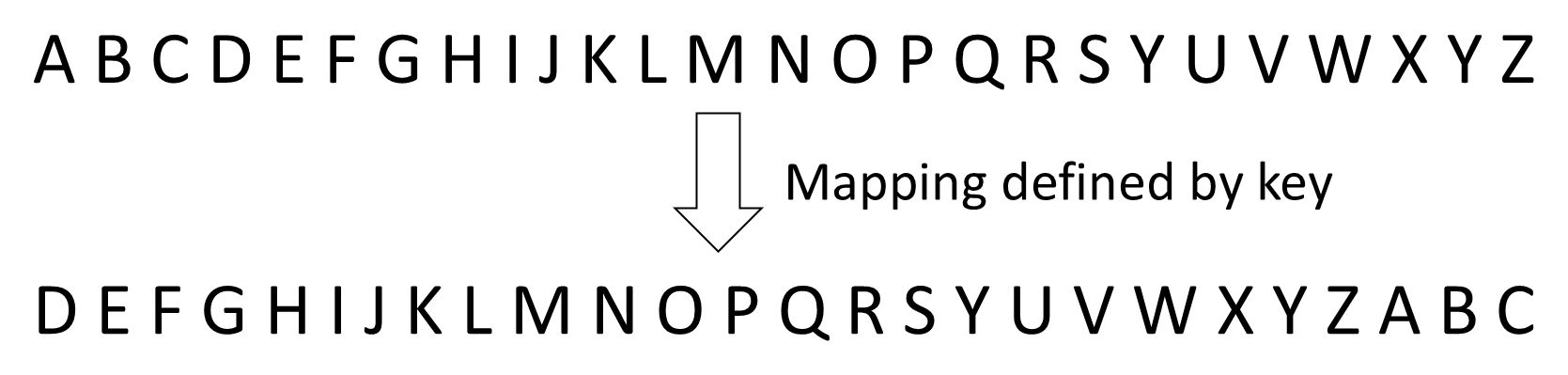
Figure 5.1 illustrates one of the simplest forms of encryption using a simple substitution cipher, attributed to Julius Caesar. In this method, each plaintext letter is replaced by another letter a fixed number of positions further along the alphabet. For example, with an offset (key) of 3, ‘D’ is encoded as ‘G’ and ‘Z’ as ‘C’; thus the word CANBERRA becomes FDQEHUUD.
The Caesar cipher exemplifies a monoalphabetic substitution cipher, a form of symmetric-key encryption. Because each plaintext symbol always maps to the same ciphertext symbol, such ciphers are easily broken by frequency analysis. The limited keyspace (only 25 possible shifts) and the preservation of statistical structure make them inherently insecure.
Modern cryptographic systems employ far more complex transformations, incorporating multiple substitution and transposition stages, large keyspaces, and mathematically strong operations that obscure both data structure and symbol frequency.