
4.8 INTERLEAVING
So far, we have considered the ability of block and convolutional coding schemes to detect and correct random bit errors—those occurring independently with roughly uniform probability. In developing block codes, in particular, we assumed that the number of errors per block was relatively small.
In many real-world communications channels, however, channel errors tend to occur in bursts rather than randomly. Burst errors arise from short-term impairments such as scintillation, fading, shadowing, and multipath propagation. While all satellite channels exhibit some burst behavior, mobile satellite communication systems are especially susceptible.
A simple but effective method for mitigating the effects of burst errors is interleaving, which rearranges the order of transmitted bits so that a burst of channel errors affects different codewords at different bit positions. In this way, interleaving converts burst errors into approximately random single-bit errors, allowing standard error-control codes to correct them effectively.
As illustrated in Figure 4.25, any (n,k) cyclic code can be formed into a new (αn, αk) code by arranging successive codewords into a matrix of n columns and α rows, where α is called the interleaving depth. The bits are then transmitted column-by-column, effectively spreading consecutive coded bits across multiple original codewords. Many forms of interleaver have been developed. The simplest is the block interleaver described in Figure 4.25, in which data are written into a rectangular memory row by row and read out column by column (or vice versa). More sophisticated designs include convolutional interleavers, matrix interleavers, helical interleavers, and random interleavers, each offering different trade-offs between burst-error protection, memory requirements, delay, and implementation complexity. Modern iterative coding schemes such as turbo codes rely heavily on carefully designed random interleavers to achieve their remarkable error-correction performance.
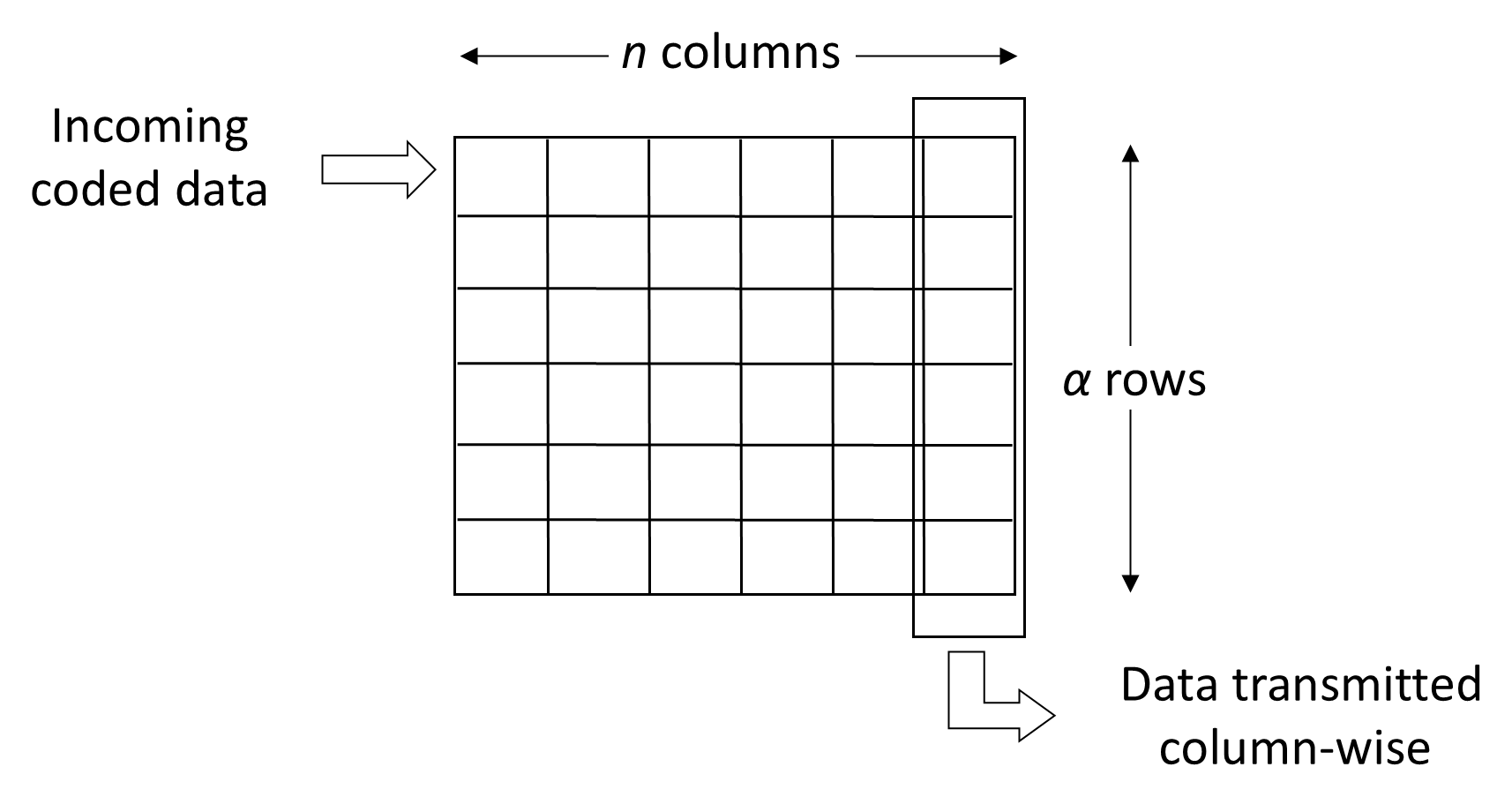
If the original code was cyclic with generator polynomial g(X), the new interleaved code is also cyclic, with generator polynomial g(Xα). The interleaved code can therefore be encoded and decoded as a cyclic code.
As a result, a burst of errors of length up to α bits produces at most one error per original codeword. If the underlying code can correct t or fewer errors, then the interleaved code can correct any combination of up to t bursts, each no longer than α bits.
In practice, deinterleaving at the receiver restores the original sequence order before decoding. The choice of interleaving depth α depends on the expected burst length and the acceptable delay introduced by the interleaver, since deeper interleaving improves burst tolerance at the cost of higher latency and memory requirements.
Interleaving is beneficial in both terrestrial and satellite communications, but its relative importance depends on the underlying channel characteristics. In terrestrial systems, such as mobile, microwave, and wireless links, multipath fading, impulse noise, and shadowing often produce long bursts of errors. Interleaving is therefore essential in these environments to randomize burst errors and enable effective use of convolutional, turbo, or LDPC codes.
In satellite channels, by contrast, noise is generally dominated by AWGN, which produces mostly random errors. Interleaving is therefore less critical in clear-sky conditions but remains valuable when links experience rain fade, ionospheric scintillation, or shadowing—particularly at low elevation angles or in mobile-satellite environments.
Consequently, interleaving is an integral part of concatenated coding schemes such as Reed–Solomon plus convolutional codes used in CCSDS and DVB standards, where it separates the error patterns seen by inner and outer decoders. Overall, interleaving provides an effective and low-complexity means of improving error resilience, trading increased delay and buffer memory for markedly better performance in burst-error channels.
The principal cost of interleaving is delay. Because the transmitter must accumulate data before rearranging it, and the receiver must wait until sufficient data have been received to perform de-interleaving, additional latency is introduced into the communication system. The amount of delay depends on the depth of the interleaver: larger interleavers provide greater protection against longer burst errors but require more memory and introduce longer delays. Designers therefore select the interleaver depth to achieve an appropriate balance between burst-error protection and system latency.
Interleaving illustrates an important principle that appears repeatedly throughout communications engineering: system performance can often be improved not by changing the communication channel itself, but by changing the way information is presented to the channel.
Back to reading