
4.5.2 General Block-Coding Scheme
We now consider a generic-block coding scheme before investigating specific examples. Figure 4.9 illustrates the basic parameters. A k-bit data word, D, is encoded into an n-bit codeword C, where n = k+r, by adding the r redundant bits. The codeword is then transmitted across the channel that introduces noise and other impairments represented collectively as an error pattern, E. The received word R is therefore C + E where the addition is modulo-2.
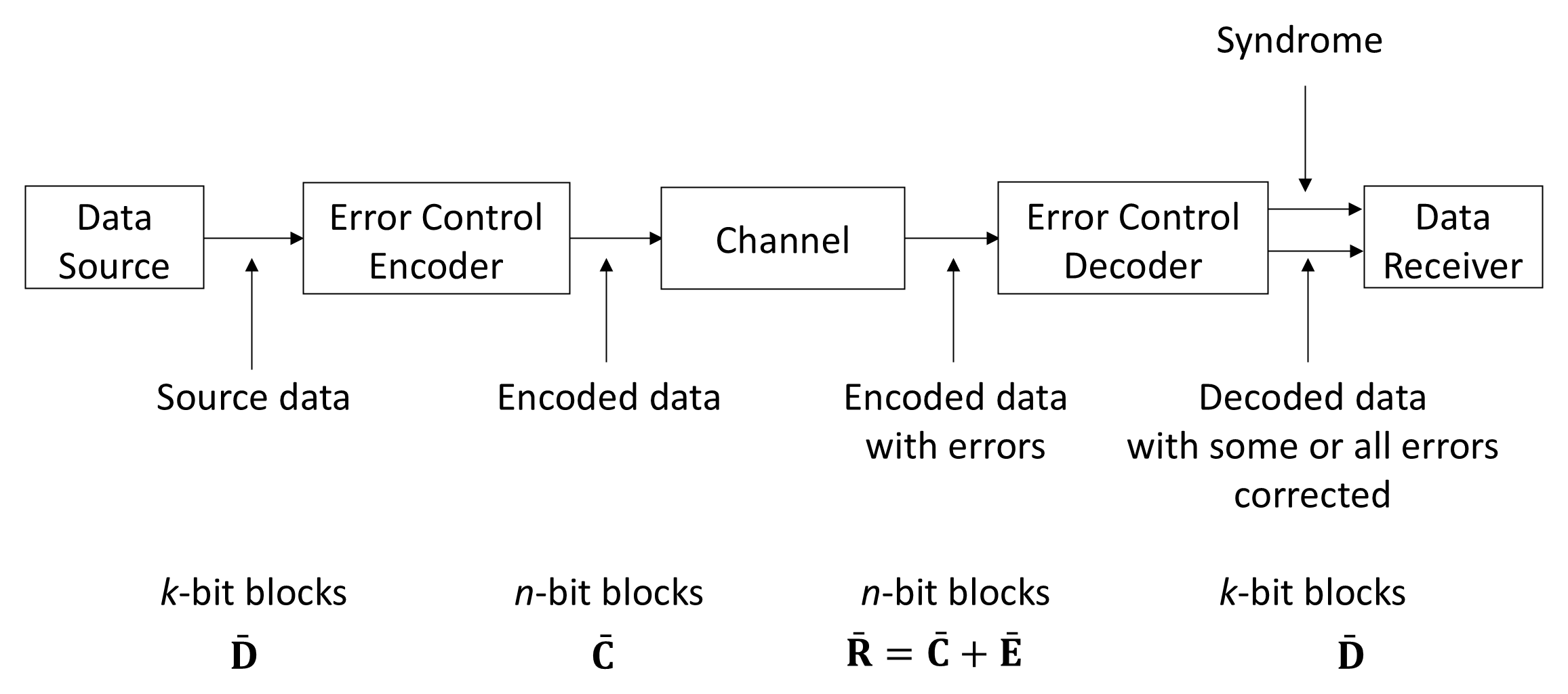
The error-control decoder processes the received word, using the redundancy embedded in the code to infer the most likely original data word D. As part of this process, it computes the syndrome, which indicates whether an error has been detected and, if the code permits, whether it has been corrected. The decoder then outputs either the corrected data word or an indication that the error was uncorrectable.
The receiver must then apply whatever policy is appropriate for the application. For example, a broadcast video system may simply ignore corrupted data (accepting occasional artefacts in the output shown to the user), whereas a data-communication system may request retransmission until an error-free block is obtained.
The following sections describe some example codes and the generation and decoding of block codes.
Back to reading