
4.14 INTEGRATING ERROR CONTROL IN SYSTEM DESIGN
The preceding sections have introduced the principal families of error-control codes, including modern capacity-approaching schemes, and have quantified coding advantage through coding gain. In practice, however, the performance of a communication link is determined not only by the choice of code, but by how error control is integrated into the overall system architecture. This section provides a system-level view of error control, linking physical-layer coding choices to channel conditions, latency constraints, feedback availability, and the performance measures used by higher-layer protocols.
Performance measures and design targets. Error-control design begins by choosing the appropriate performance measure for the service:
- Bite error rate (BER) is most useful for continuous bit streams and for assessing demodulator/decoder performance in AWGN analyses.
- Frame or block error rate (FER/BLER) is often the engineering metric for packetized systems, where a single uncorrected bit can invalidate an entire frame.
- Residual error rate after decoding may be expressed as BER, FER/BLER, or an application-level integrity measure, depending on whether corrupted frames are discarded, delivered with errors, or repaired by retransmission.
A common source of confusion is mixing these measures. A link designed to achieve a BER target may still have an unacceptable FER if frames are long; conversely, a system that discards errored frames may tolerate higher pre-discard BER provided the delivered FER meets service requirements. In packetized systems, these measures also influence throughput: a high frame error rate may result in frequent retransmissions, so that the effective delivered data rate depends not only on BER but also on frame length, loss correlation, and the retransmission policy employed.
Architectural choices: where redundancy belongs. Error control can be implemented at multiple layers, each serving a different purpose:
- Physical-layer FEC reduces the raw error probability and stabilizes the link under noise and fading.
- Link-layer detection (often CRC-based) provides strong integrity checking and enables discard, reassembly, or retransmission policies.
- Higher-layer mechanisms (e.g., transport-layer retransmission, application-layer coding) can provide end-to-end reliability across multi-hop networks.
The key architectural decision is therefore not merely “which code?”, but where the system expects errors to be corrected and where it expects errors to be detected and repaired by protocol.
Matching error control to the channel. The choice of strategy depends on the dominant impairment:
- AWGN-dominated channels favor codes designed for random errors, and performance is often predicted well by Eb/N0 curves.
- Burst-error channels (e.g., fading, impulse noise, shadowing, intermittent blockage) require interleaving, erasure-aware designs, or higher-layer recovery mechanisms.
- Interference-limited channels often require adaptive modulation/coding and careful framing to maintain throughput under changing interference conditions.
When channel conditions vary significantly over time, modern systems employ link adaptation (for example, adaptive coding and modulation or puncturing) to trade coding rate and modulation order dynamically, thereby balancing robustness and throughput while maintaining a target frame or block error rate (FER/BLER).
Latency, complexity, and block length. Although longer blocks and iterative decoders can deliver higher coding gains, practical systems are constrained by:
- Latency budgets (interactive voice, control links, short-packet telemetry),
- Decoder throughput (high-rate broadband links),
- Implementation cost and power consumption (handheld, embedded, onboard terminals).
These constraints often determine whether a system favors short- or long-block constructions, whether soft-decision decoding is feasible, and whether iterative decoding can be afforded at the target throughput.
Error control with and without feedback. Some systems can rely on a return channel and retransmission; others cannot. Where feedback is available and the round-trip delay is small relative to the service latency budget, retransmission-based schemes (ARQ) can achieve extremely high delivered integrity with relatively low redundancy. However, the efficiency of ARQ depends strongly on two factors: the round-trip time (RTT) and the statistical nature of the errors. Long RTTs increase idle time and buffering requirements, reducing effective throughput, while bursty or highly correlated losses may trigger repeated retransmissions of successive frames. In such conditions, ARQ throughput can degrade sharply even when the average bit-error probability is modest. Where feedback is unavailable, impractical, or associated with long propagation delay (for example, broadcast systems and long-delay links), FEC must carry the reliability burden and is typically paired with strong error detection to support discard and concealment policies. Hybrid schemes that combine FEC with selective retransmission (HARQ) provide a useful compromise where feedback exists but channel conditions are variable, allowing common error events to be corrected locally while reserving retransmission for rarer residual failures.
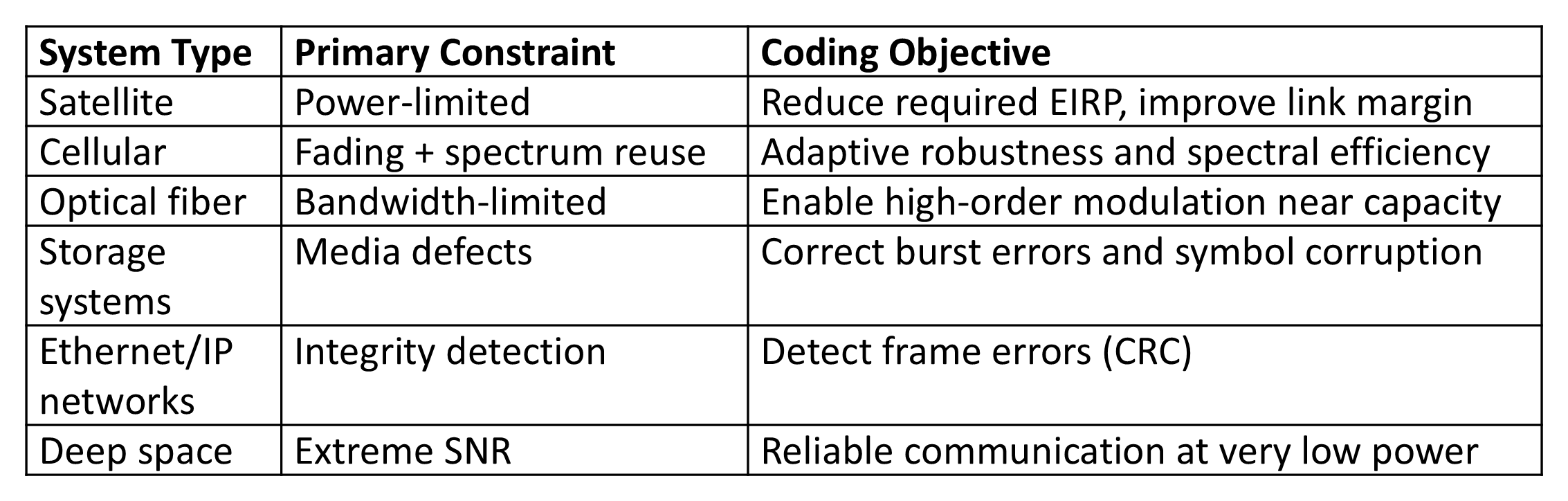
Coding across system domains. The role of coding varies by application. Figure 4-29 illustrates typical channel coding strategies in selected types of communications systems. This diversity illustrates that channel coding is not specific to any one technology nor does it have only one implementation objective. It is a universal physical-layer tool for managing uncertainty in the presence of noise. The domain-level comparison in Figure 4-29 is intentionally high-level: it shows how the primary constraint (power, bandwidth, fading, defects, or integrity) shapes the role that coding plays. To make these principles more concrete, the following worked example examines satellite communications in greater detail. Satellite links are particularly instructive because they combine power limitation, long propagation delays, and time-varying impairments, forcing explicit design choices about code family, interleaving, adaptation, and (where available) retransmission policy.
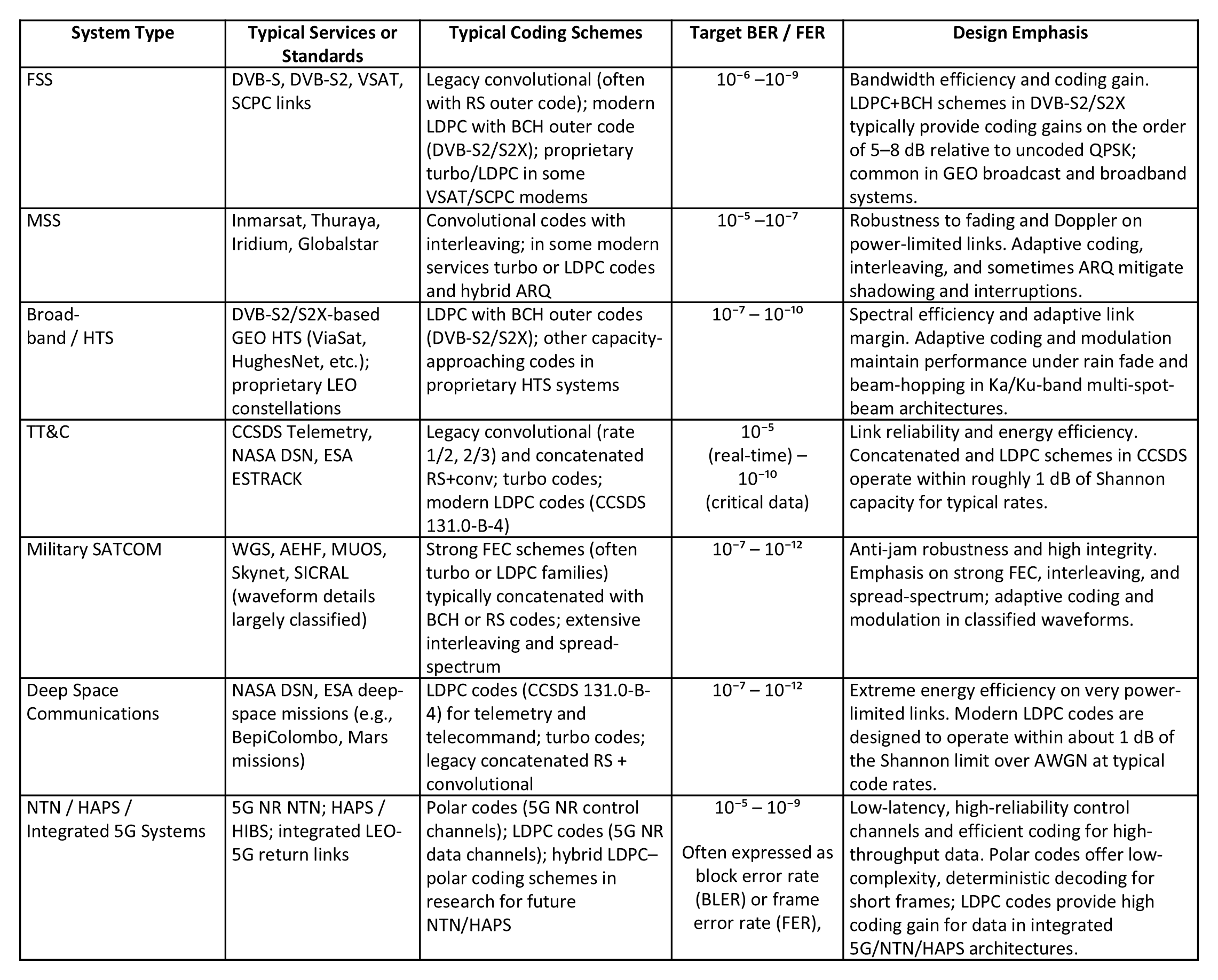
Worked example: satellite links in a broader context. Satellite communications provide a useful example because they combine several features that stress error-control design: long propagation paths, power-limited terminals, and in many cases time-varying attenuation and fading. Consequently, satellite waveforms commonly integrate strong FEC with interleaving and, where appropriate, link adaptation. In broadcast forward links, retransmission is generally impractical and the forward error correction scheme must be chosen to meet availability and delivered error-rate requirements under worst-case propagation. In two-way managed systems, retransmission may be feasible for selected services, but the propagation delay and scheduling overhead must be considered explicitly. Figure 4-30 summarizes typical channel coding strategies in satellite communications systems, providing an application profile illustrating how the general principles of this chapter are instantiated in one important domain, depending on the system type and the service provided.
Summary guidance for code and architecture selection. The following guidelines provide a practical checklist for selecting and integrating error control:
- Choose the service metric first (BER versus FER/BLER versus delivered integrity).
- Select a physical-layer FEC scheme consistent with the dominant impairment (random errors versus bursts/erasures).
- Use interleaving whenever burst errors are expected.
- Use strong error detection (typically CRC) whenever frames are delivered to higher layers.
- Decide explicitly whether reliability is achieved primarily by FEC, retransmission, or a hybrid mechanism.
- Ensure the chosen strategy fits latency and complexity constraints at the required throughput.
- Where channel conditions vary, consider link adaptation to trade robustness and throughput while maintaining a target FER/BLER.
Taken together, these considerations emphasize that error control is not a single design choice but an architecture: the selected code family, interleaver, framing, detection method, and feedback strategy must be consistent with the channel impairments and the service objectives. The next section summarizes the principal coding concepts introduced in this chapter and highlights the key system-level lessons for designing reliable communication links.
Back to reading