4.12 CODING GAIN
The advantage of coding can be quantified by a parameter called coding gain, Gc, which expresses how much less Eb/N0 is required when coding is used to achieve a given BER, compared with an uncoded system:
where the Eb/N0 ratios are for the uncoded and coded cases with the same BER at the receiver for the same data rate.
In decibels, the coding gain is:
This shows directly how many decibels less Eb/N0 is required when coding is applied. For example, a coded system achieving a target BER with Eb/N0 of 15 dB and a coding gain of 5 dB would perform equivalently to an uncoded system requiring Eb/N0 of 20 dB. Similarly, if a coded link operates at Eb/N0 of 21 dB an uncoded system would require Eb/N0 of 26 dB to achieve the same BER.
An approximate expression for coding gain, suitable for comparative analysis for estimating the performance of different codes without requiring full simulation or analytical evaluation of BER curves, is given by:
where r is the code rate (k/n), and d is the minimum distance of the code. The factor rd is called the code quality factor.
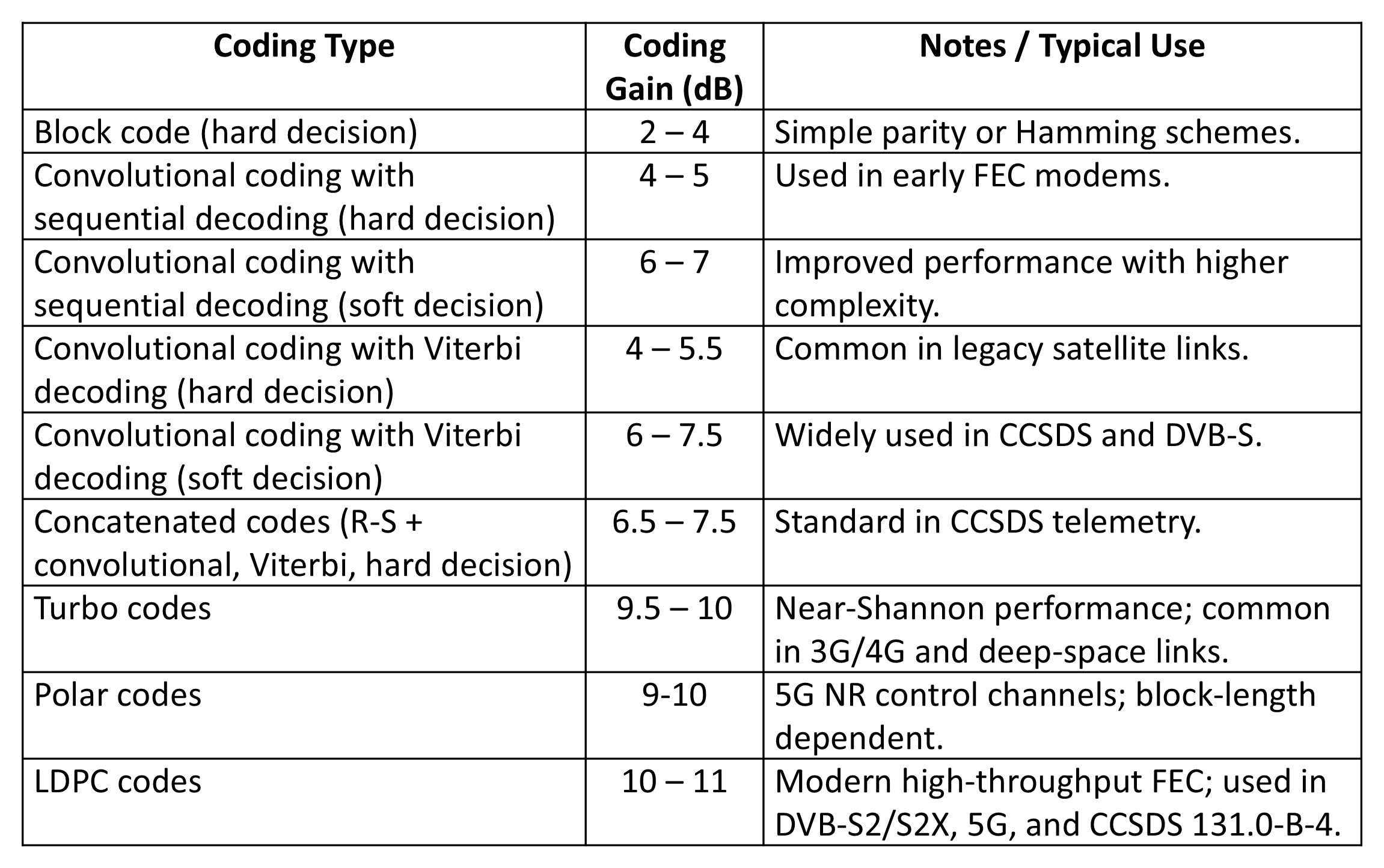
Figure 4-27 provides a comparison of representative channel-coding gains for various coding techniques in an AWGN channel at a BER=10–5. Coding gain for satellite communications applications typically ranges from 4–11 dB depending on the scheme and code rate.
Coding gain provides a convenient performance comparison, but system design must also account for latency, framing, and error-control architecture (Section 4.14).