
Volume 16, Number 2, July 2013
Dealing With Non-Stationarities In Violence Data Using Empirical Mode Decomposition
- 1 Department of Physics, Presbyterian College, Clinton, SC, 29325 USA.
- 2 DRDC CORA, 101 Colonel By Drive, Ottawa, ON, K1A0K2, Canada.
Abstract
Empirical mode decomposition (EMD) has been used across a variety of different fields such as biology and plasma physics. This paper presents the application of EMD to time series of security incidents from Afghanistan. This methodology enables separation of different modes intrinsic to the data, thus enabling better understanding of various overlying trends when compared to more conventional methodologies, and it provides a venue for the in-depth analysis of multi-scale dynamical properties of the data. In particular, the approach does not require a priori assumptions about time dependence of various data sub-components, such as periodicity of variations, thus providing a superior approach to conventional methods of analyzing violence data such as seasonal decomposition not only for the analysis of stochastic and fractal properties of the data, but even for a more conventional analysis of violence trends in direct support of military operations.
Introduction
Security incidents became one of the prime objects in the analysis of current operations in Afghanistan and Iraq. The exact definition of what comprises a security incident can vary somewhat among different organization, but they typically include violent events such as roadside bombs (attempted and exploded), ambushes and raids (direct fire engagements), anti-aircraft fire, and indirect fire incidents.
The security incident time series from military conflict areas are often an overlay of multiple components driven by different mechanisms that mask key trends. This is especially true for the data from the current conflict in Afghanistan.
The trend in violence has two major components, namely seasonal variance and a multi-year trend rendering the time series non-stationary. In addition, there are a number of factors such as religious holidays that shift from one year to another and thus are not well reflected in the annual component [1], yet they can affect the violence levels.
In this paper we apply empirical mode decomposition (EMD), devised for analyzing different modes in nonlinear and non-stationary time series, to the violence time series from Afghanistan over 2008–2012 period. To our knowledge this is the first time such an approach is applied to combat data.
The paper is organized as follows. First, traditionally used methodologies dealing with the violence data are summarized, and potential limitations are addressed. Then the EMD methodology is described, and finally the results of this methodology applied to almost four years of violence data from Afghanistan are presented.
Analyzing violent incident data in afghanistan – current approaches
There are multiple ways of characterizing violent incidents in Afghanistan. For the purpose of this paper they will be divided into two main groups: roadside bombs and other kinetic actions (comprised of direct and indirect fire incidents and anti-aircraft fire). For brevity, the latter will be denoted simply as “kinetic actions”.
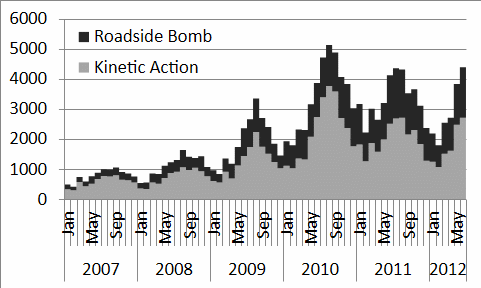
Both groups feature similar long-term behaviour, including annual cycles with increases in summer and decreases in winter (Figure 1) [1,2].
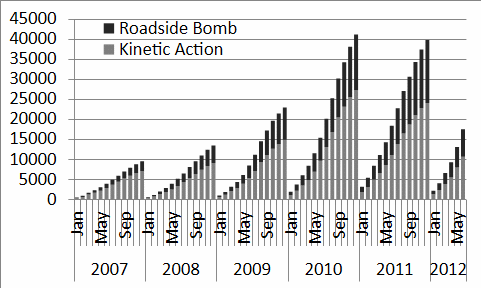
Reference [1] presents several options in dealing with seasonality in the number of security incidents. One option is using year-to-date (YTD) comparisons; the other is using seasonal decomposition [3]. Both of the approaches have serious setbacks for analyses of dynamic properties of violence time series. The YTD (Figure 2) is in essence a cumulative number of incidents reset at 1 Jan (or any other equally arbitrary date) each year. Consequently it renders any analysis of fine-scale and multi-scale dynamics almost impossible [1].
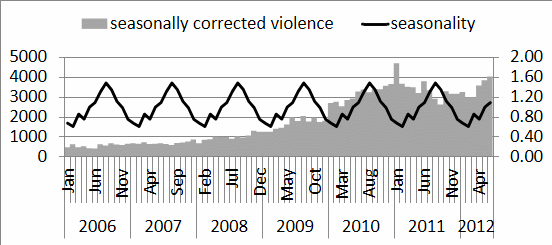
Seasonal decomposition works well if one is interested primarily in the long-term trend component (Figure 3, top), as it appears to remove seasonal variations (Figure 3, bottom).
The methodology has several significant limitations. First, it is necessary to assume the length of the seasonal cycle a priori, and the methodology uses the same period for the entire time span. Therefore, its applicability is limited in cases when the length of the seasonal variation fluctuates (for example, one year the winter can be longer than other years).
In addition, the methodology uses averaging over the length of the seasonal variation, thus again potentially losing short-scale temporal dynamics.
Despite the limitations of the methodology, seasonally adjusted violence data have been successfully and extensively used to assess correlations of violence with a variety of factors, such as weather, troop strength, and major events.
However, this approach is dependent on the analysts’ assumptions and consequently the obtained modes do not necessarily form a complete (or at least near-complete) base. In addition some correlations may be due to a common driver and thus be mutually dependent, further limiting the applicability of the methodology.
The proposed EMD addresses many of these concerns. The obtained modes are inherent to the data and do not require a priori assumptions.
In addition, they form a near-complete base, and retain even fine-scale dynamics, thus enabling better study of cross-scale dynamical processes than existing methodologies [4].
Empirical mode decomposition
Data describing dynamics of most real systems, whether natural or man-made, are often characterized by inherent nonlinearity and non-stationarity. this is why it is necessary to employ different analytical methods directly derived from the data themselves and capable of representing the inherent complex multiscale nature of dynamical systems [4–7].
To date in military data there has been a reliance on a priori methodologies to determine the trends or basis function underlying the dynamics. But in reality an a priori defined function cannot be used to build such a basis, no matter how sophisticated the basis function might be. A limited number of adaptive methods are available for signal analysis, among them being EMD [8], which serves as a complement to Fourier and wavelet transforms. In contrast to most other methods, the EMD method is intuitive, direct, and highly adaptive, with a basis defined a posteriori from the decomposition method derived from the data.
The essential idea of EMD is that any time series can be written as the superposition of a small number of monocomponent signals called intrinsic mode functions (IMFs), each characterized by a well-defined frequency. Each mode contains different features related to signal behavior for various frequencies.
EMD has been used successfully in many applications in analyzing a diverse range of data sets in biological and medical sciences, geology, astronomy, engineering, and other fields [9].
The EMD is obtained through a sifting algorithm: Let {tj} be the local maxima of a signal X(t). The cubic spline EU(t) connecting the points {(tj, X(tj))} is referred to as the upper envelope of X. The lower envelope EL(t) is similarly obtained from the local minima {sj} of X(t). Then we define the operator by:
In the so‐called sifting algorithm, the first intrinsic mode function the EMD is given by:
Subsequent intrinsic mode functions in the EMD are obtained recursively by:
The process stops when Y = X − I1 − I2 −…− Im has at most one local maximum or local minimum. This function Y(t) is the local trend in X(t).
Results
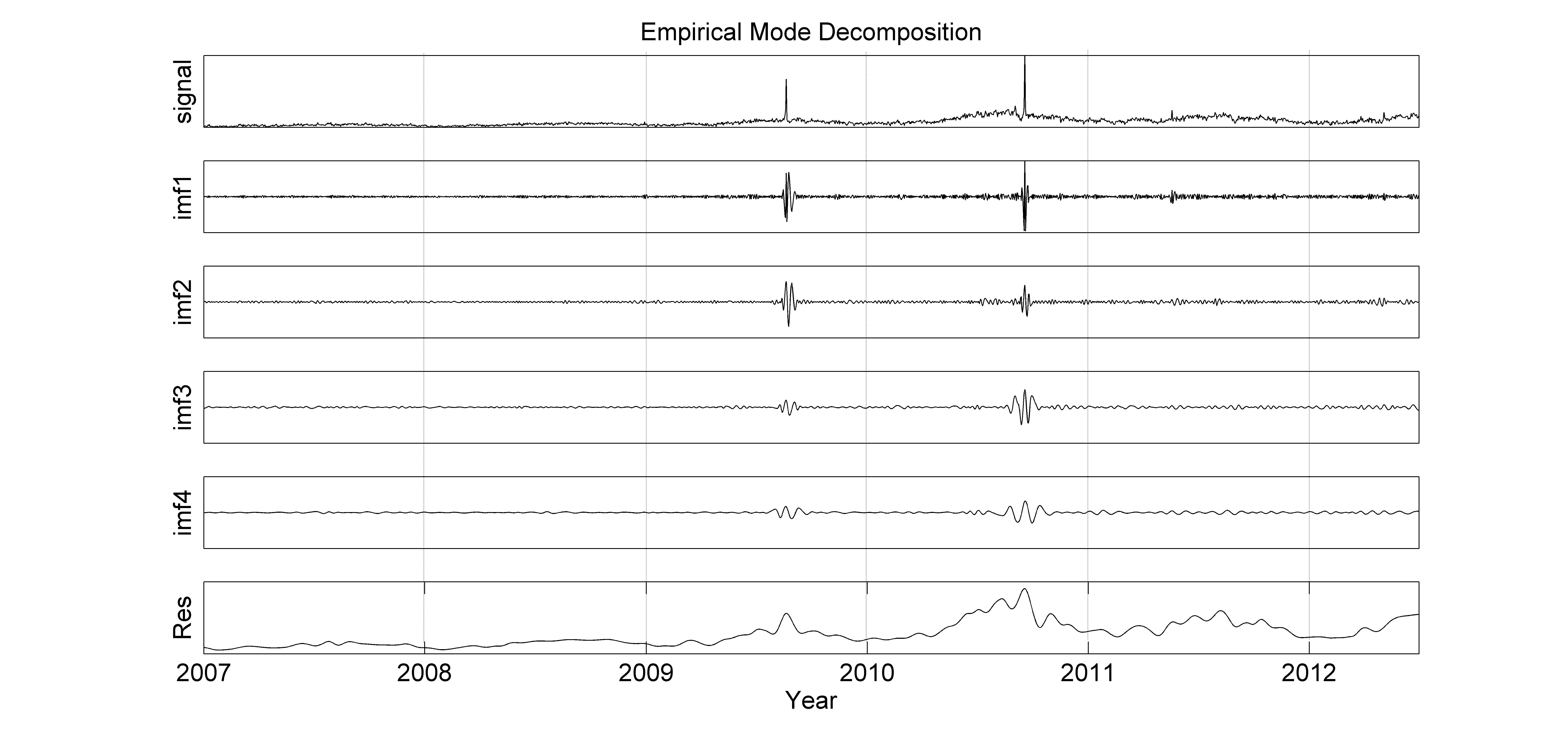
We used the EMD to get the intrinsic mode functions as displayed in Figure 4 for the roadside bombs. These data show that the randomness becomes less from I1 to I4, and I4 is relatively smooth. Hence we define the local trend of the road side-bomb data as Y = X − (I1 + I2 + I3 + I4) as in [10]. We then remove the local trend from the raw data by X–Y to get the detrended data (I1 + I2 + I3 + I4), which appear to be stationary for most of the signal.
In Figure 5 we show the violence data in grey and the trend derived from EMD in black. To best illustrate the fit for the roadside bomb incidents (top) the ordinate is truncated as the spikes in violence during the elections of 2009 and 2010. reach values near 400 and 600 daily events, respectively.
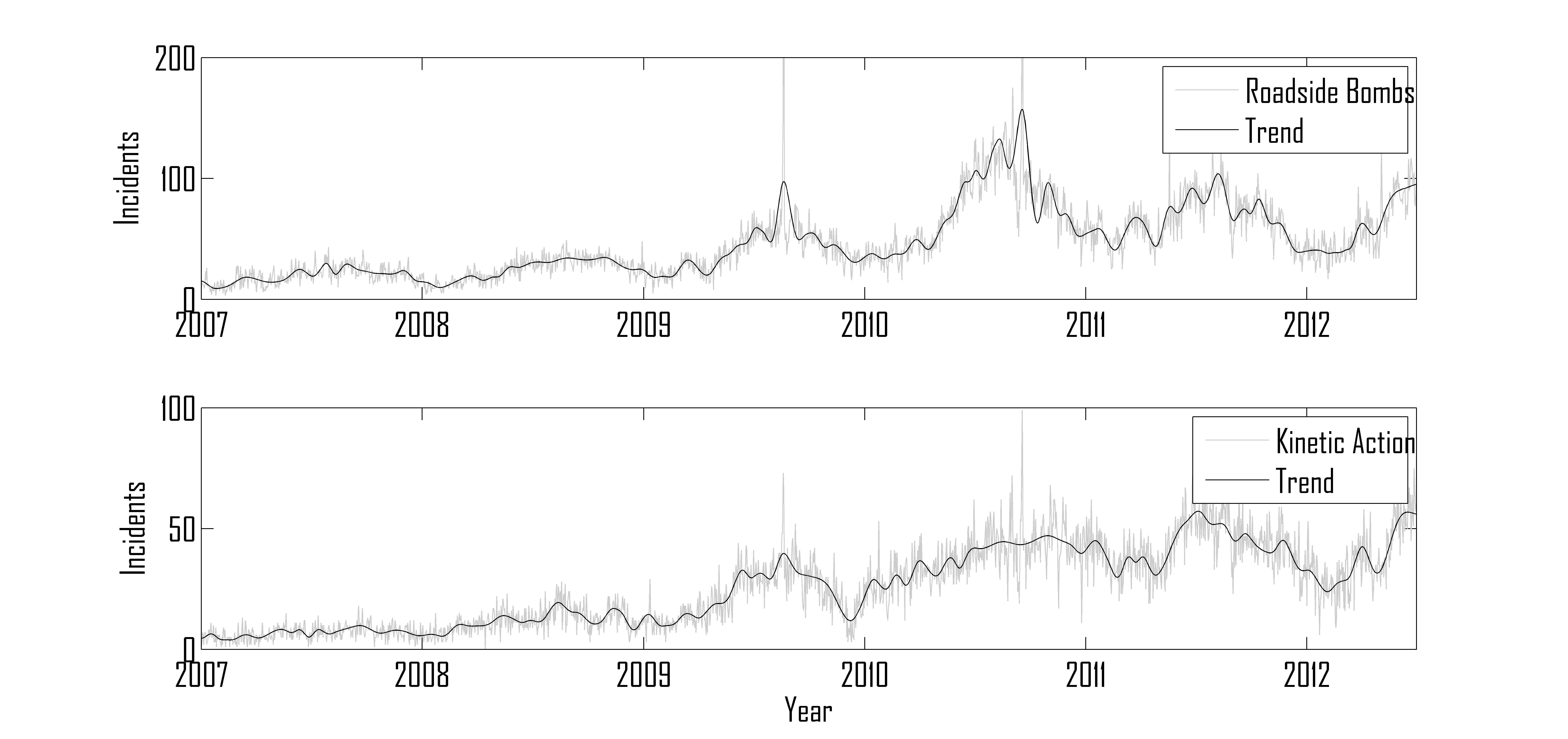
A clear seasonal trend is found, peaking after the middle of each year, and increasing in amplitude till 2010 where after the amplitude decreases.
For kinetic action (bottom panel) the annual trend is also visible, but the amplitude continues to increase throughout the data interval.
A closer look at the residual in Figure 4, as well as the trend derived from EMD reveals that the “annual” cycle that has been used previously for the seasonal decomposition is not strictly periodic, and that there is a year-to-year variation in the length of this cycle. To investigate this further, additional modes were calculated (Figure 6)
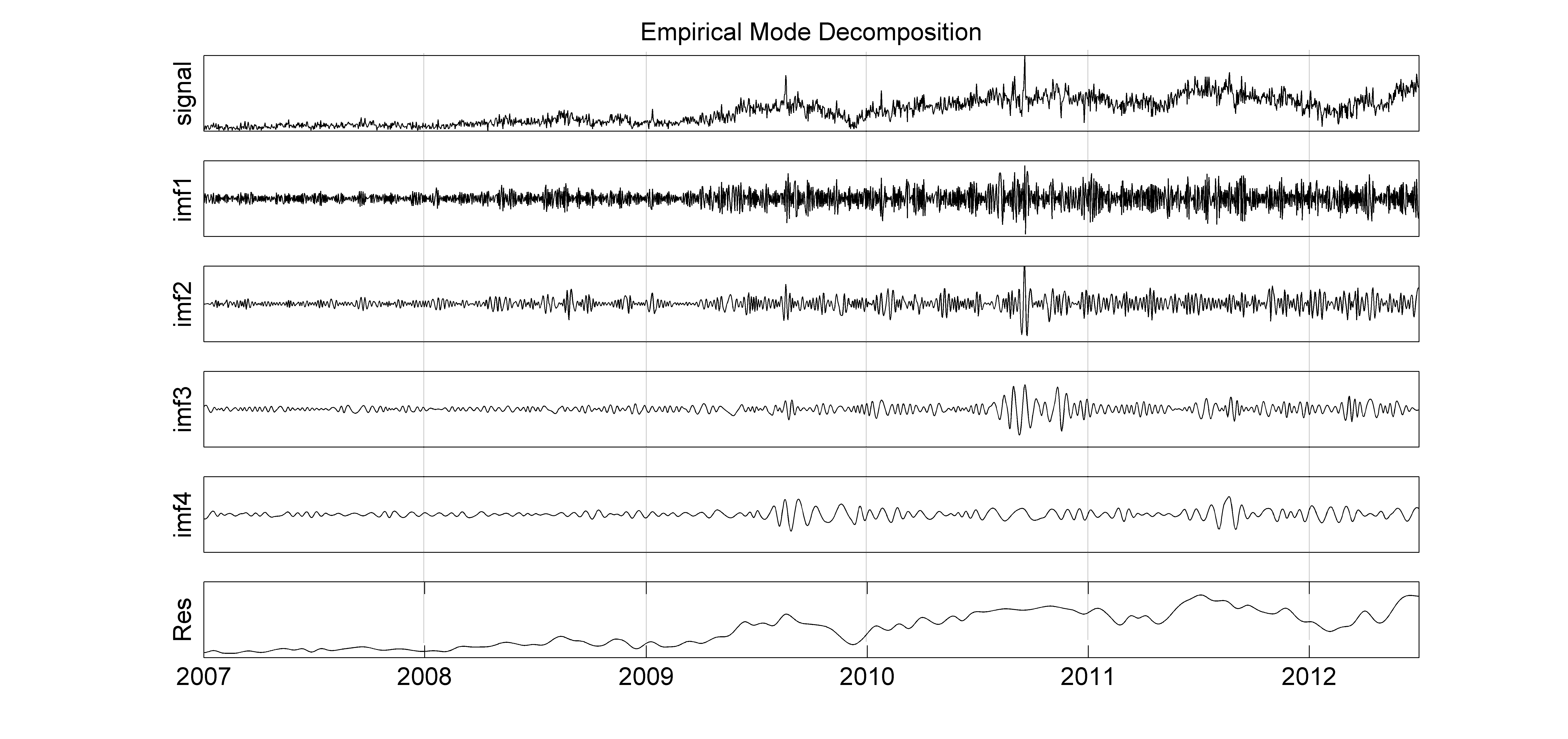
The mode imf7 corresponds to the annual cycle. The length of the cycle varies from year to year between approximately 11 and 13 months. This highlights a limitation of the standard seasonal decomposition for the removal of seasonal trends. The common assumption of a constant season duration invariably leads to overestimation or underestimation of the seasonally corrected data around turning points (minimums and maximums). This limitation would be of a lesser importance if only long-term (multiyear) variations were considered.
Summary and conclusions
The present paper explores the use of empirical mode decomposition to deal with complex data sets obtained in the context of irregular warfare, such as violence data from Afghanistan. Violence data from Afghanistan feature several different modes, ranging from pseudo-random short-term variations, through annual cycles, to multi-year trends. While some conventional methodologies such as seasonal decomposition enable separation of some of these modes, they are limited by the fact that the seasonal cycles are not strictly periodic.
The a priori assumption of a constant period required for the seasonal decomposition skews the long-term trend around turning points. For this reason we explore a relatively new method of decomposing data with complex nonlinear trends, viz. empirical mode decomposition (EMD).
By contrast to conventional methods, the EMD does not make any a priori assumptions. Instead it identifies intrinsic modes present in a time series. Depending on the purpose of a particular analysis, more or fewer modes can be used.
We have demonstrated that the EMD provides a tool that can be used for both the analysis of trends for an operational assessment of a military campaign, and for the analysis of internal structure of time series in the context of complex systems. We will explore details in later work.
References
[1] E. Gons, J. Schroden, R. McAlinden, M. Gaul, B. VanPoppel, “Challenges of Measuring Progress in Afghanistan Using Violence Trends: The Effects of Aggregation, Military Operations, Seasonality, Weather, and Other Causal Factors”, Defence & Security Analysis, Vol. 28, No. 2, 2012, pp. 100-113.
[2] International Security Assistance Force, Monthly Violence Trends, published monthly at www.isaf.nato.int.
[3] T. Hill, P. Lewicki, Statistics: Methods and Applications, StatSoft, Tulsa, OK, 2007; (Electronic version: StatSoft, Inc.. Electronic Statistics Textbook. Tulsa, OK: StatSoft, 2012. WEB: http://www.statsoft.com/textbook/).
[4] V. Anh, Z.-G. Yu, and J.A. Wanliss, “Analysis of Global Geomagnetic Variability”, Nonlinear Processes in Geophysics, Vol. 14, No. 6, 2007, pp. 701–708, doi:10.5194/npg-14-701-2007.
[5] J. A. Wanliss and J. M. Weygand, “Power Law Burst Lifetime Distribution of the SYM-H Index”, Geophysical Research Letters, Vol. 34, L04107, 2007, doi:10.1029/2006GL028235.
[6] J.A. Wanliss and V.M. Uritsky, “Understanding Bursty Behavior in Midlatitude Geomagnetic Activity”, Journal of Geophysical Research, Vol. 115, 2010, A03215, doi: 10.1029/2009JA014642.
[7] J.A. Wanliss and M.A. Reynolds, “Fractal Dimension of Low-latitude Geomagnetic Temporal Variations”, Annales Geophysicae, Vol. 21, 2003, pp. 2025–2030, doi: 10.5194/angeo-21-2025-2003.
[8] N.E. Huang, Z. Shen, S.R. Long, M.C. Wu, S.H. Shih, Q. Zheng, C.C. Tung, and H.H. Liu, “The Empirical Mode Decomposition and the Hilbert Spectrum for Nonlinear and Non-stationary Time Series Analysis”, Proceedings of Royal Society of A-Mathematics and Physics, Vol. 454, 1998, pp. 903–993, doi:10.1098/rspa.1998.0193.
[9] Z.-G. Yu, V. Anh, Y. Wang, D. Mao, and J. Wanliss, “Modeling and Simulation of the Horizontal Component of the Geomagnetic Field by Fractional Stochastic Differential Equations in Conjunction with Empirical Mode Decomposition”, Journal of Geophysical Research, Vol. 115, 2010, A10219, doi:10.1029/2009JA015206.
[10] F. Shi, Q.J. Chen, and N.N. Li, “Hilbert Huang Transform for Predicting Proteins Subcellular Location”, Journal of Biomedical Science and Engineering, Vol. 1, 2008, pp. 59–63.