
Volume 15, Number 1, March 2012
Sensemaking In A Combat Support Headquarters
- * School of Electronic, Electrical and Computer Engineering, University of Birmingham, Edgbaston, Birmingham, B15 2TT, UNITED KINGDOM.
- ** Systems Engineering and Assessment (SEA), Beckington Castle, 17 Castle Corner, Beckington, Frome, Somerset, BA11 6TA, UNITED KINGDOM.
Abstract
This paper presents an exploration of sensemaking in response to disruptions to logistics networks. Observations were conducted with two deployments of a UK Combat Support Headquarters during their pre-deployment exercises between October 2010 and November 2011. This research identified that the resolution of disruptions is primarily a framing problem—that is, it is principally concerned with the definition of the ‘problem space’. Sensemaking for problem solving is a collaborative process; even seemingly simple problems are rarely solved by a single specialist or branch—many require multi-branch input, both for framing and solution development. Problem solving therefore becomes an issue of transactive memory regarding the social network of the headquarters (that is, knowing who to talk to) rather than merely one of direct access to information (that is, knowing what information to look for or where to find it). This implies that Information Management is more than the effective use of technology but must also consider the Human Factors associated with the manner in which information is captured and shared. To this end, a wide range of artefacts is shown to support sensemaking activity, by representing the current state of the problem space and by functioning as resources for action—cueing frame seeking and frame-defined data collection. Suggestions are made for improving collaborative sensemaking within the Combat Support Headquarters.
Introduction
The notion of logistics as a supply ‘chain’ implies a linear sequence of interlocking elements; however, in recent years this metaphor has been challenged by the concept of the logistics network [1]. Indeed, in the UK, the Defence Support Chain organisation is currently being transformed into a Defence Support Network. The logistics supply network functions as a total process from concept to disposal and exists to maximise the freedom of action of commanders [2,3]. In order to achieve this, the principles of military logistics are defined as foresight, efficiency, simplicity, cooperation, and agility [4].
Supply networks may be considered as complex adaptive systems consisting of both material and knowledge flow [5]. ‘Knowledge logistics’ is a phrase used to describe the process of providing timely access to knowledge [6], however, as greater quantities of information do not necessarily improve situation awareness [7], the necessity is not for ‘information superiority’, but rather for logisticians to be able to make sense of the system that they operate within. This paper presents a study of sensemaking processes within UK Combat Support Headquarters prior to deployment to Afghanistan.
Sensemaking and shared understanding
Sensemaking is conceptualised as the ongoing process by which people construct meaning and develop explanations in order to establish what is going on [8,9]. Pirolli and Russell [10] propose that contemporary theories of sensemaking can be divided into three broad perspectives. The first involves the processes of transforming an artefact or representation, from its initial state into one to which expertise can be applied and then into a form more suited to communication [10]. This view of sensemaking as a technologically mediated activity [11] is analogous to some of the concepts underpinning Distributed Cognition, which is the study of cognitive processes of groups of individuals and artefacts engaged in the performance of a task [12]. The concept of artefacts functioning as resources for action argues that their design appearance or functionality may act as prompts for agents to perform certain activities [12], therefore it is also important to consider how the design and use of artefacts may guide the sensemaking process.
The second perspective involves the mapping of data to frames. In Klein, Moon and Hoffman’s [13] data/frame model, frames (which are akin to schema) take the form of a retrospective narrative account, based on expertise and experience—and are used to organise data and anticipate future events [14]. According to this model, the process of sensemaking involves the recognition and fitting of data into an appropriate frame, which then guides further data collection and influences the filtering of data viewed as relevant to the situation [13]. These processes of frame construction/modification and frame-defined data collection are thought to occur in parallel [13]. This approach suggests that it is important to consider ways in which logistics problems are ‘framed’, meaning both the ways in which an issue can be described and the underlying assumptions that define an issue’s importance.
The third perspective is the collaborative search-after-meaning. Weick [8] describes sensemaking as a social process that takes place in equivocal situations—that is, where different meanings or significance may be attributed to the situation. As a result, Weick stresses the importance of the expertise and experience of those parties involved in the collaborative interpretation of events [8,15].
In discussions of ‘sharedness of understanding’ of members of a team, Bourbousson et al. [16, page 120] state that for a specific task, sharedness can be explored through the consideration of three areas which closely match Russell and Pirolli’s [10] perspectives of sensemaking:
- The contents of sharedness—that is, what information do teammates need to share in order to work together effectively? This can be related to Russell and Pirolli’s [10] first perspective on sensemaking (the processes involved in artefact transformation).
- The forms of sharedness—that is, should knowledge be shared by all members or should it be selectively distributed? This can be related to Russell and Pirolli’s [10] second perspective on sensemaking (the processes involved in defining ‘frames’).
- The process of sharing—that is, how should sharedness be constructed and regulated by the team members? This can be related to Russell and Pirolli’s [10] third perspective on sensemaking (which relates to the social processes of collaborative search-after-meaning).
This categorisation provides a structure for the description and analysis of sensemaking during military logistics and will be used to discuss the findings discussed later in this paper.
Combat support headquarters
The role of the Headquarters observed is to provide logistic Combat Support Services and deliver broader capability integration, campaign infrastructure development, inter-theatre movement, personnel administration, and national support planning functions. This includes some logistic support to partner ISAF (International Security Assistance Force) national forces. The wider command structure that the Headquarters sits within is complex; in addition to forming part of UK Command and Control in Afghanistan, it is also under the operational control of ISAF command elements. The Headquarters comprises a core of logistics Brigade personnel, augmented by staff from across the three services. The role of the Logistics Brigade Headquarters is to carry out the command and control of those support activities defined above; command authority is held by the Commander, whilst the capability to control is realised through the personnel and technologies available in the Headquarters. The Headquarters is split into branches, each of which has a specialist role. In each branch, Staff have defined roles, such as in J4 (logistics), there are planning and operational roles and specialists on ordnance, materiel, aircraft, fuels, and contracts.
During the resolution of disruptions, the Staff of the Headquarters act to support the Commander to make critical decisions; this is done in a structured manner through the use of either the six step Operational Estimate (Table 1—used by the first Headquarters), or the seven step Combat Estimate (used by the second Headquarters (cf [17])).
These structured processes are used throughout UK Armed Forces and provide a means for structuring a problem, deriving potential Courses of Action and choosing the best option for achieving the mission [18].
| Step 1 – Understand the operating environment | |
|---|---|
| Step 2 – Understand the problem | |
| 2a - Mission Analysis | 2b - ‘Art of the possible’ |
| 2c – Commander’s Confirmation | |
| Step 3 – Formulate potential CoAs (Courses of Action) | |
| Step 4 – Develop and Validate CoAs | |
| Step 5 – Evaluate CoAs | |
| Step 6 – Commander’s Decision |
Headquarters Staff work through the process to structure problems and provide potential Courses of Action. Command input is sought at defined stages in this process. Headquarters’ Staff enact the Commander’s decisions through the creation of documentation (‘product’), which are the outcomes of the stages of the Estimate process.
Digitisation of headquarters activity
Attempts are being made to increase the technological support available to military personnel, in order to improve collaborative problem solving and planning activities (cf [19,20]) and a number of studies of the Human Factors of planning, decision making and problem solving for war fighting have already been undertaken (cf [17,21,22]). These studies note the importance of social processes and low tech planning artefacts (such as flipcharts and whiteboards) in enabling fast, flexible and adaptable planning and caution against the introduction of technologies which might impact upon existing working practices [17]. The role of the Combat Support Headquarters differs from that of war fighting units, arguably functioning within a more ambiguous (that is, poorly defined) environment [23,24]. Therefore, it is possible that understanding the very nature of a logistics problem, as well as identifying the specific task constraints, will occupy a large proportion of Headquarters activity. Consequently, this study aims to examine sensemaking practices within the Combat Support Headquarters.
Method
Between October 2010 and November 2011, observations were made of two Logistics Brigade Headquarters as they took part in final training and evaluation in preparation for deployment to Afghanistan as the Combat Support Headquarters. These exercises were held at the Command and Staff Trainer (CAST(N) in North Yorkshire and CAST (S) on Salisbury Plain). Both headquarters took part in two four-day exercises, the second of which was an intensive mission rehearsal exercise, following which they deployed to theatre. The scenario of these exercises was present day Afghanistan. Events were controlled from a separate command room, with information being fed into the headquarters via emails, phone calls and face-to-face meetings with role-playing exercise controllers (‘EXCON’). A number of incidents (‘Serials’) were fed into the headquarters during the exercises; these were designed to test the ability of the headquarters to function effectively. The Serials were based on events that had been encountered in-theatre by EXCON staff.
Our investigation of sensemaking within the Combat Support Headquarters concentrated on the three categories of sensemaking described earlier:
- The contents of sharedness (transformation of artefacts).
- The forms of sharedness (mapping data to frames).
- The process of sharing (collaborative search-after-meaning).
In addition to observations of the Headquarters, documentation on the Serials was collected and both Headquarters and EXCON staff were interviewed regarding Serial outcomes. This enabled the identification of points of difficulty during problem resolution. EXCON staff also discussed examples of when they had faced the same or similar issues whilst working in-theatre. A number of artefacts were used in the Headquarters to capture and present information and were then the focus of discussions, either during group problem solving, monitoring and oversight, or as part of formal and informal briefings and updates. This meant that it was possible to use these artefacts in conjunction with audio recordings of the exercises to identify the content that was being shared during planning and problem solving. In addition to detailed note taking, collection of serial documentation and photographing of Headquarters activity, over 24 hours of audio recordings of meetings and interviews were made. This in-depth approach resulted in a wealth of data that has been drawn on to produce the findings presented here.
Findings
Process of sharing: collaborative search-after-meaning
Issues that the Headquarters dealt with during the exercises could be broadly split into three types i) those that could be dealt with through normal day-to-day branch activity, ii) medium to long term issues that required cross-branch planning activity and iii) ‘critical’ incidents—that is, acute events which had potentially significant impact and which take priority over other Headquarters activity.
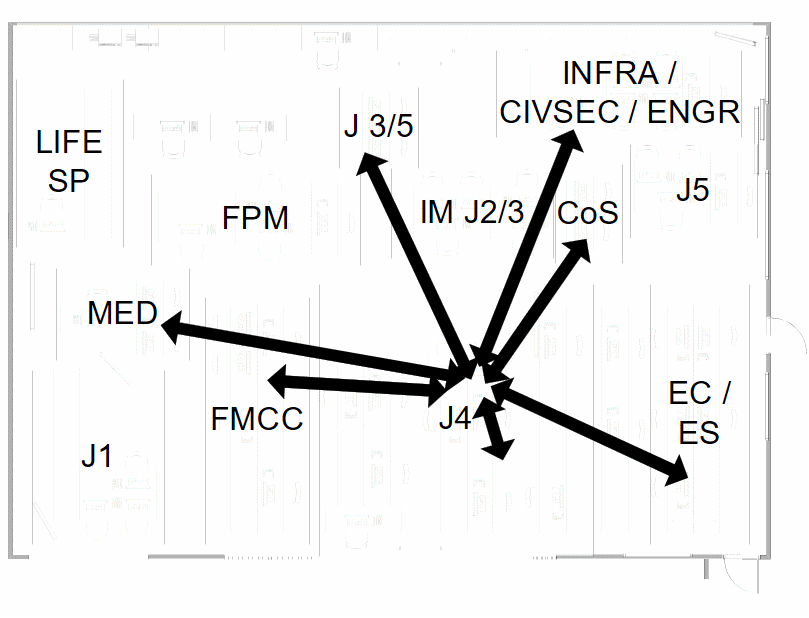
The majority of disruptions encountered by the Headquarters were resolved through normal (routine) business processes—a great deal of which involves informal collaboration across branches (each of which contains specialists in a particular area) and outside of the headquarters. However, even simple problems are rarely solved by a single specialist or branch—many require multi-branch input, which often involves ad-hoc, cross-branch ‘huddles’. The reason for this is that an issue can have a number of second and third order effects, which are unlikely to be self-evident and which may affect other areas of the headquarters or elements of the coalition effort. Figure 1 shows the various branches involved in the resolution of a logistics problem; whilst there was a great deal of interaction between these branches directly, the SO1 J4 coordinated their activity and collated their inputs.
Headquarters Staff reported that they did not routinely use a formal Estimate process when dealing with lower level issues; however, observations suggested that they do consider the main components (such as mission analysis, course of action development, and resource requirements), even if informally.
Only a minority of more complex medium to long-term issues required formal cross-branch collaboration and, in line with previous research (cf [17]), the two headquarters were observed using the Combat and Operational Estimate processes to deal with these. A Special Planning Group (SPG) would be formed to identify and put in place a Course of Action, with reviews and guidance from the Commander being provided at key stages. Finally, a smaller number of significant events were encountered, which required rapid cross-branch input and command direction to resolve. A further complicating issue is that complex cross-branch problems were sometimes presented by EXCON as innocuous routine ‘Serials’, with a potential to snowball and create significant problems for the Headquarters if not dealt with in a timely and effective manner.
Problems may come into the Headquarters through a variety of routes; they may be identified within branch, or else through the central (J2/J3) Chief of Staff ‘hub’, for example through the Watchkeeper. Thus, the communication of problems is both a top down (via branch heads) and bottom up activity and therefore close monitoring and feedback of branch activity is required to ensure that all issues of significance are escalated in a timely manner. Additionally, in an attempt to identify those issues that are cross branch in nature, there is extensive cross-branch monitoring of activity, via three daily branch updates. The Chief of Staff plays a crucial role in monitoring the activities of, and coordinating interaction between, the branches on more complex issues, as well as determining when to escalate the response to an incident and to notify the Commander. At the same time, individual Staff Officers must use their judgement to determine how ‘cross-branch’ an issue is and whether to push for the use of the formal cross-branch planning process, or to try to manage the issue within-branch, making do with less formal collaborative processes. Key considerations for Staff Officers include what areas of the headquarters are potentially impacted / may impact upon the issue, and which personnel may have the information and specialist knowledge required to help formulate the appropriate course of action? Thus, sensemaking is a matter of transactive memory regarding the social network of the headquarters (that is, knowing who to talk to). In addition, Staff Officers must develop an initial understanding of the problem. An example of this came during a conversation between one of the J4 Staff Officers and the J4 EXCON, who were discussing options following the closure of a kitchen that had failed a routine inspection. In response to a question from the EXCON about who the Staff Officer was going to include in the SPG, the Staff Officer replied:
“Well, I haven’t called an SPG I’ll be honest with you, it feels a little J4-centric. I have called in my colleague on the contracts desk, because obviously there’s a huge contract implication... I’m about to give HQLF DFS a call because it would seem that a previous SORs have been rejected, which means that I can dust them off rather than reinvent the wheel. So, I intend to do a bit of interaction but actually in headquarter terms, I’m not sure there’s much else.”
This example demonstrates the circular nature of the problem facing both individuals and the wider headquarters when dealing with ambiguous issues: forming the group of individuals who will define the nature of the problem (that is, frame-seeking) requires prior understanding of the nature of the problem (that is, it is a frame-defined activity). As the implications of a problem are rarely obvious, ‘uncertainty in logistics’ relates to the framing of problems and realizing who to involve in finding a solution, as much as traditional issues around resolving mission constraints.
Forms of sharedness—processes of defining frames
During an initial SPG, discussions are focussed on the conceptualisation of the problem (that is, frame-seeking), and the form and means of achieving the solution—that is:
- What is the problem?
- What is the (potential) scale of the problem?
- Who should own a problem?
- Who should be involved?
- What form should the solution take?
This reflects the first steps of the Operational Estimate (‘understand the operating environment’ and ‘understand the situation’). Having the relevant cross-branch specialists present enables the rapid identification of key issues and potential second order effects that arise from the problem. Once the SPG has conceptualised the problem space, this then cues frame-defined data collection, which frequently takes the form of requests for information (RFIs) to further define the constraints that limit the available courses of action.
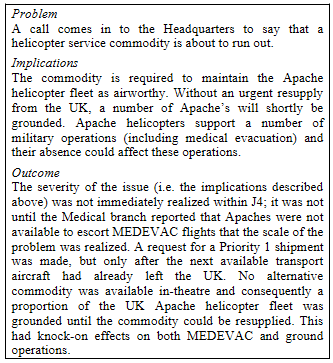
As was stated earlier, only a minority of issues are dealt with in a structured manner, through the use of an Estimate process. The importance of quickly determining an appropriate frame for problems is demonstrated by Figure 2, where a branch specialist failed to work through the knock-on effects of a commodity shortage (an apparently innocuous occurrence) to realise that it could lead to the grounding of the UK Apache helicopter fleet unless further supplies were urgently requested. Comments by the Staff Officer dealing with the issue demonstrate their initial failure to frame the problem correctly: “…here’s a logistics issue in its narrowest J4 sense...and suddenly it’s hitting the J1-J9 spectrum, because it’s got much wider applicability…”
When dealing with issues, Headquarters Staff may draw upon a large body of Standard Operating Instructions (SOIs), Standard Operating Procedures (SOPs), and Contingency Plans (CONPLANs). These documents were referred to by EXCON staff as ‘handrails’ and whilst they may be used to assist in the process of building a frame for making sense of an incident, an initial over-reliance on existing procedures risks failing to properly make sense of and thus deal appropriately with a problem.
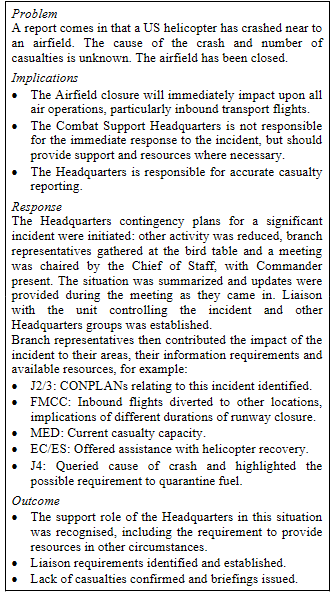
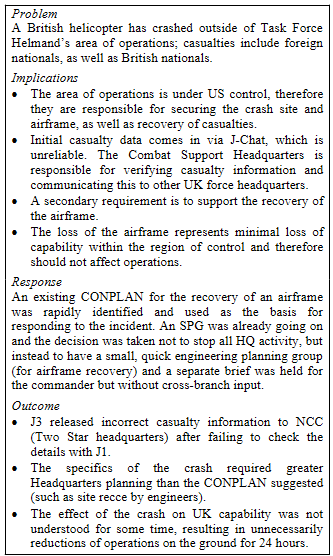
Both of the Headquarters observed were given similar incidents involving helicopter crashes, but these were dealt with in a very different manner. Figures 3 and 4 summarise the two incidents. Figure 3 depicts an intensive frame-seeking activity which lasted approximately 20 minutes and focussed primarily on establishing an understanding of the situation and identifying the immediate consequences that it would have upon the Headquarters and on wider Task Force Helmand activities. This was done by having the incoming reports of the situation read out, whilst the various branches voiced their perception of the impact it could have on their area—for example, a discussion of the potential need to quarantine and test fuel supplies, depending on the cause of the crash.
During the meeting, the Commander gave his view of how such critical incidents should be managed:
“There comes a point where we can corroborate sufficient information to package into a holding statement...but I think there are some ingredients we are looking for, so as we go around the table, we are embellishing our picture board or story… we should have someone scribing what we think our statement review of the situation is, someone captures it on a big board and that needs to be the default and actually by the time we’ve gone round the table, we’ve got a reasonable feel for the problem...take our time as we go round to capture and cross reference all these thoughts. And feel free to chip in...”
The key factors of the incident were quickly identified and the headquarters rapidly returned to normal activity, whilst continuing to monitor the situation. All branches were ready to reconvene in the event that the situation changed. In contrast, Figure 4 depicts a frame-defined activity, in which the CONPLAN for the recovery of an airframe was adopted as the frame for interpreting and dealing with the whole incident, when in fact it was merely a record of how one element of this type of incident had been dealt with in the past. As a result, it was not felt necessary to interrupt Headquarters activity and hold a cross-branch meeting to discuss the incident; consequently, relevant input from branch specialists was not discussed, impairing the quality of the response.
Contents of sharedness—artefact transformation
A number of artefacts are used to support sensemaking activity in the Headquarters. These artefacts support group sensemaking through the representation of task relevant information. For example during initial frame-seeking activities, occasionally mind maps or more often timelines were drawn on whiteboards and used as the focus for discussion of the problem.
Figure 5 shows part of a roughly sketched timeline drawn on a whiteboard during an SPG called to formulate a plan for the handover of several bases to a fighting force from another nation. Initially, the timeline was drawn out and the deadlines (circled in black) were plotted. The SPG then jointly discussed the implied activities for each deadline (based upon reasonable assumptions) and came up with a number of critical events (dashed black circles). As the discussion progressed, it became apparent that some critical events needed to happen sooner than initially anticipated, necessitating a rethink of the timeline (dashed white circles).
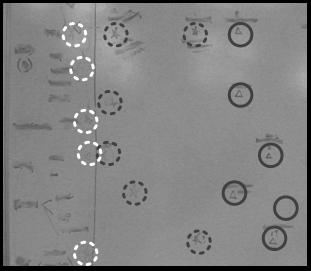
The use of assumptions enables the planning process to begin with only minimal information available. Each step in the Combat and Operational Estimates produces products (such as timelines, operation schematics and schemes of manoeuvre). These products are then used as an input for the next step, as well as for briefing superiors on planning progress and to enable key decisions to be made, such as the selection of courses of action.
These products will also form part of orders distributed to subordinate units, who in turn use them as the basis to begin their own parallel planning activity.
As the planning process progresses, these ‘draft’ plans are revisited and amended, as further clarification becomes available. This avoids the need to either wait to start planning or to restart the whole planning process again from scratch.
Figure 6 depicts key iterations in the development of the timeline first sketched in Figure 5; after the initial SPG and following further branch input (regarding dates and dependencies) the timeline was redrawn on a whiteboard. As the planning process neared completion, the timeline was converted into a PowerPoint slide, to be presented as part of the Commander’s review. Finally, once Command approval had been obtained, the timeline was included as part of the final headquarters planning output. In this manner, artefacts support frame-seeking and then frame-defined data collection (such as by cueing requests for information that is missing from the timeline). They also propagate the sensemaking ‘work in progress’ not only within the headquarters, but out to subordinate units and back in to subsequent planning steps.
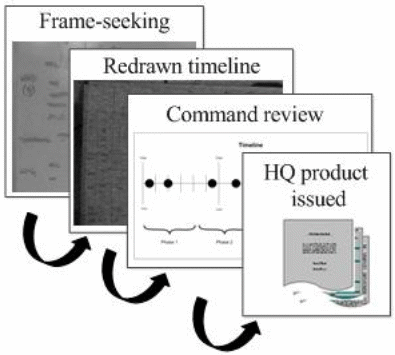
However, within the Headquarters, there is a disconnect between the digital and analogue environments; IT equipment is used for communication, information retrieval, and the production of formal briefings, reports and other products. At the same time, a range of temporary products are created using flip-charts, white boards, and notebooks and are used during group sensemaking discussions. This separation of the artefacts used during collaborative sensemaking and those for communication and document creation means that the inherently group-based problem solving activity becomes fragmented, as Staff Officers leave the group environment to search databases or send out requests for information.
It could be argued that the analogue sketches and associated task discussions better represent the state of a problem (that is, the logistics ‘picture’) than the formalised digital summaries that are produced for briefings, plans and reports. The creation of these formal Headquarters products involves repetition of activity, as schematics and diagrams sketched out on whiteboards are copied into notebooks and then re-drawn on laptops. In one instance, the schematics were captured as digital photographs, but, for the most part, the manual translation of schematic from whiteboard to laptop was the norm.
Discussion
Comparing the findings of this study to earlier research on military planning in war fighting units (cf [17,20]) reveals that the Combat Support Headquarters adopts a less structured approach to sensemaking and problem solving, with formal Estimate processes being used only infrequently. In fact, some EXCON staff reported not having performed a full Estimate processes during the operational tour that they had just completed. One EXCON Staff Officer gave the following explanation for this:
“Joint Force Support is a bit funny, it doesn’t work like every other unit…It’s much more of an intuitive decision making process. So much of what they do is desk level stuff, therefore you’re using the experience and the qualifications of those people in here to gain certain bits of information which can then be fed into a wider planning process, a wider decision making process.”
This illustrates a collaborative process of frame-seeking and frame-defined activity underpinning Combat Support activity. However, the often unstructured nature of combat support sensemaking occasionally runs the risk of failing to respond to issues in an appropriate manner.
This investigation of logistics activity to support military operations has identified three closely associated challenges for sensemaking in this environment; firstly, even routine Headquarters issues have the potential to affect multiple branches and may affect operations if not resolved expediently. The framing of problems requires input from the appropriate personnel during the initial planning process. To further complicate the matter, the owner of an issue may not know who to involve at this early stage, consequently personnel from other branches may remain unaware of the issue until it has developed into a more serious problem. Suggesting that formal Estimate processes could solve such problems would appear to be misguided, both in terms of the nature of the problems that were dealt with and the nature of the work in the Headquarters. Further, there is a disconnect between the analogue artefacts (flip charts, whiteboards) used during problem framing and the digital artefacts (IT systems, databases, email) used to capture, store and reuse organisational knowledge, produce Headquarters outputs, and communicate with the wider military command structure.
A number of suggestions for improving collaborative sensemaking within the Combat Support Headquarters are made. These are based on the following principles:
- Enhancement, rather than replacement of current practices which work well.
- Avoidance of the introduction of additional work.
- Joint optimisation of social and technical components of the work system.
- Use of currently available technological solutions.
Informal Frame-seeking Huddles
An Exercise Controller suggested that the way to resolve issues in a more efficient manner was to encourage more informal cross-branch ‘huddles’ to quickly scope-out (that is, frame) problems and define the relevant groups to be involved. This approach is core to the training intentions behind the exercises. This would help to address the issue of needing to know who to involve in a particular problem and to avoid fundamental misinterpretations of the nature of a problem or its consequences. However, increasing the number of impromptu meetings taking place within the Headquarters would increase the number of interruptions to Staff Officers’ work. Cross-branch involvement at the problem framing stage ensures that the issue at hand is correctly conceptualised, thereby reducing the time taken to resolve the problem and preventing second and third order effects before they arise—which would consequently reduce the overall Headquarters workload.
Artefacts for Concept Mapping
In terms of identifying the potential effects resulting from an event or course of action, one Staff Officer used mind-maps to sketch out the relationship between assertions. This approach could be a useful means of capturing initial discussions relating to the framing of the problem. There are two broad approaches to this: the first is to define, in a Desk Manual, guidance on the construction of such diagrams—for example, an Issue to be defined in terms of Context, Assumption, Courses of Action. The second is to develop software tools to support ‘concept mapping’. These would not only provide a means of capturing the mapping in a digital format (and hence, support sharing and storage of these) but also have some form of ‘checking’ that prompt the users to add information or question the content.
Technologies for Collaborative Search-after-meaning
Improved cross-branch interaction could foster communities of practice within the Headquarters. Developing communities of practice within the Headquarters and more widely across the logistics network may have benefits in terms of the framing of problems and identification of solutions. Planning within the in-theatre Combat Support Headquarters relies heavily on frequent, informal, cross-branch activity. Given that planning activity takes place in parallel across elements of the logistics network (and other command elements of ISAF), there may be some benefit in exploring ways of promoting wider collaboration. During Multi-National Experiments (MNE) IV and V, the researchers observed the use of chat rooms to allow Staff to collaborate on specific issues. Each chat room would have access to appropriate resources (for example, to material required to resolve the issue) and would allow designated members to join and contribute to discussion.
Large Screens for Problem Framing
A common information environment visualised through large-screens could enable improved access to specialist knowledge during the all-important problem framing stage of the issue management process. Such a large-screen could be seen as functioning both as a common workspace and as a closer representation of the current logistics state or picture, in terms of the current set of ‘live’ issues, the manner in which they have been conceptualised and the progress made in their resolution. Such an information environment could also function as a means for the capture of decision making processes and rationale.
Digital Artefacts for a Joined-up Planning Process
During the exercises, the Information Management cell explained that there is an aspiration for all thought processes behind decisions to be formally captured. A J4 representative commented that they tend to make soft copy backups of the information contained on whiteboards, acknowledging that whiteboards are vulnerable to being scuffed and thereby losing the information represented on them. A range of digital artefacts exist that mimic the behaviours of paper or whiteboards; these ‘smart boards’ would enable the capture of entries made by Staff Officers during group problem solving. Combining an interactive board with the Operational Estimate would provide a structure to be populated during group problem solving activities at the various stages of the six steps, reminding participants what questions they should be considering and the types of options and products they should create. This might help to avoid situations where the group fail to identify and consider important aspects of the estimate process. It could also provide a vehicle for concept mapping.
Widening the collaborative search-after-meaning
‘Transactive memory’—the issue of ‘knowing who knows what’—is essential to the working of the Headquarters. While the training exercises and labelling of workstations support this process, the high turnover of Headquarters staff in-theatre and the extended wider C2 system and complex logistics networks represent significant challenges to effective communication and information transfer. Within-Headquarters, the suggested large screen / linked interactive whiteboards would assist with the development of an organisational transactive memory, by providing increased visibility of cross-branch workings and the involvement and (by implication) expertise of specific individuals. This may also have the benefit of cueing individuals to ‘push’ information unsolicited, as visibility of the problems being worked on would suggest ‘who needs to know what’. Similarly, interactions with elements outside of the Headquarters could be improved where they also share access to the collaborative digital working environment. Some of the stronger connections to external organisations are likely to be built of ‘social capital’ (that is, achieved through the development of good working relations between specific individuals across organisations). Shared digital working environments could be used not only to indicate ‘who knows what’, but also ‘who knows who’, which may suggest more circuitous but ultimately more effective ways to interact with other organisations.
Summary and implications
The key focus of this work has been on the manner in which sensemaking is performed in a Combat Support Headquarters. From a Human Factors perspective, there are three essential issues to consider. The first is the distinction between ‘frame-seeking’ and ‘frame-defined’ sense-making activity. In the former, a problem space is defined and explored using appropriate specialists; in the latter, a situation is recognised and a Standard Operating Procedure can be applied. While the latter might lead to faster resolution of the problem, it might also lead to effort after the wrong solution. The second is the ‘informal’ nature of much of the work observed. Insisting on closer following of Estimate processes or introducing detailed Information Management procedures might help some aspects of activity but might constrain other aspects. Third, personnel use a range of artefacts to capture their decision-making but are not always able to effectively translate between analogue and digital versions. While developments in technology might solve these translation problems, a simpler solution could be to encourage Staff to recognise the value of the artefacts that they are creating in the frame-seeking activity and to use these to support their frame-defined sensemaking.
Acknowledgement
This work, from the Human Factors Integration Defence Technology Centre, was part-funded by the Human Dimension & Medical Sciences Domain of the UK Ministry of Defence Scientific Research Programme. The authors would like to thank the staff of the two logistics Headquarters and the staff of Command and Staff Trainer (North and South) for their support during the completion of the research reported here.
References
[1] S.G. Lazzarini, F.R. Chaddad, and M.L. Cook, “Integrating Supply Chain and Network Analyses: The Study of Netchains”, Journal of Chain and Network Science, Vol. 1, pp. 7–22, 2001.
[2] NATO, NATO Glossary of Terms and Definitions (English and French), AAP-6 2009, NATO Allied Publication. http://www.nato.int/docu/stanag/aap006/aap-6-2009.pdf
[3] MoD, How Defence Works: Defence framework. Ministry of Defence UK, 2010. www.mod.uk.
[4] MoD, Logistics for Joint Operations: Joint Doctrine Publication 4-00 (3rd Edition), Shrivenham: MoD DCDC, 2007.
[5] T.Y. Choi, K.J. Dooley, and M. Rungtusanatham, “Supply Networks and Complex Adaptive Systems: Control versus Emergence”, Journal of Operations Management, Vo. 19, pp. 351–366, 2001.
[6] S. Sturing, A. Hintze, and E. Blumel, “Knowledge Logistics in Technical Services—Potentials of Interactive Visualization”, in H. Luczak, A.E. Cakir and G. Cakir (eds) WWDU 2002—World Wide Work, Proceedings of the 6th International Scientific Conference on Work with Display Units. ERGONOMIC Institut fur Arbeits- und Sozialforschung, Forschungsgesellschaft mbH, Berlin, Ava, pp. 609–611, 2002.
[7] I. Tudge, M. Tibble, and K. Allen, Briefing Paper on SIT Human Capability Priority Research Area 8: Human Issues in Logistics, DSTL Knowledge Services, Farnborough, 2008.
[8] K.E. Weick, Sensemaking in Organizations, London: Sage, 1995.
[9] J. Landgren, “Shared Use of Information Technology in Emergency Response Work: Results from a Field Experiment”, Proceedings of the 2nd International ISCRAM Conference, Brussels, Belgium, 2005.
[10] P. Pirolli and D.M. Russell, “Introduction to this Special Issue in Sensemaking, Human-Computer Interaction, Vol. 26, pp. 1–9, 2011.
[11] S. Attfield and A. Blandford, “Making Sense of Digital Footprints in Team-based legal investigations: The Acquisition of Focus”, Human Computer Interaction, Vol. 26, pp. 38–71, 2011.
[12] N.V. Flor and E.L. Hutchins “Analyzing Distributed Cognition in Software Teams: A Case Study of Team Programming During Perfective Software Maintenance”, in J. Koenemann-Belliveau, T.G. Moher and S.P. Robertson (eds) Empirical Studies of Programmers: Fourth Workshop, Ablex Publishing Corporation, Norwood, New Jersey. 1991.
[13] G. Klein, B. Moon and R.R. Hoffman, “Making Sense of Sensemaking 2: A Macrocognitive Model”, IEEE Intelligent Systems, Vol. 21, No. 5, pp. 88–92, 2006.
[14] P. Pirolli and S. Card, “The Sensemaking Process and Leverage Points for Analyst Technology as Identified through Cognitive Task Analysis”, Proceedings of the International Conference on Intelligence Analysis, 2–4 May 2005.
[15] K.E. Weick, “Enacted Sensemaking in Crisis Situations”, Journal of Management Studies, Vol. 25, No. 4, 1988, pp. 305–317.
[16] J. Bourbousson, G. Poizat, J. Saury, and C. Seve, “Description of Dynamic Shared Knowledge: An Exploratory Study During a Competitive Team Sports Interaction”, Ergonomics, Vol. 54, No. 2, 2011, pp. 120–138.
[17] N.A. Stanton, K. Revell, L.A. Rafferty, G.H. Walker, P.M. Salmon, and D.P. Jenkins, “Ergonomic Challenges for Digitization: Learning from Analog Mission Planning Processes”, The International C2 Journal, Vol. 4, No. 3, pp. 3–29, 2010.
[18] MoD, Campaign Planning: Joint Doctrine Publication 5-00 (2nd Edition), Shrivenham: MoD DCDC, 2011.
[19] A. Bahrami, J. Yuan, and D. Mott, “Collaborative, Context Aware and Chain of Command Sensitive Planning”, 2nd Annual Conference of the International Technology Alliance (ACITA'08), London, UK, 16–18 September 2008.
[20] P.M. Salmon, N.A. Stanton, D.P. Jenkins, G.H. Walker, L. Rafferty, and K. Revell, “Decisions, Decisions….and Even More Decisions: The Impact of Digitization in the Land Warfare Domain”, Proceedings of NDM9, the 9th International Conference on Naturalistic Decision Making, London, June 2009.
[21] G.H. Walker, N.A. Stanton, R. Stewart, D. Jenkins, L. Wells, P. Salmon, and C. Baber, “Using an Integrated Methods Approach to Analyse the emergent properties of Military Command and Control”, Applied Ergonomics, Vol. 40, pp. 636–647, 2009.
[22] N.A. Stanton, L.A. Rafferty, P.M. Salmon, K.M.A. Revell, R. McMaster, A. Caird-Daily, and C. Cooper-Chapman, “Distributed Decision Making in Multi-helicopter Teams: A Case Study of Mission Planning and Execution from a Non-combat Evacuation Operation Training Scenario”, Journal of Cognitive Engineering and Decision Making, Vol. 4, No. 4, pp. 328–353, 2010.
[23] C.C. Chou, “A Decision Making Model for the Taiwanese Shipping Logistics Company in China to select the Container Distribution Center Location”, in M.J. Smith and G. Salvendy (eds), Human Interface and the Management of Information—Interacting in Information Environments (Part II), Springer, Heidelberg, Germany, pp. 844–854, 2007.
[24] H. Peck, “Reconciling Supply Chain Vulnerability, Risk and Supply Chain Management”, International Journal of Logistics: Research and Applications, Vol. 9, No. 2, pp. 127–142, 2006.