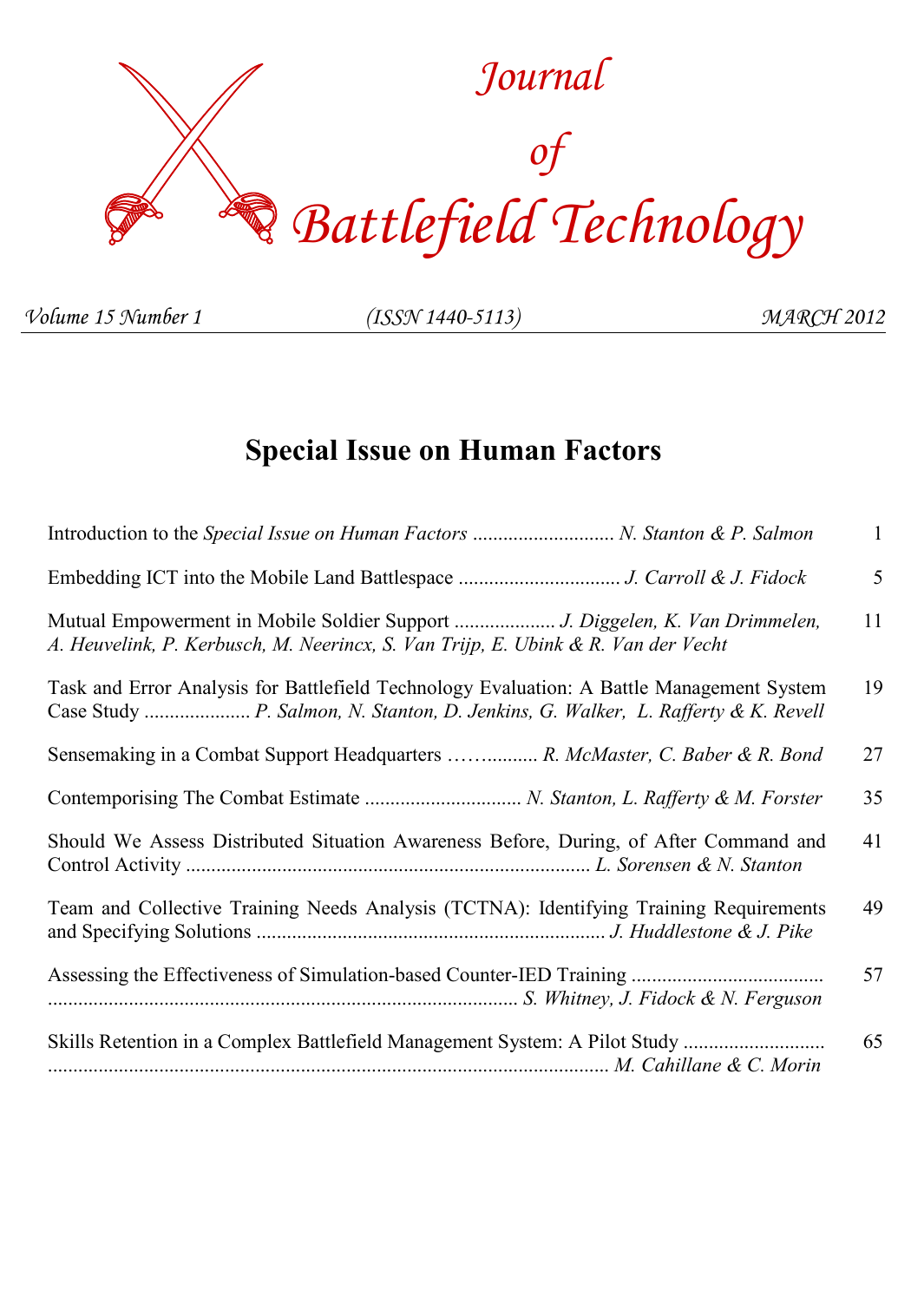
Guest Editors: Neville A. Stanton and Paul M. Salmon
Human Factors, the discipline that is concerned with “the scientific study of the relationship between man and his working environment” [1], has much to offer in support of the design, evaluation, and implementation of battlefield technologies. In particular, theories of human and complex system performance and structured methodologies for describing and evaluating performance are increasingly being employed in these contexts. The discipline abounds with books on methods which will aid the development and understanding of the ways of working in complex systems [2]. This understanding can lead to the identification of new models of Command and Control [3]. The methods can also be used to support the design and evaluation of new battlefield technologies, such as digital Battlespace Management systems [4,5]. Legacy approaches, such as Cognitive Work Analysis [6] and Socio-Technical Systems Theory with some 50 years pedigree, have been applied to offer new insights [7, 8]. New methods have been developed to examine the distributed nature of situation awareness in command systems [9]. Taken together, these works amongst others have redressed the balance of Command and Control technology, with more emphasis on human aspects of systems. More recently, softer concepts such as “trust” have been used to explain the relations between military teams, organizations and technology [10]. The point here is that Battlefield Technology should be as much about the people who use it in pursuit of their mission goals as it is about the equipment.
Jennie Carroll and Justin J. Fidock
This paper examines some of the challenges of embedding information and communication technologies (ICTs) into the mobile land battlespace. It links a long tradition of research that highlights difficulties in deriving value from investment in ICTs to current efforts to build a mobile land battlespace. Two theoretical frameworks assist in understanding the complexity of these efforts. Lessons from research into technology appropriation and technology portfolios highlight the time needed to embed new ICTs, the types of support that facilitate change, and management strategies to reduce likely risks. These lessons are applied to the defence domain. Guidelines for achieving the potential inherent in the mobile land battlespace are provided.
Jurriaan van Diggelen, Kristian van Drimmelen, Annerieke Heuvelink, Philip J.M. Kerbusch, Mark A. Neerincx, Suzanne M.A. van Trijp, Emiel M. Ubink, and Bob van der Vecht
By Mutual Empowerment, strengths and weaknesses of humans and technology can be dynamically balanced, resulting in new concepts for mobile soldier support. One part of our research focused on developing the mutual empowerment mechanisms themselves—for example, for supporting soldiers with text messages that are relevant to their role, location or task; for increasing organizational awareness; and for predicting collateral damage. Another part of our research focused on well-founded methods for designing such systems in an iterative and coherent way. We have developed a modular user-centred design methodology which aims at developing a library of reusable components for mutual empowerment. We developed support tools for designing, prototyping and testing such components. This paper presents the methodology, the outcomes, and our reflections on the methodology.
Paul M. Salmon, Neville A. Stanton, Daniel P. Jenkins, Guy H. Walker, Laura A. Rafferty and Kirsten M.A. Revell
Human factors methods have a key role to play in the design and evaluation of battlefield technologies. This article presents an application of task analysis and error prediction methods for evaluating the usability of a new digitised battle management system. Based on data collected during live observation of an operational field trial of the battle management system, task and error prediction analyses were undertaken to identify usability issues. The analyses identified several issues, including general design flaws and a range of design-induced user errors. Recommendations for enhancing user interactions with the battle management system are specified. In closing, the key role that human factors methods have to play in the design and evaluation of battlefield technologies is discussed.
Richard McMaster, Chris Baber, and Russell Bond
This paper presents an exploration of sensemaking in response to disruptions to logistics networks. Observations were conducted with two deployments of a UK Combat Support Headquarters during their pre-deployment exercises between October 2010 and November 2011. This research identified that the resolution of disruptions is primarily a framing problem—that is, it is principally concerned with the definition of the ‘problem space’. Sensemaking for problem solving is a collaborative process; even seemingly simple problems are rarely solved by a single specialist or branch—many require multi-branch input, both for framing and solution development. Problem solving therefore becomes an issue of transactive memory regarding the social network of the headquarters (that is, knowing who to talk to) rather than merely one of direct access to information (that is, knowing what information to look for or where to find it). This implies that Information Management is more than the effective use of technology but must also consider the Human Factors associated with the manner in which information is captured and shared. To this end, a wide range of artefacts is shown to support sensemaking activity, by representing the current state of the problem space and by functioning as resources for action—cueing frame seeking and frame-defined data collection. Suggestions are made for improving collaborative sensemaking within the Combat Support Headquarters.
Neville A. Stanton, Laura A. Rafferty, and Michael Forster
The aim of this paper is to adapt the Combat Estimate so that it can be used to support Human Terrain Mapping for use in Contemporary Operating Environments, in particular to facilitate the planning and interaction of both soft and hard effects. The planning tools in the present version of the Combat Estimate were developed for hard kinetic effects and are less useful for planning for soft, influence, effects. This paper focuses primarily on identifying how tools from other domains, such as commercial marketing and political campaigning, can help to analyse, and then provide a path to influencing, a target population in a military context. A Contemporised Tool Set was developed and tested at the Joint Services Command Staff College with 186 newly promoted Majors undertaking their compulsory promotion training. The participants were divided into a control group (using the current planning tools associated with the Combat Estimate) and a treatment group (using the Contemporised Tool Set in addition to the current planning tools). The results suggest that the Contemporised Tool Set increased plan quality significantly without increasing workload or decreasing usability of the Combat Estimate.
Linda J. Sorensen and Neville A. Stanton
Command and control (C2) environments are characterised by rapid pace of change, complex yet often incomplete information with considerable time and decision-making pressures. These pressures create particularly challenging environments in which teams must operate. Advances in information and communication technology afford new ways of organizing C2 structures and support to military personnel. New technologies and ways of working require assessment of their impact on situational awareness (SA). This paper considers the question of when Distributed Situation Awareness (DSA) should be assessed; before, during or after C2 activity. The paper presents a review of three DSA data collection methods: Hierarchical Task Analysis (HTA), Communication Analysis, and Critical Decision Method (CDM) against fourteen criteria.
John A. Huddlestone and Jonathan Pike
This paper describes Team and Collective Training Needs Analysis (TCTNA), which is a novel approach to the identification of training requirements and the specification and evaluation of training environments appropriate to team and collective training. Our defence forces face operating environments of ever-increasing complexity, whilst current budgetary and environmental pressures necessitate increasing reliance being placed on synthetic training environments. The challenge to the training community is to ensure that training environments are correctly specified so that effective training environment options can be selected. Whilst the principles of Needs Analysis/Front End Analysis have a well established tradition within NATO Forces, the underpinning analytical techniques are predominantly focused on individual training. In the published literature there are relatively few techniques that address the issues of team and collective training. The first part of the paper describes the architecture of the TCTNA method and its underpinning model of team training. The second part of the paper demonstrates how analytical techniques from the human factors and software engineering domains can be adapted and integrated with some new representations to implement this approach, illustrated with a case study from maritime local area surface defence.
Susannah J. Whitney, Justin J. T. Fidock, and Nicole Ferguson
This study compares the effectiveness of simulation-based and traditional counter-Improvised Explosive Device (IED) training methods in the Australian Army. Participants were 16 enlisted personnel from the Royal Australian Corps of Transport who took part in simulation-based training using Virtual Battlespace 2 (VBS2) and conventional Rehearsal of Concept (ROC) drill training. Usability and training effectiveness of each were assessed through a mixture of qualitative and quantitative measures. Participants’ performance in a field exercise following training was also analysed. Results showed significant differences between levels of self-efficacy in VBS2 and ROC drill, and qualitative data indicated that participants perceived the value and training benefit of both methods. The implications for use of simulation-based training, challenges of conducting experimentation in conjunction with military training courses, and recommendations for future research are discussed.
Marie A. Cahillane and Caroline Morin
This paper reports the findings of a pilot study which examined the long-term retention of digital skills in a UK Information Management System (IMS). Empirical evidence suggests that, long periods of non-use of a complex digital system may impact on the retention of the digital skills required to use the system effectively. However, no empirical data was available for a UK system. An experimental trial was conducted with military personnel to investigate skills retention for a UK IMS over a nine-week period.